
Thank you for visiting this site. This article covers the byword for maritime mystery: “the Mary Celeste.”
December 1872, the Atlantic off Portugal. A sailing ship was found drifting quietly with nobody aboard. The hull was sound, provisions and water still stowed. Yet the captain, his family, and the crew — ten people in all — had simply vanished. What happened aboard? A century and a half later, there is still no confirmed answer. What we do know is that many famous details — “warm, half-eaten meals on the table” — are later fiction. Strip away the inventions, and what does the real mystery look like? Let’s rebuild it from the records alone.
What Was the Mary Celeste Incident?
The Mary Celeste was an American two-masted brigantine. In November 1872 she left New York for Genoa, Italy, carrying 1,701 barrels of industrial alcohol. Aboard were ten people: the experienced and well-respected Captain Briggs, his wife, their two-year-old daughter, and seven hand-picked crewmen. Briggs was known as a devout, abstemious, steady man, and the crew were chosen for reliability. This was not a company likely to produce drunken brawls or mutiny — a point that matters for weighing the later speculation.
About a month later, in early December, the cargo ship Dei Gratia sighted her near the Azores. Sails partly set, course wandering, no answer to hails. Something was wrong. The boarding party found a ship utterly empty of human presence.
Despite some water in the hold, the vessel was entirely seaworthy, with roughly six months of food and water remaining. Personal effects were untouched — the captain’s wife’s melodeon, even the little girl’s toys. No signs of struggle, no blood. The final log entry predated the discovery by about ten days, placing the ship near the Azores. Which means the Mary Celeste had likely sailed crewless across the Atlantic for nearly ten days on her own. And still: ten human beings, nowhere. The Dei Gratia’s men sailed the empty ship to Gibraltar, and the case became world news.
The Myth of the Warm Meal — Fiction Inflated the Mystery
To discuss this case honestly, we must first remove the later embellishments — the circulating story is saturated with invented detail.
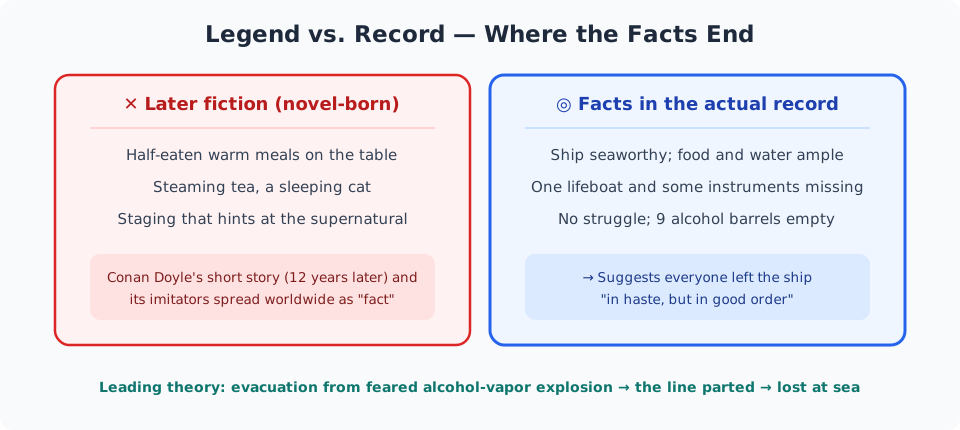
The famous images — “half-eaten warm meals on the table,” “still-steaming tea,” “a cat asleep on a locker” — are vivid, and appear nowhere in the discoverers’ testimony or the admiralty hearing records. One major source of these images is a short story published twelve years after the incident by the young Arthur Conan Doyle (later creator of Sherlock Holmes). His fictionalized version was a sensation, and the story’s stagecraft spread worldwide as “fact” — even the ship’s name is often misspelled per the fiction.
The actual record describes something plainer and, for that, eerier: one lifeboat was missing, and some essential navigation instruments and papers had been taken. A hatch stood open; a sounding rod (for measuring water in the hold) lay on deck. The scene suggests that “everyone left the ship in a hurry — but in good order.” Traces of urgency and traces of method, side by side. That incongruity is the true doorway of the mystery.
The Leading Theory: Fear of Explosion Drove Ten People onto the Sea
Why abandon a seaworthy ship? The most widely supported account is the “temporary evacuation theory” centered on the alcohol cargo.
Industrial alcohol is violently flammable. When the cargo was finally unloaded, 9 of the 1,701 barrels were empty. Suppose leaked alcohol vapor had accumulated in the hold and rushed out when a hatch was opened. A whoosh, a plume of white vapor — Captain Briggs may have concluded the ship was about to explode. Alcohol vapor genuinely can cause explosions, and fire means death on a wooden ship.
On this theory, Briggs moved everyone into the lifeboat, tethered to the ship by a line, to wait out the danger. This fits the sounding rod, the open hatches, the removed instruments. But then the line parted — or the wind rose, and the crewless mother ship, sails still set, simply outran them. A small yawl cannot chase a brigantine through Atlantic swells. Ten people, adrift, were spent. No bodies or boat were ever found, so proof is impossible — but as the account most consistent with the ship’s condition, the cargo, and the weather records, it commands wide support. Rival theories — seaquake, waterspout, a false alarm of sinking from a fouled pump — all lack a clincher.
Rereading the Evidence
Let’s line up the main findings against the evacuation scenario.
| Evidence at discovery | Reading under the evacuation theory |
|---|---|
| One lifeboat (the yawl) missing | Everyone left the ship by boat |
| Mainsails furled, only some sails set | The ship was hove to (near-stopped) at evacuation |
| Sounding rod on deck, pump partly disassembled | Hasty checks of water in the hold |
| Hatches and skylight open | Venting alcohol vapor from the hold |
| Navigation instruments and papers taken | An orderly abandon-ship procedure |
| Food, effects, cargo untouched | They intended to return shortly |
Arranged this way, scattered evidence converges on one line: “they sensed an explosion risk and evacuated, expecting to return.” Note especially the untouched food and effects. In the ghost-ship telling this is the symbol of uncanny vanishing; under the evacuation theory it flips into evidence they never meant to be gone long. The same facts, reversed in meaning by the framework of reading — the whole craft of mystery verification in one table.
Gaps remain, honestly noted. Why would so experienced a captain leave the ship without fully heaving to? Why did the tow line part or slip? The final hours’ details are forever beyond reach. But those blanks are information lost with the witnesses — not the paranormal. Keeping that distinction straight is the key to this case.
Suspicion of the Rescuers, and the Ship’s Cursed End
The aftermath deepens the shadows. At the Gibraltar admiralty hearing, the prosecuting advocate relentlessly suspected the discoverers themselves — fueled by the fact that the Dei Gratia’s captain knew Briggs personally. Conspiracy to seize the ship, he implied. But the supposed bloodstains proved not to be blood; no evidence emerged. The suspicion officially dissolved — yet the salvage award paid to the rescuers was slashed far below the customary rate. The men who had risked their lives bringing a ghost ship to port were rewarded with suspicion and a pay cut.
The Mary Celeste’s own end was fittingly strange. Branded an unlucky ship, she passed through a chain of owners, until her last captain, in 1885, deliberately ran her onto a Caribbean reef for the insurance money. The fraud unraveled almost immediately; the captain faced court, and the legendary ship rotted on the reef. A vessel made immortal by an unsolvable mystery, finished off by a shabby, very human crime. History rarely writes ironies this clean.
Questions About the Mary Celeste
Wasn’t It Pirates, or an Insurance Scam?
Both were the first suspicions in 1872, and both fail against the record. Pirates or robbers leave no explanation for untouched cargo and valuables. The insurance-fraud theory against the discoverers was pressed hard at the Gibraltar hearing and collapsed — no struggle, no blood, no proof (indeed the rescuers suffered a reduced award for their trouble). Mutiny fares no better: a small, disciplined crew with no motive, and the captain’s family vanished with them. The peculiarity of this case is that explanations built on human malice make the mystery harder, not easier.
Why Did This Case Become So Famous?
Beyond the inherent chill of “the ship intact, only the people gone,” the answer is the power of story. Conan Doyle’s dramatization, and the decades of fiction and journalism that layered inventions like the warm meal on top, grew the case into the archetype of the sea mystery. Maritime history holds other derelict ships — but only the Mary Celeste became legend, because a genuine mystery got a fiction booster. The way this mystery became famous is itself a fine case study in how information travels.
Could the Truth Still Come Out?
Realistically, prospects are poor. The decisive find would be the yawl or the crew’s remains, but locating one small boat lost somewhere in the 1872 Atlantic verges on impossible. Yet the outline of what happened has already been narrowed considerably. Remove the fiction, reconstruct from the ship’s condition and the cargo’s dangers, and “temporary evacuation from a feared explosion, then loss of the ship” holds up entirely. Nothing supernatural is required anywhere. A mystery, yes — but a mystery of human judgment and the sea’s indifference. That is the real face of this case.
Related Mysteries
See the fellow vanishings: “the Bermuda Triangle,” “the disappearance of Amelia Earhart,” and “the lost colony of Roanoke.”



Summary
This article covered “the Mary Celeste.”
Ten people gone from a seaworthy ship — the core is eerie enough without decoration. And the decoration — the warm meals and steaming tea — began as fiction, starting with Conan Doyle’s short story. The actual record shows one missing lifeboat and the traces of a hurried but orderly departure. From there flows the leading account: evacuation driven by fear of the alcohol cargo exploding, and a parted line that turned a precaution into a death sentence.
Stripped of its legends, the case is no ghost story. It is the tragedy of a captain protecting his family aboard a ship full of explosive cargo — a likely rational decision that broke the wrong way. To me, that plain human story cuts far deeper than the myth ever did.
To return to the full list of mysteries, follow the link below.
Thank you for reading. We hope to see you in the next article.

Also popular with readers
📚 Series: World Mysteries (12/21)