Thank you for visiting this site. This article covers the founding mystery of American history: “the lost colony of Roanoke.”
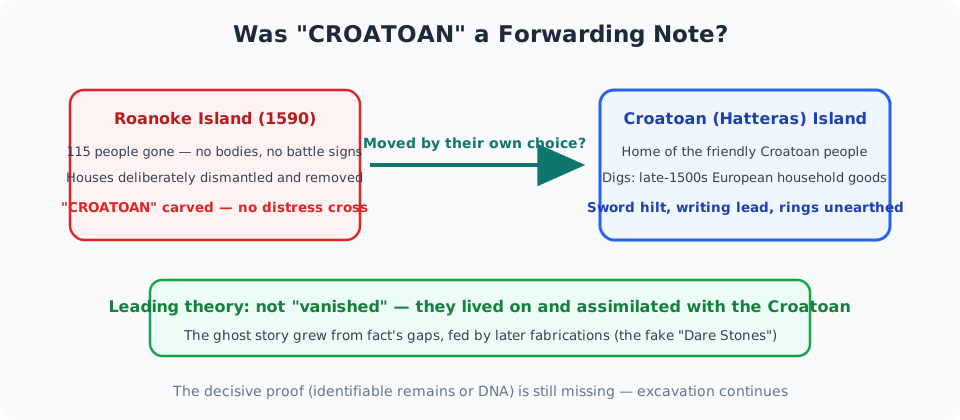
In 1587, England made its bid to put down roots in America: about 115 men, women, and children settled an island off what is now North Carolina. But when their leader — who had sailed home for supplies — returned three years later, the settlement was dismantled and all 115 people were gone without a trace. All that remained was a single word carved into a post: “CROATOAN.” No signs of battle; no bodies. The “Lost Colony” has been told and retold ever since — but recent excavation has revealed a reality quite different from the legend.
What Was the Roanoke Colony?
The Roanoke colony was an early English attempt to settle North America, launched in 1587 — a full twenty years before the famous permanent colony at Jamestown. The site was Roanoke Island off the North Carolina coast. Under governor John White, himself an accomplished painter, about 115 people — families, not soldiers — crossed the ocean.
The colony carries one landmark in its story: soon after landfall, White’s daughter gave birth to a girl — Virginia Dare, the first English child born in America, whose name is remembered to this day.
This was not the first attempt on Roanoke. A few years earlier, a first, military-led settlement had collapsed within a year amid food shortages and violent conflict with the Native peoples. The 1587 expedition was organized as a colony of families precisely in reaction. But the poison left by the earlier settlers — grievance and distrust among the Native nations — had not dissipated, and the newcomers began their venture inside an already fraught web of relations. Knowing this history makes their eventual reliance on the friendly Croatoan people all the more understandable.
The venture was troubled from the start. With supplies thin and relations tense with some tribes, governor White himself sailed back to England to arrange resupply — an agonizing departure just days after his granddaughter’s birth. And that voyage decided everything: war erupted with Spain (the Armada), every ship was requisitioned, and White could not get back.
The Return, Three Years Later — and One Word
White finally reached Roanoke again in August 1590 — three years later, around his granddaughter Virginia’s third birthday. His own account records the party sounding trumpets from the shore and singing familiar English songs as they approached the settlement. No one answered.
The scene was eloquent. The houses had been not abandoned but deliberately taken down and removed. And on a post of the palisade was carved the word: “CROATOAN.” On a nearby tree, the unfinished letters “CRO.” Croatoan was the name of an island to the south (today’s Hatteras Island) — and of the friendly Native people who lived there.
Crucially, White and the colonists had agreed on a code before his departure: “if you move, carve your destination; if you leave in distress, add a cross.” And on the post, there was no cross. Read plainly, the carving is a message: “we left not in distress, but by our own choice, for Croatoan.” White tried to sail there to confirm — storms blocked him, and he returned to England in despair. No organized search ever followed, and the colonists passed out of history.
The Painter’s Other Legacy
John White, before he was the tragic governor, was a painter of remarkable gifts — and his brush left history something of incalculable value, apart from the mystery.
Accompanying the 1585 expedition as its recorder, White painted Native villages, ceremonies, fishing methods, dress, plants and animals in dozens of meticulous watercolors — among the earliest systematic visual records of Native North American life by any European. From his paintings we see watchtowered villages, cornfields, dugout-canoe fishing — the rich texture of Native society at first contact, alive on paper. The watercolors survive, treasured and studied as first-rank sources of archaeology and anthropology.
Knowing this reframes the Roanoke story. White was no conqueror sneering at “savages” but a man who observed and recorded Native culture with care. That he emigrated with his family; that his colonists finally (it appears) turned to a Native island for survival — behind these choices may stand the same gaze visible in his paintings: a way of seeing the other as human. That reading carries my own conjecture, admittedly — but as a key to the hearts of the people who carved “CROATOAN,” his watercolors are among the best evidence we have.
Not “Vanished” but “Assimilated”? The Theory Excavation Supports
So what became of the 115? The current leading theory: they moved to Croatoan (Hatteras Island) and lived on among the Native people, gradually assimilating. After all — they carved their destination themselves. It is also simply the honest reading.
Archaeology is bearing it out. Excavations on Hatteras Island have recovered, from Native habitation layers, late-16th-century European artifacts — a sword hilt, gun hardware, a writing lead, rings — items of daily life, mixed into the strata of Native living in ways trade alone explains poorly. Later records from Jamestown (the 1607 colony that survived) preserve Native reports of “people with white skin” seen inland, keeping open the possibility that the colonists split into groups, some moving inland.
The real Roanoke, in other words, was very likely not “a supernatural vanishing” but “people cut off from resupply, turning to friendly neighbors to survive.” Duller as a mystery — and, I believe, the most honest ending this story can have.
How the Legend Was Manufactured
Why, then, did the “Lost Colony” legend run wild? Three reasons.
First, the absence of decisive proof. The migration-assimilation theory leads, but no artifact or record yet says “this particular Roanoke colonist lived here.” Into that gap poured every imaginable fantasy. Second, later fabrications: in the 20th century, inscribed slabs — the so-called “Dare Stones,” purporting to carry colonists’ last testaments — began to be “discovered.” After the first made headlines, more than forty reward-hunting “finds” followed, the great majority judged fakes. Third, narrative demand. A colony including America’s first English child, vanishing behind one cryptic word — irresistible material for ghost stories and drama.
The pattern is the twin of the Mary Celeste, covered on this site: fiction fills and amplifies the gaps in fact. With most great mysteries, watching how the mystery was cultivated is as revealing as the mystery itself.
Questions About the Roanoke Colony
Why Were They Left Alone for Three Years?
Because a national emergency outranked them. Just after White reached home, England plunged into its life-or-death war with the Spanish Armada, and no ship could be spared for the Atlantic. White tried repeatedly — requisitions and failed voyages blocked him — until at last he crossed on a borrowed passage in 1590. Three years without seeing his granddaughter’s face; his grief is beyond imagining. The colony’s tragedy was also the tragedy of a frontier abandoned to the priorities of the metropole.
Couldn’t They All Simply Have Died?
The possibility remains, but it fits the scene poorly. Death by famine or epidemic leaves bodies, graves, abandoned goods; the settlement was instead dismantled in good order. A Spanish attack finds no match in Spain’s own records. Some colonists may indeed have died in conflicts — but nothing suggests a single collective catastrophe. The evidence points, consistently, to a planned departure.
Could Descendants Exist Today?
Unconfirmed — but entirely plausible. If assimilation is right, the colonists’ lineage continued inside Native communities. Regional tribes in later eras preserved traditions of “white ancestors,” and DNA verification projects have been attempted. But isolating the bloodline of a few dozen people across four centuries strains current methods, and no decisive result exists. If a burial on Hatteras someday yields remains identifiable as Roanoke-born, this mystery will close formally at last.
Related Mysteries
See the fellow vanished-people mysteries: “the Mary Celeste,” “the Dyatlov Pass incident,” and “the disappearance of Amelia Earhart.”
Summary
This article covered “the lost colony of Roanoke.”
What met the returning governor was a neatly dismantled settlement and the carved word “CROATOAN” — without the agreed cross of distress. The scene reads as a forwarding note: “we have moved to the neighboring island.” And recent excavation keeps finding late-16th-century European household goods inside Native life on Hatteras Island, steadily supporting the theory that the colonists survived by joining the Croatoan people.
As a ghost story, Roanoke does not survive scrutiny. But the reality — people cut off from home, turning to their neighbors in a foreign land, and quietly dissolving into history — resonates far deeper than any ghost story could. A mystery whose answer may have been not tragedy but coexistence: they do not come along often.
To return to the full list of mysteries, follow the link below.
Thank you for reading. We hope to see you in the next article.

Also popular with readers
📚 Series: World Mysteries (16/21)