Thank you for visiting this site. This article covers one of Britain’s oldest mysteries: “Stonehenge.”
On Salisbury Plain in southern England stands a ring of megaliths several meters tall. Construction began about 5,000 years ago — before writing. Who built it, why, and how? What makes this site so compelling is that recent science has pinpointed the stones’ origins one after another — and deepened the mystery in the process. Some stones came from Wales, about 250 kilometers away; and the Altar Stone, astonishingly, most likely traveled more than 700 kilometers from Scotland. Why did it have to be those stones, from those places, at that cost?
What Is Stonehenge?
Stonehenge is a circular megalithic monument (stone circle) in southern England. It was not built in one campaign: from around 3000 BC, it was remodeled in stages across roughly a thousand years into its present form. First an earthen bank and ditch, then an age of timber posts, then the age of stone. Less a single building than an “unfinished project” handed down through more than 30 generations — all without a single written record.
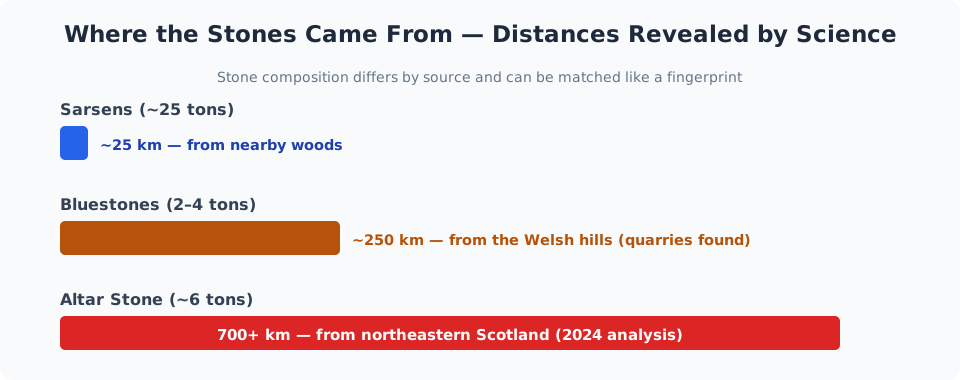
Two main kinds of stone were used. The sarsens are giant sandstone blocks averaging around 25 tons apiece — the famous doorway-like trilithons (two uprights capped by a lintel) are built of these. The bluestones are smaller, though still 2–4 tons each.
The monument does not stand alone. The surrounding landscape is dense with contemporary works — vast circular earthworks, countless burial mounds, a processional avenue — and the whole area is a World Heritage site. Discoveries continue: recently a ring of massive pits ten meters across was reported nearby. Stonehenge was never an isolated stone circle but the heart of an immense sacred landscape.
Its defining feature: the monument’s axis is aligned to the midsummer sunrise and midwinter sunset. On the summer solstice, viewed from the center, the sun rises over a particular stone. That this is deliberate is considered near-certain: the builders raised this monument with the sun’s motion firmly in mind. To this day, crowds from around the world gather at the stones each solstice to watch the sunrise. A “theater of the sun” designed 5,000 years ago, still filling its seats every year — a thought that never stops being strange and moving.
What the Stones’ Origins Reveal: Transport as Obsession
The most exciting engine of Stonehenge research has been the science of provenance — determining where each stone came from. Stone composition varies subtly by source, matchable like a fingerprint.
The giant sarsens were traced by X-ray fluorescence work in 2020 to woods about 25 kilometers away. Twenty-five tons over twenty-five kilometers: experiments show sledges, ropes, and enough people can do it — a colossal undertaking even so.
Then it gets astonishing. The bluestones were sourced to the Preseli Hills of west Wales, about 250 kilometers away — where the actual Neolithic quarries have been identified. A glacial-transport theory once competed; today deliberate human transport is the mainstream view. And in 2024 came the shock: analysis matched the central Altar Stone not to Wales but to rock from northeastern Scotland, more than 700 kilometers away. By sea? By sledge? The transport question is under intense study right now. What provenance science is revealing is a mindset: to these people, stone was not “local material” but “a special being to be brought from afar.”
What Was It For?
So what was this obsessively assembled place actually for? This is the citadel of the mystery, held by several strong and coexisting theories.
One solid anchor: the site has yielded large quantities of cremated human bone. For at least part of its history, Stonehenge was a burial ground and place of ancestor veneration. Around this fact has grown the grand interpretation of paired worlds — the living and the dead — described below.
The solstice alignments argue strongly for seasonal festival ceremonies. The builders’ village excavated nearby preserves the debris of winter feasts on great numbers of pigs slaughtered at prime age — pointing to midwinter festivals. Better yet, isotope analysis of the pigs and cattle shows people brought animals from all across Britain to these gatherings.
Fascinatingly, near that village stand timber circles (Woodhenge and others). From this comes the celebrated hypothesis: “the perishable wooden circles represented the world of the living, the eternal stone circle the world of the dead and the ancestors — twin sanctuaries linked by the river.” People feasted at the village of the living, then traveled downriver to the place of the dead. Unproven — but it meshes beautifully with the cremations and the feasting debris, and stands as one of archaeology’s most attractive hypotheses. Other proposals — a healing sanctuary centered on the bluestones’ believed powers, a monument of unification binding scattered communities — are not mutually exclusive. Cemetery, festival ground, and unifying symbol at once: a place of many faces is the current balanced view.
A Thousand-Year Construction Timeline, and the Buried
Here is the shape of the “30-generation unfinished project”:
| Period (BC) | Main works |
|---|---|
| ~3000 | Circular bank and ditch dug; 56 pits arranged inside; cremation burials begin |
| ~2900–2600 | The timber-post era; much remains unclear |
| ~2500 | The great sarsen trilithons erected; bluestones brought in |
| Following centuries | The bluestones repeatedly rearranged |
Do not miss this: for 500 years before any stone stood, this was already a special place for burying cremated dead. The recovered cremations number in the dozens, making Stonehenge one of Britain’s oldest large cremation cemeteries.
Recent bone science added a beautiful twist. Strontium isotope analysis (an elemental fingerprint of where a person’s food was grown) indicated that some of the buried may have spent much of their lives not locally but toward west Wales — the homeland of the bluestones. Perhaps people, like the stones, made the 250-kilometer journey. The narrative — “carrying the stones of the ancestral land, together with the ancestors’ bones, to a new home” — is unproven. But provenance science and burial science pointing the same direction is an almost suspiciously perfect convergence.
Questions About Stonehenge
Didn’t the Druids Build It?
No — the classic misconception. Stonehenge was built around 3000–2000 BC, thousands of years before Celtic culture or Druids appeared in Britain. The builders were the Neolithic farming peoples already living there. The Druid association is a later invention of the imagination. Modern self-described Druids do gather at the solstice — a recent custom, separate from the monument’s original history. A fine specimen of the rule that “the most famous image is often centuries out of date.”
How Did They Raise the Megaliths?
No record survives, but experimental archaeology has demonstrated practical methods. Dig a pit with one sloped side, tip the stone’s base in, then haul it upright with ropes, timber shear-legs, and levers, by force of numbers. Lintels were likely raised on incrementally built timber cribs. Lintel and upright interlock through mortise-and-tenon joints, woodworker’s craft translated to stone — testimony to their skill. No machines required; mechanics and organization suffice. As with the pyramids, the error lies in assuming “the ancients couldn’t.” One more honesty note: today’s monument includes 20th-century conservation — leaning stones re-erected from records, bases set in concrete. Not “untouched antiquity” but “antiquity plus care.” Knowing that makes the picture truer.
So How Much of the Mystery Is Solved?
“When,” “who,” and “how” are resolved to remarkable precision: Neolithic communities building in stages from about 5,000 years ago, stone sources increasingly pinpointed, transport and erection methods validated by experiment. The remaining core is “why” — above all, why stones had to come from 250 and 700 kilometers away. The composite role — cemetery, festival, unifier — is visible now; the reason for the obsession with distant stone, though wrapped in attractive hypotheses about ancestral lands, remains unconfirmed. The attempt to read the hearts of a people without writing continues.
Related Mysteries
See the fellow megalith-and-ancient-civilization mysteries: “how the pyramids were built,” “the moai of Easter Island,” and “the Nazca Lines.”

Summary
This article covered “Stonehenge.”
A megalithic complex built across a thousand years by Neolithic people, beginning five millennia ago. Solstice-aligned design, masses of cremated bone, midwinter festivals drawing visitors from across Britain — excavation and analysis have revealed a place that was cemetery, festival ground, and unifying symbol at once. And provenance science has laid down the staggering facts: bluestones from Wales at 250 kilometers, an Altar Stone from Scotland at over 700 — transport that can only be called devotion.
Why did it have to be those stones? The hearts of a people who left no writing remain not quite legible. But watching patient science close in on that core, step by step, is genuinely thrilling. Modern instruments, decoding the shape of a 5,000-year-old prayer: Stonehenge is exactly that — a mystery in progress.
To return to the full list of mysteries, follow the link below.
Thank you for reading. We hope to see you in the next article.

Also popular with readers
📚 Series: World Mysteries (6/21)