Thank you for visiting this site. This article covers the mystery famous as “the world’s most unreadable book”: “the Voynich manuscript.”
A handwritten volume of roughly 240 pages, made about 600 years ago — every page filled with an unknown script matching no language on Earth. The illustrations only deepen the strangeness: plants that do not exist, cryptic astronomical charts, women bathing in green liquid. Military codebreakers, linguists, and modern AI have all been defeated by this book. What is it — a repository of deep knowledge, an elaborate cipher, or a magnificent hoax? Let’s stack up only the verified facts and find out where the mystery stands today.
What Is the Voynich Manuscript?
The Voynich manuscript is an old book of unknown authorship and unknown content, written in an unidentified writing system. It now resides in Yale University’s library. The name comes from Wilfrid Voynich, the rare-book dealer who acquired it in 1912 and brought it to the world’s attention.
Start with what science has settled. Radiocarbon dating of the vellum places the material in the early 15th century (circa 1404–1438). The pages, at least, are genuinely 600 years old — no modern forgery. (The old theory that Voynich himself faked it collapses against documented references to the book centuries before his birth.) Parts of its provenance can be traced: in the 17th century, Holy Roman Emperor Rudolf II reportedly paid a fortune for it — an emperor devoted to alchemy and the occult, exactly the sort of buyer this book would attract. Letters survive in which scholars of the era pass the “unreadable book” around, begging each other for a decipherment. Nobody could read it 600 years ago either.
From the illustrations, the contents appear to divide into botanical, astronomical, balneological (the bathing women), and pharmaceutical sections. Yet the plant drawings match no known species in most cases, so even the pictures refuse to identify the subject. Everything about it is unidentified.
The script itself is distinctive: some 20–30 basic symbols, flowing left to right in a smooth, confident hand, with elegant tall gallows characters that give it the air of a medieval European manuscript. Corrections and hesitations are almost absent — the writer could evidently write this script fluently. Improvising gibberish with such uniformity is hard. That fluency of the pen is one more piece of circumstantial evidence whispering “there may be meaning here.”
A History of Defeated Codebreakers
The book’s fearsome reputation rests on the caliber of its challengers — and the fact that every one of them lost.
In the 20th century, elite American cryptanalysts — the very people who broke Japanese and German ciphers in World War II — sat down with this book for years. Total defeat. The professional techniques that cracked military codes could not convert Voynichese into meaningful language. Linguists, mathematicians, and amateurs followed, and announcements of “successful decipherment” have come repeatedly — recent claims include “abbreviated Latin from an old herbal” and “a lost proto-Romance language” — but not one has survived expert scrutiny.
AI-driven analyses are now in play, without a decisive result. At this point one wants to conclude “there was never any meaning at all.” Except the story is not that simple.
The Eerie Fact: The Text Behaves Like a Language
Why can’t the manuscript be dismissed as scribble? Because statistical analysis of the text reveals properties strikingly similar to real language.
Take Zipf’s law, covered on this site: in natural languages, word frequency falls in inverse proportion to rank — and the “words” of the Voynich manuscript obey the law beautifully. Word-length distributions, vocabulary shifting by section (the botanical and astronomical chapters favor different frequent words) — the marks of a meaningful document appear throughout. Reproducing these properties by idly dragging a pen is not easy.
Yet distinctly un-language-like features coexist: the same word repeating three times in a row (rare in real languages), and predictability patterns in the character stream that match no known tongue. This cohabitation of “language-like” and “language-unlike” is what torments researchers. Not a simple cipher; not simple gibberish. An unidentified something in between. That is the deepest stratum of this mystery.
Three Hypotheses: Language, Cipher, or Hoax
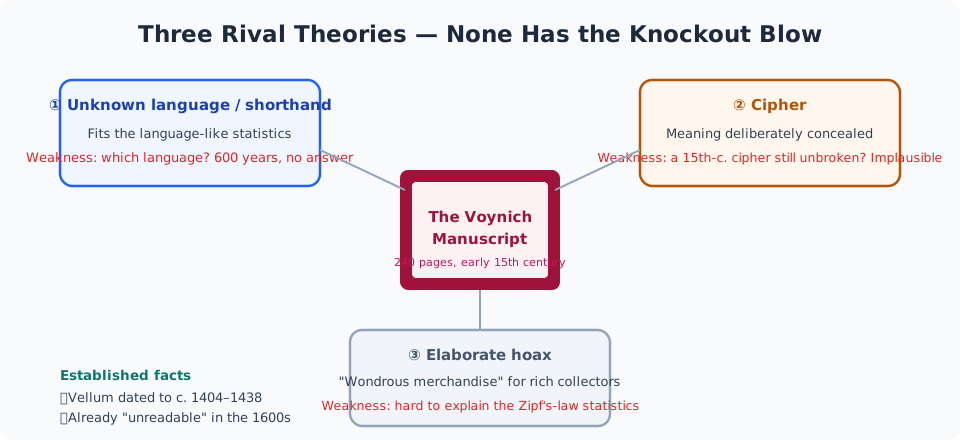
Current thinking splits into three camps.
First, the “unknown language / shorthand theory”: some language transcribed in an invented script, or a specialized abbreviation system. It fits the statistics well — but its fatal weakness is that in 600 years, nobody has identified which language.
Second, the “cipher theory”: meaningful text deliberately concealed. But the cryptography known in the 15th century is nearly helpless against modern cryptanalysis, and critics object that a cipher built with that era’s tools remaining unbroken today is implausible.
Third, the “elaborate hoax theory”: meaningless text mass-produced to look profound — merchandise built for collectors like Rudolf II who paid fortunes for wondrous books. The scenario is persuasive, and research has shown that simple mechanical procedures can generate “language-ish” text. Yet whether a 15th-century forger could accidentally build in the full suite of statistical properties, Zipf’s law included, remains doubtful. All three theories stand wounded but alive — that is the current state of play.
What’s Actually Inside
Let’s walk the unreadable book’s contents. The manuscript runs to roughly 170,000 characters — tens of thousands of words — and the illustrations divide it as follows:
| Section (inferred) | What’s drawn there |
|---|---|
| Botanical | One unidentifiable plant per page, over 100 in all |
| Astronomical | Stars and circular charts; some suggest the zodiac |
| Balneological | Basins of green liquid, women connected by strange tubes |
| Pharmaceutical | Plant fragments and dense starred paragraphs |
The balneological section is the eeriest. Women immersed in pool-like vessels, linked by odd pipes and conduits. A diagram of human physiology? Spa therapy? Alchemical allegory? No interpretation has stuck. The pictures are concrete; only the meaning keeps escaping. The whole book’s character, condensed into one chapter.
The research history includes tragedy. In 1921, the American philosophy professor William Newbold announced “it is the work of the 13th-century scientist Roger Bacon, and I have deciphered it” — worldwide headlines. After his death, his “decipherment” was exposed: he had been reading random ink cracks as shorthand symbols. His reputation was destroyed, and the affair survives as the warning that “the Voynich devours scholarly careers.” A century on, the book remains a graveyard of challengers.
Questions About the Voynich Manuscript
Couldn’t It Just Be a Fake?
The “modern forgery” line is effectively dead. The vellum dates to the early 15th century, ink and pigment analyses are consistent with the period, and 17th-century scholars’ letters mention the book. That it is “a book genuinely made 600 years ago” is beyond reasonable doubt. The live question sits one level deeper: was it made 600 years ago as a book with meaning, or as a wondrous book with none? Not “is it fake?” but “what was it for?” — that is the real question.
Can I See It Myself?
The original is locked away at Yale — but wonderfully, high-resolution scans of every page are freely available online. Anyone can examine the strange script and impossible plants down to the last stroke. Amateur researchers worldwide run their own analyses on these public images — Voynich studies has become an open, crowd-sourced investigation. Even just browsing, the flowing beauty and wrongness of the script comes through. If your curiosity is stirred, search for it.
Will It Ever Be Deciphered?
Honestly — unknown. But there is hope. Statistical and AI methods grow stronger every year; if the text truly carries meaning, the odds of capturing its structure keep rising. And if it is meaningless, then explaining how its language-like statistics were manufactured would amount to a solution in itself. Either branch permits an ending. As the unsolved problems series on this site notes, centuries-old mysteries really do fall suddenly to new tools. I am quietly waiting for the day the world erupts because someone finally read it.
Related Mysteries
See the fellow undeciphered enigmas “Linear A” and “the Kryptos cipher,” plus “Zipf’s law,” which governs the manuscript’s uncanny statistics.
Summary
This article covered “the Voynich manuscript.”
Two hundred forty pages, six hundred years old, readable by no one. The vellum, the ink, the provenance — all authentic; only the script matches nothing on Earth. Military codebreakers and AI alike have failed, and yet the text displays the “language-likeness” of obeying Zipf’s law. That suspended, in-between eeriness is why the Voynich is called the king of mysteries.
Unknown language, cipher, or exquisite hoax — three theories, none with a knockout blow, while the fully public page scans host challenges from around the world. A book nobody can read, speaking to us this loudly — savoring that paradox is the true pleasure of this mystery.
To return to the full list of mysteries, follow the link below.
Thank you for reading. We hope to see you in the next article.
Also popular with readers
📚 Series: World Mysteries (7/21)