Thank you for visiting this site. This article covers a strange regularity hiding in words and in the world’s numbers: “Zipf’s law.”
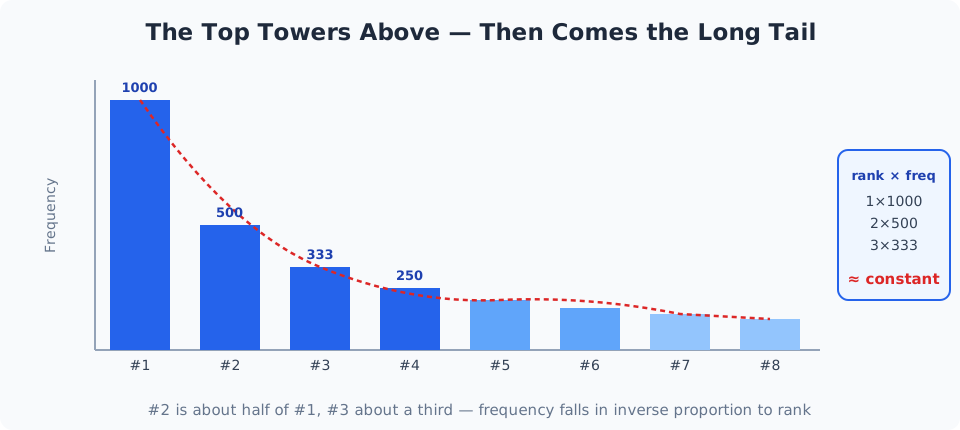
Rank the words of any text by how often they appear, and an astonishingly clean rule emerges. Take the most frequent word as the baseline: the second appears about half as often, the third about a third as often, the fourth about a quarter. In other words, multiply “rank” by “frequency,” and the product stays roughly constant. This is Zipf’s law — and the same rule surfaces far beyond language, in city populations, income distributions, and more. This article covers the fun of it, and the puzzle of why it happens.
What Is Zipf’s Law?
Zipf’s law is the rule of thumb that “when items are ranked by frequency, frequency is inversely proportional to rank.” It was discovered by the American linguist George Zipf while studying how words are used.
Translating “inversely proportional” into concrete terms: the #2 item appears about 1/2 as often as #1, #3 about 1/3 as often, #10 about 1/10 as often. Equivalently, rank × frequency lands near the same number at every rank. If #1 has frequency 1000, #2 will sit near 500 (2×500=1000), #10 near 100 (10×100=1000).
In English text, word counts led by the follow the law beautifully. Every language shows the same tendency with its own high-frequency function words. A few words get used overwhelmingly; the vast majority barely appear at all — and the skew takes this eerily regular shape.
Feeling “Rank × Frequency = Constant”
The delight of the law lies in how enormously the top items dominate. Some numbers.
Count the words in a book: the #1 word might take 7% of the text, #2 about 3.5%, #3 about 2.3%, falling smoothly with rank. Notice what this implies: a tiny handful of words fills a huge share of the text, while the great majority of words appear a handful of times.
We imagine ourselves deploying vast vocabularies; in truth, the words we actually reuse constantly are remarkably few. This shape — “a few dominate; the many stretch out thin and long” — drawn as a graph, plunges steeply at first and then trails off in a long, shallow slope. That long tail is Zipf’s law’s visual signature.
The scale of the skew astonishes when made concrete: in English, the top 100 or so words are said to account for nearly half of all running text — out of a vocabulary of tens of thousands. And there is an irony inside: the semantically thin words (“the,” “of”) get used the most, while the richly meaningful words wait long stretches between appearances. Inside that lopsidedness, Zipf’s law sits as a neat mathematical curve.
Far Beyond Words: A Rule Written Across the World
What makes Zipf’s law genuinely uncanny is that it holds for objects with no apparent connection to language.
The famous case is city populations. Rank a country’s cities by size, and in many countries the second city holds roughly half the population of the first, the third roughly a third. The exact shape of word frequencies, reappearing in urban demography.
Similar skews are reported in income and wealth distributions, firm sizes, website traffic, book sales — a few giants and countless small entries, arrayed in regular proportion. Utterly different domains, same mathematical form, over and over. That universality has fascinated researchers for decades.
Think of video platforms or online marketplaces: a sliver of megahits absorbs most of the attention, while a staggeringly vast catalog of items each draws only a trickle. This “few blockbusters, infinite niches” structure is precisely Zipf’s curve — and the internet is what finally shone light on the long tail that older markets left buried. A law born from counting words now reads modern business models. Where Benford’s law found shared skew in leading digits, Zipf’s law illuminates the world’s lopsidedness from another angle: the relationship between rank and size.
Why Does This Rule Emerge?
Why does the same shape appear so widely? Honest answer: no single accepted explanation exists to this day. But there are compelling candidates.
Zipf’s own proposal was the “principle of least effort.” Speakers want to economize (get by with few words) while also wanting to be understood (differentiate their words). Where the tug-of-war between “be lazy” and “be precise” balances, he argued, a Zipfian distribution appears.
Meanwhile, others point out that much simpler mechanisms produce the same shape. Even “text” generated by randomly mashing keys shows a Zipf-like distribution — suggesting the regularity may stem less from meaning than from the bare act of counting and ranking things. That the cause remains only partly understood is part of what makes Zipf’s law such a deep phenomenon.
Common Questions About Zipf’s Law
How Is It Different from Benford’s Law?
They are cousins — both about regular skews hiding in the world’s numbers — but they watch different things. Benford’s law watches “the leading digit,” finding that numbers starting with 1 dominate. Zipf’s law watches “the relationship between rank and size,” finding size falling in inverse proportion to rank. Different lenses; shared wonder: naturally arising data keeps producing common mathematical forms. Known as a pair, they widen how you see the world of numbers.
Is It Related to the Pareto Principle?
Deeply. The Pareto principle — “80% of results come from the top 20%” — expresses concentration in the few. Zipf’s law expresses the same skew structure in a different projection: a small elite occupying most of the total. Mathematically, both belong to the family of “power laws,” sharing the skeleton of a few giants and many dwarfs in regular arrangement. A handy mnemonic: Zipf reads the world’s lopsidedness through rank; Pareto reads it through shares.
Can I Verify It Myself?
Easily. The best experiment: count the words in a longish text you have on hand. Tally how often each word appears (including little function words), sort descending, and watch the top few tower over everything while counts collapse with rank. Or rank your country’s cities by population — if the second city runs about half the first, Zipf is on duty there. Finding hidden mathematical order in everyday numbers, with your own hands, is this law’s particular pleasure.
Related Laws
See “Benford’s law” (skew in leading digits), the “Pareto principle” (concentration in the few), and “Moore’s law” (exponential growth in numbers).

Summary
This article covered “Zipf’s law.”
Rank times frequency stays roughly constant: #2 runs about half of #1, #3 about a third — a suspiciously clean skew, first found in how we use words. And the identical form surfaces in city populations, incomes, firm sizes — places with no visible connection to language. A few giants and countless small entries in regular procession: the “long tail” is this law’s true face.
Why it happens remains only partly explained — the principle of least effort and other intriguing accounts compete. Mystery included, Zipf’s law reveals that the familiar world of numbers runs on strange, quiet order. Next time you see a long text or a table of cities, compare the top entries with the tail. The mathematics will be there, working silently.
To return to the full list of laws, follow the link below.
Thank you for reading. We hope to see you in the next article.

Also popular with readers
📚 Series: Famous & Fascinating Laws (24/25)