Thank you for visiting this site. This article covers the law that skewers technology’s great irony: “Wirth’s law.”
New, more powerful PCs and phones arrive every year. The chips inside them, as we saw in the Moore’s law article, are advancing furiously. And yet — “my new machine isn’t as fast as I expected,” “after a few years it somehow got sluggish” — sound familiar? Wirth’s law names the mystery: “software is getting slower more rapidly than hardware is becoming faster.” A rule of thumb aimed squarely opposite Moore’s law — and painfully true. Let’s dig in.
What Is Wirth’s Law?
Wirth’s law is the rule of thumb that “software slows down faster than hardware speeds up.”
It comes from the Swiss computer scientist Niklaus Wirth, famous as the creator of the programming language Pascal, in a 1995 paper. There he sounded the alarm about the relentless bloating of software and made his plea for lean, disciplined programs.
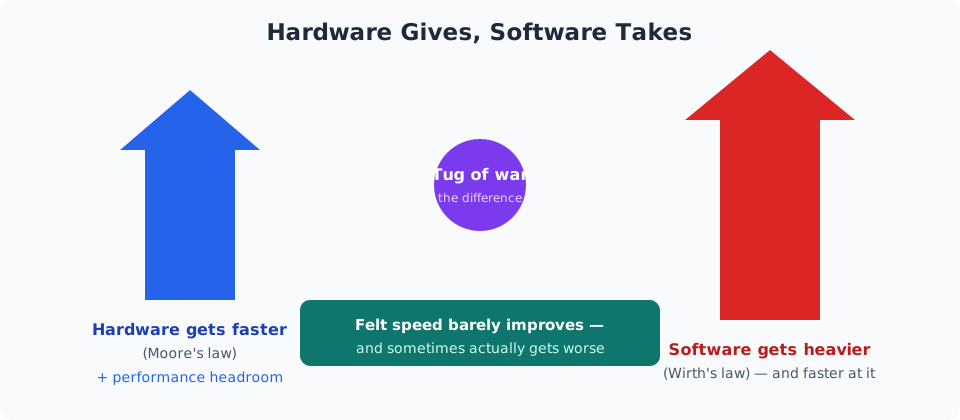
The meaning: hardware advances steadily along Moore’s curve. But the software running on it grows heavier faster than the hardware’s gains can cover. Net result: despite faster machines, perceived speed barely improves — and sometimes actually declines. If Moore’s law is progress’s bright face, Wirth’s law is its sharply observed shadow.
Faster — Yet Somehow Not Faster
Feeling this law requires no expertise. Compare a computer from several years ago with one from today: the components are several times more powerful. Yet boot times and app-launch waits are about what they were years ago. Nearly everyone has lived this.
Why? Simply put, software consumes whatever slack the hardware provides. Double the processing power, and if software starts demanding more than double the work, the waiting doesn’t shrink. Every performance gain licenses new software extravagance.
It resembles the traffic phenomenon where widening a road fails to cure congestion because more cars appear. The freed capacity is instantly filled by new demand. Hardware progress builds the wider road; bloating software supplies the extra cars. The fruits of progress rarely reach our fingertips as felt speed — that is the law’s central irony.
You have watched the cycle personally: the new laptop feels “genuinely fast” for a while, then updates and new services pile on, and within years the old sluggishness returns. The hardware degraded not at all; the software above it grew heavier, and the speed was eaten. Behind every disappointed “why isn’t my new device more pleasant?” Wirth’s law is quietly at work.
Why Does Software Keep Getting Heavier?
Why does software bloat when left alone? Not from malice — from several perfectly natural causes stacking up.
First, feature accretion. Each new version adds capabilities and polish. Individually convenient, collectively heavy. Software fattens by hoarding features that may never be used.
Second, layers stacked for developer convenience. Modern software is assembled from many strata of prebuilt components and frameworks. This multiplies development speed — while inserting extra machinery into every single operation, slowing execution.
Third, optimization gets skipped. When hardware is fast enough, the reasoning “some inefficiency won’t matter — the hardware will absorb it” comes easily. Shipping quickly beats trimming carefully. Thus software slackens, leaning on hardware’s progress. This is precisely the decay of the “lean software” Wirth championed.
The Tug-of-War with Moore’s Law
Wirth’s law is most fun understood in contrast with Moore’s law — the two are locked in a permanent tug-of-war.
Moore’s law names the progress hardware gives: chips doubling every two years, gifting us headroom. Wirth’s law names software devouring that gift. What hardware giveth, software taketh away.
Hence perceived speed never rises as fast as the hardware does. The upward pull of Moore against the downward drag of Wirth — the difference between them is the “speed” we actually experience. View technological progress through both its bright face (Moore) and its shadow (Wirth), and your relationship with technology gains a dimension.
The industry immortalized the tug-of-war in a wry saying: “what Andy giveth, Bill taketh away” — “Andy” being the chief of a chip maker and “Bill” the chief of a software company of that era. The hardware side raises performance; the software side spends it all. That the pattern earned a catchphrase built on two industry titans’ names tells you how universally the phenomenon has been felt.
Common Questions About Wirth’s Law
Is Software Bloat Just Developer Laziness?
Not fairly, no. As we saw, bloat grows from legitimate pressures: feature demand, productivity-boosting frameworks, tight schedules. As Hanlon’s razor counsels, look for the circumstances before reaching for “malice or sloth.” What Wirth’s law really indicts is not individual laziness but an industry-wide slackness licensed by “the hardware is fast anyway.” The genuine question is where to balance convenience against discipline.
Does the Law Apply to Modern Phones and AI?
The basic structure is alive and well. Apps grow more capable yearly, ratcheting up their hardware demands in step — the reason a few-year-old phone chokes on the newest apps. That said, battery-life pressures have revived real interest in software efficiency, so pure one-way bloat is not guaranteed. Meanwhile, with compute-hungry technologies like generative AI arriving in waves, the dynamic of “software demand whipping hardware progress forward” has arguably intensified.
Is There Anything We Users Can Do?
Several things. Simply pruning unused features and background apps noticeably improves felt speed — refusing to accept bloat passively and slimming your setup to your actual use. When choosing tools, add “lightness and simplicity” to your criteria. More features do not mean better; sufficient-and-snappy usually wins on comfort in the long run. Wirth’s ideal of lean software speaks not only to builders but to all of us choosing our tools.
Related Laws
See “Moore’s law” (the exponential gift being spent), “Brooks’s law” (why adding people doesn’t add speed), and “Hanlon’s razor” (circumstances before malice).
Summary
This article covered “Wirth’s law.”
Software gets slower faster than hardware gets faster. Amid the chip industry’s furious progress, the reason our devices never feel proportionally quicker is this law: feature accretion, convenience layers, skipped optimization — software slackening and fattening in the shade of hardware’s gains.
The delight is its perfect opposition to Moore’s law: hardware gives, software spends, and the remainder is the speed we feel. Watch technology with both faces in view — and when choosing tools, prize lightness and simplicity. Wirth’s law is the rare rule that turns naive celebration of progress into thoughtful use of it.
To return to the full list of laws, follow the link below.
Thank you for reading. We hope to see you in the next article.

Also popular with readers
📚 Series: Famous & Fascinating Laws (25/25)