Thank you for visiting this site. This article covers a way of thinking that dramatically reduces relationship stress: “Hanlon’s razor.”
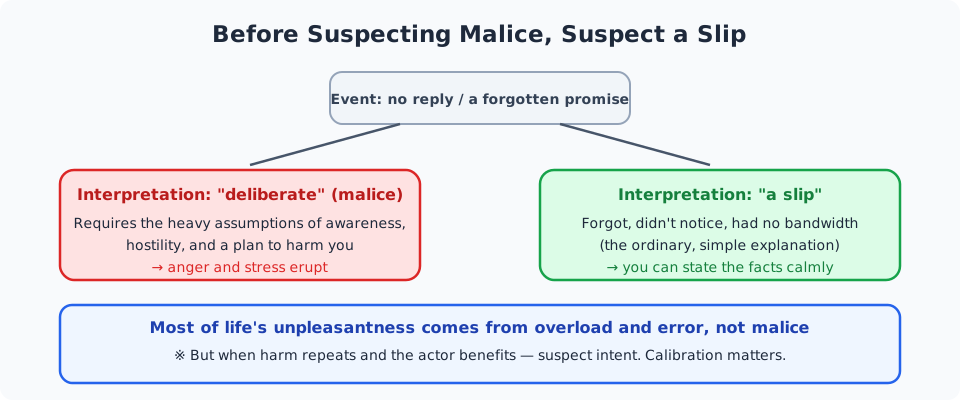
No reply to your message. A forgotten promise. Careless treatment. In moments like these we leap to suspecting the other person’s malice — “they’re doing it on purpose,” “they don’t take me seriously.” But in most cases the truth is simpler: they just forgot, didn’t notice, or couldn’t get to it. Hanlon’s razor compresses this wisdom — “before suspecting malice, suspect carelessness or overload” — into one line. Merely knowing it cuts a remarkable amount of pointless anger out of your life.
What Is Hanlon’s Razor?
Hanlon’s razor is the principle: “never attribute to malice that which is adequately explained by stupidity” — where “stupidity” means garden-variety carelessness and limited capacity, not an insult.
The “razor” here is not a shaving tool. In philosophy, a razor is a principle for shaving away unnecessary assumptions. When explaining an event, before reaching for the heavy assumption of “malice,” check whether the lighter, more commonplace explanation — “a slip” — already suffices, and shave off the excess. Hence: Hanlon’s razor.
A concrete case. Your boss rejects your proposal. Think “it’s because they dislike me” and anger follows. Apply the razor, and gentler explanations surface: “maybe the proposal simply didn’t land,” “maybe they were swamped and never read it properly.” And statistically, the great majority of life’s unpleasant events are born not of malice but of exactly this kind of simple error and lack of bandwidth.
A Cousin of Occam’s Razor
Hanlon’s razor is kin to the far more famous “Occam’s razor.”
Occam’s razor, attributed to the 14th-century philosopher William of Ockham, holds that “entities should not be multiplied beyond necessity — when two explanations cover the facts, prefer the simpler one.” A noise in the night? “Burglar” loses to “wind, cat, or the house settling” most of the time. Prefer the ordinary, simple explanation.
Hanlon’s razor is this same principle applied to human relationships. In explaining someone’s behavior, “malice” is actually a complex, heavyweight hypothesis: the person must be aware of you, hostile to you, and deliberately planning your harm. “A slip,” “limited skill,” “no bandwidth” are vastly more common and simpler. The Occamite spirit — choose the simpler, more ordinary explanation — flows straight into Hanlon’s razor. It is a pleasing thread: a philosophical tradition of prizing simplicity reaching all the way down into everyday interpersonal wisdom.
Why Do We Suspect Malice in the First Place?
Why do we read malice into events a simple mistake would explain? Deep psychology is involved.
Humans have a strong tendency to attribute other people’s behavior to their character and intentions. This is the “fundamental attribution error,” covered in detail on this site. When someone is late, we blame their interior: “sloppy person,” “they don’t respect me.” Yet when we are late, it’s “the train was delayed,” “something urgent came up” — the situation’s fault. Others’ failures get character and malice; our own get bad luck and circumstances. That asymmetry writes the story “they did it on purpose” for us.
Hanlon’s razor functions as a conscious brake on this deep-rooted bias. When someone’s behavior stings, try viewing them with the same generosity you extend yourself: “if I had done this, what circumstances might explain it?” Most of the time, the malice narrative turns out to be an evidence-free assumption. You might say Hanlon’s razor is a device for granting others the same excuses you grant yourself.
The Origin Is Murky — the Wisdom Is Universal
The name “Hanlon” has a genuinely unclear history.
The most cited account credits one Robert Hanlon, who supposedly submitted the line to a joke compilation around 1980. But near-identical formulations existed earlier. Science fiction writer Robert Heinlein wrote essentially the same idea into a 1941 story, and the thought itself — “stupidity is more common than malice” — has been voiced for centuries; a similar sentiment is said to appear in Goethe.
So Hanlon’s razor is less one person’s invention than a piece of wisdom humanity kept re-deriving through long experience, onto which Hanlon’s name happened to stick. That its authorship is too old and diffuse to pin down is itself testimony to the universality and usefulness of the insight. People across eras and countries kept arriving at the same conclusion — that is how strongly we over-read malice.
Powerful — and Dangerous If Misused
Finally, the important cautions. A tool this strong cuts the wrong way when misused.
First, Hanlon’s razor does not deny that malice exists. Real malice and deliberate harm are out there. Continuing to charitably interpret a clearly repeating pattern of harm as “probably just carelessness” endangers you. Against repeated harassment or plainly hostile behavior, the razor must be set down. A healthy calibration: “the first time, suspect incompetence; when it repeats, suspect intent.”
Second, swinging Hanlon’s razor at other people is rude. Saying aloud, “this wasn’t malice, you’re just incompetent,” is plain insult. The law is a tool for calming your own anger, inside your own head. A shield for your peace of mind, never a sword for judging others. Hold that line, and Hanlon’s razor becomes a dependable daily ally against stress.
Questions About Hanlon’s Razor
Doesn’t This Just Let People Off the Hook?
A good question. Hanlon’s razor is not about “forgiving” failures or “letting them slide.” If a promise was forgotten, you may absolutely point that out. What the razor changes is only the interpretation in your own mind — “malice” versus “a slip.” Believe you were deliberately slighted, and anger takes over; believe they simply forgot, and you can state the facts calmly. Treat the problem as a problem without convicting the person as a villain. That is not indulgence — it is the more constructive response.
How Do I Actually Tell Malice from Carelessness?
No perfect test exists, but two practical markers do: “once, or repeatedly?” and “does the other person gain from it?” A one-time slip that profits them nothing is almost never malice. Conversely, the same harm repeated, with clear benefit accruing to the actor, earns legitimate suspicion. Remember: Hanlon’s razor softens “the first interpretation” — it is not a vow to keep assuming good faith against the evidence.
Does It Help in Business and Management?
Enormously. Most organizational trouble arises not from “somebody slacked” or “sabotage,” but from information that never arrived, procedures never defined, and simple understaffing — malice-free failure. Hunt for a culprit and prosecute their supposed intent, and the same failure recurs anyway. Reframe trouble through Hanlon’s razor as “a systems problem,” and the energy goes instead into building processes where the mistake can’t happen — which connects beautifully to Murphy’s law’s “prevent slips with mechanisms.”
Related Laws and Biases
See the “fundamental attribution error” (blaming others’ failures on character), “self-serving bias” (success is mine, failure is theirs), and “Murphy’s law” (prevent slips with design, not vigilance).
Summary
This article covered “Hanlon’s razor.”
When someone’s behavior irritates us, the mind auto-generates a story titled “malice.” Hanlon’s razor is the simple, powerful tool that interrupts the story with one question: “is this really malice — or does an ordinary slip explain everything?” Most of the world’s unpleasantness grows from overload and oversight, not from enemies.
Vigilance against genuine malice remains necessary. But surrendering hours of anger to a malice that hasn’t even been established is a poor trade. Next time someone’s conduct makes your jaw tighten, quietly draw this razor inside your mind. The other person will look different — and, more importantly, your own heart will feel lighter.
To return to the full list of laws, follow the link below.
Thank you for reading. We hope to see you in the next article.

Also popular with readers
📚 Series: Famous & Fascinating Laws (9/25)