Thank you for visiting this site. This article covers the law that answers a mystery everyone feels: “Janet’s law.”
As a child, summer vacation stretched toward eternity. As an adult — “the year’s over already?” “wasn’t it just New Year’s?” — the years blur past. Why does time seem to accelerate as we age? Janet’s law is the attempt to explain this universal experience: “the subjective length of time is inversely proportional to one’s age.” It is not your imagination — the law touches something real about how we perceive time. And it even hands us hints for getting the time back.
What Is Janet’s Law?
Janet’s law is the proposition that “the subjective length of a period of time is inversely proportional to the age of the person experiencing it.” It was proposed by the 19th-century French philosopher Paul Janet and became known through his nephew, the psychologist Pierre Janet.
The words sound technical; the content is simple: “the same year feels long when you’re young and short when you’re old.” The charm of Janet’s law is that it puts numbers to a feeling everyone recognizes.
Why “inversely proportional”? Janet’s idea: we feel the length of a year relative to the total length of the life we have lived so far. Let’s see the actual numbers.
Comparing a Year at 5 and a Year at 50
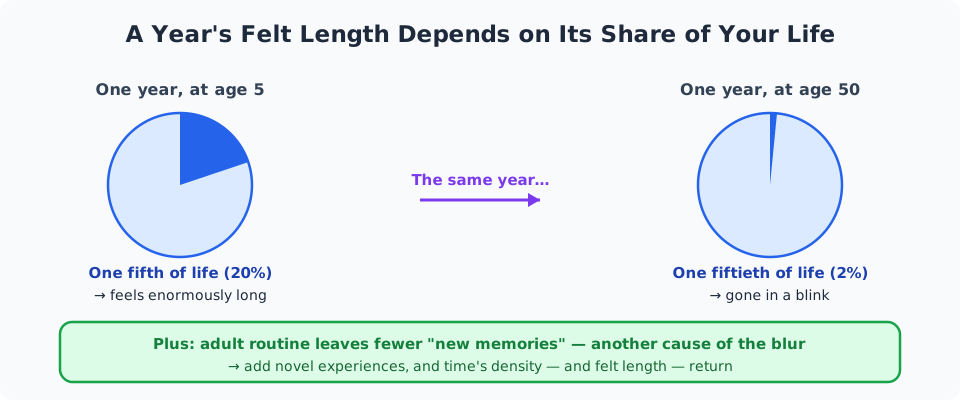
The heart of Janet’s law is weighing “a year” as a fraction of the whole life lived.
To a five-year-old, one year is one-fifth of their entire life — a massive block, 20% of everything they have ever known. To a fifty-year-old, one year is one-fiftieth of their life — a mere 2%.
The same “year” is a fifth of existence for the child and a fiftieth for the adult. This difference in “share of life” is what produces the difference in felt duration, Janet argued. For a fifty-year-old to feel a year the way a five-year-old does, the fifty-year-old would need ten years. A childhood year carries the density of an adult decade. No wonder summer vacation felt endless.
The arithmetic yields a striking corollary. Assumptions vary the numbers, but applied straightforwardly, this proportional model puts the subjective midpoint of life not at the clock’s halfway mark (age 40 of an 80-year life) but far earlier — somewhere in the teens or around twenty. The second half of life, long on the clock, streams by in felt time. A little melancholy — and very much worth knowing.
The Fraction Alone Doesn’t Explain Everything
Janet’s “share of life” account is intuitive, but it cannot carry the whole load. Modern psychology adds a deeper layer.
If the fraction were the only cause, felt time would shorten smoothly with age. In reality, the same adult experiences some stretches as a blur and others as slow and full — everyone knows this. Enter the stronger explanation: the quantity of new experiences.
The idea: we judge a period “long” in retrospect when it is densely packed with retrievable memories. Childhood was an unbroken run of firsts — the first bicycle ride, the first summer of swimming, the first trip somewhere new. The brain records novelty vividly, so childhood leaves thick layers of memory, and looking back, the time reads as long.
Adulthood, by contrast, is largely routine. Same commute, same work, similar weekends. Repetitive days barely register as new memories, so the year, reviewed later, is thin — and the verdict comes back: “it flew by.” The year didn’t move faster; it simply left fewer memories behind. And this account, unlike the arithmetic, points directly at a remedy.
How to Make Time Longer and Denser
Janet’s law plus the psychology of felt time answers the question “is the acceleration of the years inescapable?” with genuine hope: deliberately increase novel experiences, and felt time returns.
Concretely, these are held to work:
- Go somewhere new; attempt something new. Travel and fresh hobbies carve vivid memories, stretching the felt length of the period
- Take a different route; enter a different shop. Even small breaks in routine thicken the day’s memory
- Review the day each evening. Deliberate recall fixes even ordinary events into memory, raising time’s density
- Immerse yourself deeply in something. A day drifted through is forgotten immediately; a day of absorption stays sharp
Ever returned from a trip thinking, “only a few days, but it feels like ages”? That is novel experience stretching time before your eyes. I feel months dissolve when my days repeat, so I make a point of mixing small “firsts” into ordinary weeks. Nobody can add hours to the clock — but the density of felt time is adjustable by design. That is the most hopeful lesson Janet’s law has to offer.
Common Questions About Janet’s Law
Is This Law Scientifically Proven?
Honestly: the precise mathematical claim — “felt time is exactly inversely proportional to age” — is not a rigorously verified scientific law. It is an attractive hypothesis that fits intuition well. The phenomenon itself — “time feels faster with age” — is confirmed by plenty of research. But its cause remains contested: the share-of-life account, the novelty account, plus theories involving biological clocks and metabolic change. The accurate summary: the phenomenon is real; the explanation is plural.
Why Does Time Fly Even When I’m Busy?
This is beautifully explained by felt time’s double structure. Time has “the feel while living it” and “the feel in retrospect.” A boring meeting crawls in the moment yet vanishes from memory and seems brief afterward. A wonderful trip flies in the moment yet, packed with memories, reads long afterward. Busy, fulfilling days typically race while happening and lengthen in review. Hence the trick for a life that feels long: maximize experiences that survive into memory.
I Can’t Return to Childhood — Does the Remedy Still Work?
Fully. What Janet’s law really teaches is that the acceleration comes less from age itself than from life turning repetitive. Which means a person of any age who keeps attempting new things keeps feeling time thick and long. Look around: people who stay absorbed in new pursuits at any age visibly inhabit their time richly. Settle into repetition “because of my age,” or keep running small adventures — Janet’s law quietly pushes toward the latter, and refuses to accept age as the excuse.
Related Laws and Paradoxes
See “hyperbolic discounting” (the tyranny of the present moment), “Thomson’s lamp” (a thought experiment slicing time infinitely), and “Achilles and the tortoise” (the paradox of time and motion).



Summary
This article covered “Janet’s law.”
The years accelerating in adulthood is neither an illusion nor a personal failing. Each year claims a smaller share of your life, and repetitive days leave fewer memories — a natural process that happens to everyone. The law delivers a slightly bittersweet truth, and with it, hope: the feel of time can be reclaimed by design.
Go somewhere new. Attempt something new. Review the day before sleep. Multiplying the moments that survive into memory is the only real resistance to passing time. If today ends in your memory not as “a day when nothing happened” but as “the day I learned something new” — then your time has already grown a little longer.
To return to the full list of laws, follow the link below.
Thank you for reading. We hope to see you in the next article.

Also popular with readers
📚 Series: Famous & Fascinating Laws (10/25)