Thank you for visiting this site. This article covers the law that unlocks the mystery of remembered experience: “the peak-end rule.”
When you recall a wonderful trip, you do not remember all of it equally. The single most exhilarating moment, and the mood as it ended — those two things determine nearly the whole impression. It is also why the theme-park ride you queued three hours for and enjoyed for five minutes lives in memory as “amazing.” Human memory grades an experience almost entirely on two points: the peak and the end. That is the peak-end rule — and knowing it hands you levers for raising your own life satisfaction.
What Is the Peak-End Rule?
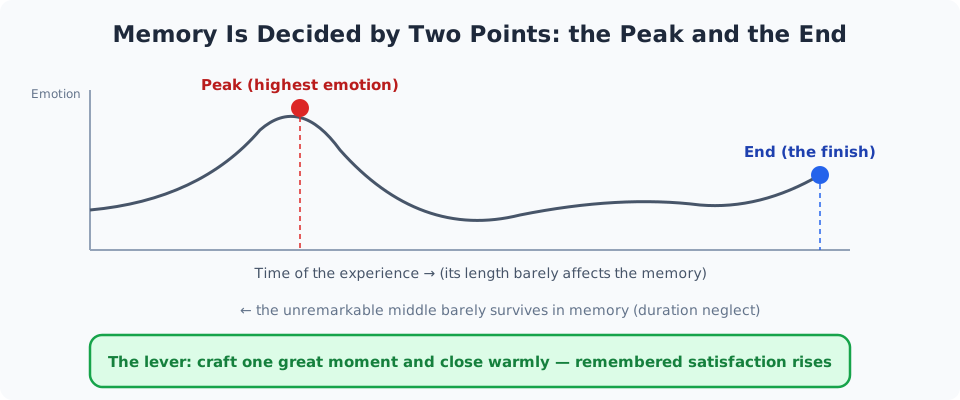
The peak-end rule is the psychological law that “when people look back on an experience, they judge its overall quality mainly from the moment of strongest emotion (the peak) and from how it ended (the end).”
The rule was discovered and formulated by the research team of Daniel Kahneman, the Nobel laureate of behavioral economics. What they revealed is the surprising fact that memory does not record experience impartially.
Watch a two-hour film, and you believe you remember the two hours evenly. In fact, what persists and drives your later verdict is centered on the scene where your emotions surged (the peak) and the final scene (the end). The unremarkable middle barely registers. Not the sum, not the average — two points stand in for the whole. That is the rule’s core, and the experiments below display it vividly.
The Pain Experiments That Exposed Memory’s Habit
The peak-end rule was cemented by some slightly devious experiments from Kahneman’s team.
Most famous is the cold-water experiment. Participants underwent two ordeals. First: hold your hand in painfully cold water (14°C) for 60 seconds. Second: the same 60 seconds — plus 30 more seconds in water warmed just slightly (15°C).
Logically, the second ordeal is worse: 30 additional seconds of discomfort. Yet asked “which would you repeat?”, most participants chose the second. Why? Because the second ends on the slightly less awful 15-degree water. Total suffering increased — but the memory “it ended better” recast the entire experience as “less bad.”
The team confirmed the same in their colonoscopy research: lengthening the procedure but appending a gentler, low-pain interval at the end made patients remember the whole examination as less painful. The astonishing conclusion: the duration of an experience is almost entirely ignored by memory. Psychologists call this “duration neglect.” Long or short, what memory keeps is the peak and the end — never the total.
Why Do We Remember by Two Points?
Why is memory this crude? Surely a complete record would serve judgment better. There is a rational story hiding here.
If the brain recorded every second of every experience verbatim, storage would collapse instantly. Instead, the brain runs a compression strategy: extract only the essentials — “the point of strongest emotion” and “the final point” — and archive those. Moments of intense emotion are likely to be survival-relevant, so they get priority. The ending matters because an experience’s final outcome directly informs whether to attempt it again.
The peak-end rule, then, is not memory being lazy — it is a shrewd evolutionary compromise for efficient judgment on limited storage. But the compromise cuts both ways. A long, happy relationship that ends badly becomes “a bad memory” — the rule’s saddest side effect. We grade life’s chapters not by their volume of happiness but by peak and finale. Knowing this habit is what unlocks the smart applications below.
Engineering “All’s Well That Ends Well”
The delightful part of the peak-end rule: know the psychology, and you can deliberately raise the remembered satisfaction of any experience. Service industries and entertainment discovered this long ago.
Theme-park design is the clean example. Whatever the queues and crowds, a spectacular ride climax (peak) plus the closing parade and fireworks (end) send visitors home remembering “the best day.” The small dessert or warm word a restaurant adds at the end of a meal works the same way — polish the parting impression, and the memory of the whole establishment rises.
The wisdom ports directly into daily life. In a presentation, build one unmistakable core moment (the peak) and close with a strong final line. In conversations and goodbyes, end with a smile or a word of thanks. Even the shape of a day: make the last hour before sleep pleasant, and the whole day files itself away as a good one. My own habit — recalling one good thing about the day before sleeping — is exactly an engineered end. Rather than straining to perfect everything, invest in the peak and the ending. That is the rule’s most practical teaching.
Common Questions About the Peak-End Rule
Does the Middle Not Matter at All Then?
It matters. The common misreading is “coast through everything except the peak and the end” — that is not the claim. First, a strong peak only grows out of a solid middle. Second, the rule concerns “memory in retrospect,” which is distinct from “the lived experience of each moment” — the ordinary middle hours have real value while you are inside them. What the rule offers is a priority map for limited energy: where investment most affects memory. Care for the whole; concentrate on the peak and the ending. That is the correct reading.
Can a Bad Experience Be Rewritten into a Better Memory?
To a degree, yes. As the cold-water study showed, softening even the ending of an ordeal improves the memory of the whole. A brutal project closed with a genuine round of team appreciation tends to be remembered as “hard, but good.” The dentist’s kind word at the end operates identically. One caution: using this as a substitute for fixing real problems is a bad trade — dress up the endings while neglecting the substance, and people eventually see through it. Improving the content and honoring the ending work only as a pair.
Are Several Short Vacations Better Than One Long One?
From memory’s standpoint — quite possibly. If duration is neglected, then one long trip and several short trips may deposit similar satisfaction per trip — and more trips mean more peak-and-end pairs, hence more good memories in total. Long vacations do offer deep experiences short ones cannot, so no absolute verdict. But the rule offers this cheerful nudge: never cancel joy just because you can’t book a long block of time. Short spans with a real peak and a warm ending, taken often, are their own kind of rich life.
Related Laws and Biases
See “Janet’s law” (another law of felt time), “hyperbolic discounting” (the tyranny of the present), and the “availability heuristic” (recallability distorting judgment).
Summary
This article covered “the peak-end rule.”
Memory does not weigh experience evenly — it grades everything on two points: the emotional peak and the closing note — and it nearly ignores duration. The cold-water experiment exposes just how rough-cut our retrospective judgments really are.
But the rule is also a recipe for a richer life. Instead of straining for wall-to-wall perfection, deliberately craft the moments that matter, and close things warmly. That alone transforms what remains in memory. The old proverb “all’s well that ends well” turns out to have laboratory evidence behind it. Tonight, give the last hour of your day a slightly better ending.
To return to the full list of laws, follow the link below.
Thank you for reading. We hope to see you in the next article.

Also popular with readers
📚 Series: Famous & Fascinating Laws (11/25)