Thank you for visiting this site. This article covers a law that captures a strange truth about groups: “the worker ant rule” (the 2-6-2 rule).
Ants are the very symbol of industry — but watch a colony closely and a surprising fact emerges. Only about 20% of the ants work hard; 60% work moderately; and the remaining 20% barely work at all. Even better: gather only the hardworking 20% into a new colony, and a new “idle 20%” soon appears within it. This is the worker ant rule, famous for mapping uncannily well onto human organizations. And the 20% that looks like slackers turns out to have a real job. This article covers the mechanism and its lessons.
What Is the Worker Ant Rule?
The worker ant rule is the observation that “any group, observed closely, splits into hard workers, average workers, and near-idlers at a ratio of roughly 2:6:2.” It is also called the “2-6-2 rule.”
The phenomenon was originally found by watching ant colonies. A throng of apparently busy ants, tracked individual by individual, divided into a diligent minority, a moderately working majority, and a barely moving minority — in proportions close to 2:6:2.
An honest caveat: the split is not a crisp “2:6:2.” What the research actually shows is the tendency that “hard workers and near-idlers always exist in some stable proportion.” “2-6-2” is a memorable rounding of that tendency. Even so, this rough ratio proves astonishingly useful for understanding groups.
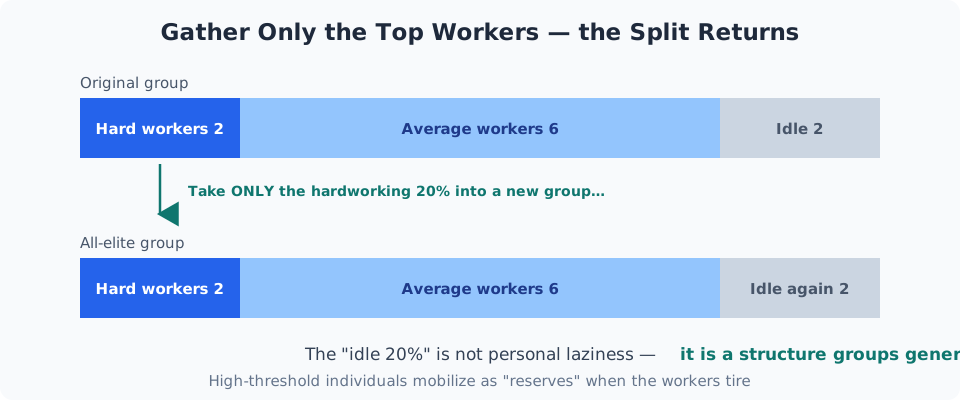
Gather Only the Hard Workers — and 20% Go Idle Again
What made the rule famous is the question: “what happens if you build a new group from only the top-working 20%?”
Common sense predicts an elite squad of nonstop workers. Reality disagrees. Within the elite group, a “barely working 20%” re-emerges. And the reverse holds too: build a group from only the idle 20%, and some of them start working, until the distribution settles back near 2:6:2.
In other words, the idlers exist not because those individuals are lazy, but as a structure the group itself naturally generates. To me this is the most fascinating part of the rule: who idles is not fixed — roles rotate with the group’s circumstances. Which leads to an important implication: simply blaming “the people who don’t work” solves nothing. So why does this happen?
Why the Idle Ants Matter
Why does a fixed share of near-idle ants always exist? The explanation: ants differ in how much prodding they need before they move. Biologists call this a difference in response thresholds.
Unpacked: some ants have hair triggers — the slightest stimulus (food found, nest damaged) sends them to work. Others move only when tasks pile up severely. Normally the hair-trigger ants handle everything, so the high-threshold ants look like “the ants that don’t work.” But when the workers tire and rest, or a sudden flood of work arrives, the heavy-threshold ants finally move out.
There is real meaning in this. If every ant had a hair trigger — all working at once, all exhausting at once — then the moment they collapsed together, the nest would be left with no workforce at all, in crisis. What prevents this is the existence of normally idle “reserves.” Because substitutes are on standby, the colony can work without interruption, indefinitely. The idea popularized as “idle ants have their purpose” names precisely this value of reserves. The 20% that looks like waste is quietly underwriting the colony’s survival — a richly suggestive lens for thinking about organizations.
The Relationship to the Pareto Principle
Seeing “20%,” you may recall the Pareto principle, also covered on this site: “80% of results come from 20% of the whole,” a.k.a. the 80/20 rule.
The worker ant rule and the Pareto principle resemble each other — “a minority carries an outsized share” — and are often told together. Indeed, “the top 20% produce most of the output” is essentially Pareto’s claim.
But their viewpoints differ. Pareto spotlights the magnitude of the top 20%‘s contribution. The worker ant rule goes further: the bottom 20% also has a role, and membership in each tier rotates. Not stopping at “the 20% are heroes” but attending to the whole group’s balance and reserves — that is the worker ant rule’s distinctive flavor. Set the two similar-sounding laws side by side and each one’s message comes into focus.
Applying It to Human Organizations
The rule offers several practical lessons for companies and teams — with traps for the careless, so let’s step carefully.
First and foremost: do not conclude that “cut the idle 20% and productivity rises.” The rule’s whole point is that removing them regenerates a new 20% among those who remain. The problem is not individuals; it is a structure that groups naturally produce. “Build an all-elite team and everyone will run at full throttle” almost never survives contact with reality.
Second: don’t reflexively condemn visible slack. An organization where everyone runs at 100% all the time looks efficient — and has zero cushion when someone collapses or a crunch arrives. The person who sometimes seems to have idle hands may be the substitute in the emergency, or the one who takes on the new experiment. This is not a license to slack. It is a balance claim: organizations with some margin and diversity are stronger over the long run. Grind efficiency to zero slack, and you get fragility. I try to keep this lens in my own work.
Common Questions About the Worker Ant Rule
Does Every Group Really Split Exactly 2:6:2?
No — not exactly. As noted, the numbers are a rounded, memorable guide. What research actually demonstrates is that “hard workers and near-idlers persist in some stable proportion,” with ratios varying by group and situation. What deserves your attention is not the digits but the structural surprise: gather only the diligent, and the same distribution reassembles itself. Take the numbers as a tendency, not a law of nature.
If I’m in the ‘Idle 20%,’ Am I a Failure?
Not necessarily. The rule shows that roles are unfixed and rotate with circumstances. Looking under-occupied today is fully compatible with stepping up in the crunch, when others burn out. A heavy threshold can be exactly what makes you the group’s “reserve capacity.” This is not an excuse for coasting — but knowing that “you are not worthless unless permanently at full throttle” should ease the mind a little.
Is a Company Wrong to Try Reducing Its ‘Non-Performers’?
Not categorically wrong — but the rule warns that “remove them and the problem disappears” is a dangerous fantasy. Swap out the underperforming 20% and a new idle 20% likely emerges from those who remain. The real work is at the level of design: “why does this structure arise?” and “how do we put the reserves to use?” Look at the system before blaming individuals — a stance that connects naturally to Hanlon’s razor’s “suspect circumstances before malice.”
Related Laws and Biases
See the “Pareto principle” (a minority carrying the bulk), “Hanlon’s razor” (charitable readings of behavior), and “survivorship bias” (skews in who remains visible).

Summary
This article covered “the worker ant rule (2-6-2).”
Observe any group and it splits, roughly, into a hardworking 20%, an average 60%, and an idle 20% — and even a hand-picked elite re-develops the same distribution. The mystery traces to differences in response thresholds — how much prodding each individual needs. The normally idle ants are the “reserves” who move out when the workforce tires, underwriting the colony’s survival.
That is why “cut the idle 20% and efficiency rises” rarely works. The problem lives in the structure, not the individuals. Squeeze out every drop of slack and the system turns brittle; a measure of margin and diversity is what long-term strength looks like. Understanding the purpose of the 20% that seems to be slacking offers a kinder lens — for organizations, and for your own way of working too.
To return to the full list of laws, follow the link below.
Thank you for reading. We hope to see you in the next article.
Also popular with readers
📚 Series: Famous & Fascinating Laws (13/25)