Thank you for visiting this site. This article covers “Dunbar’s number,” which puts a figure on the limit of human relationships.
However many thousands of followers you have, the people whose faces, names, and current lives you actually know are a small handful, aren’t they? It is believed that there is a rough ceiling on the number of stable relationships one human can maintain — around 150 people — and that figure is known as Dunbar’s number. It is thought to be a limit rooted in the processing capacity of the brain, acquired over our evolution — meaning that no matter how many business cards you hand out, your true circle does not keep growing. A slightly wistful, deeply persuasive fact. This article explores it.
What Is Dunbar’s Number?
Dunbar’s number is the idea that “there is an upper bound on the number of people with whom one person can maintain stable social relationships — roughly 150.” It takes its name from the British anthropologist Robin Dunbar, who proposed it.
A “stable relationship” here means more than matching a face to a name. It means knowing roughly where the person is in life, how they relate to you, and being able to pick up a conversation without awkwardness after a long gap. One hundred fifty is the approximate ceiling on how many such meaningful ties can be maintained at once.
What makes the number fascinating is that it is thought to be a limit rooted in the brain’s architecture — not something effort or personality can overcome. Even the most sociable person cannot expand deep relationships without bound. Where does 150 come from? Let’s look.
Where Did “150” Come From?
The origin of Dunbar’s number lies, surprisingly, in research on monkey troops. Observing monkeys and apes, Dunbar noticed a relationship: species with larger brains (particularly the thinking regions) live in larger groups.
Why would that be? Keeping good relations within a troop means continuously tracking complex information — “who is allied with whom,” “can this one be trusted.” As companions multiply, the combinations of relationships to remember explode. The size of group a species can sustain is set by the brain capacity available for that social bookkeeping.
Dunbar extrapolated this brain-size-to-group-size relationship to humans. The group size predicted from the human brain came out at roughly 150. Even better: the sizes of hunter-gatherer villages, the basic fighting units of armies through history, and many other real human groupings cluster around 150. Theory and observed reality landing in the same place — that agreement made the number famous.
The figure surfaces in modern life too. A study of holiday-card lists found that the total number of people a household actually exchanges cards with settles near 150. In companies, it is a commonplace that once a unit grows beyond this size, people stop knowing each other’s faces and circumstances, and communication frays. Theory, history, and daily life all keep producing numbers near 150. That eerie convergence is what elevates Dunbar’s number above a mere hunch.
Relationships Come in Layers
Quoting only the single number 150 misses the best part. What Dunbar described is a structure in which relationships stack in layers by intimacy.
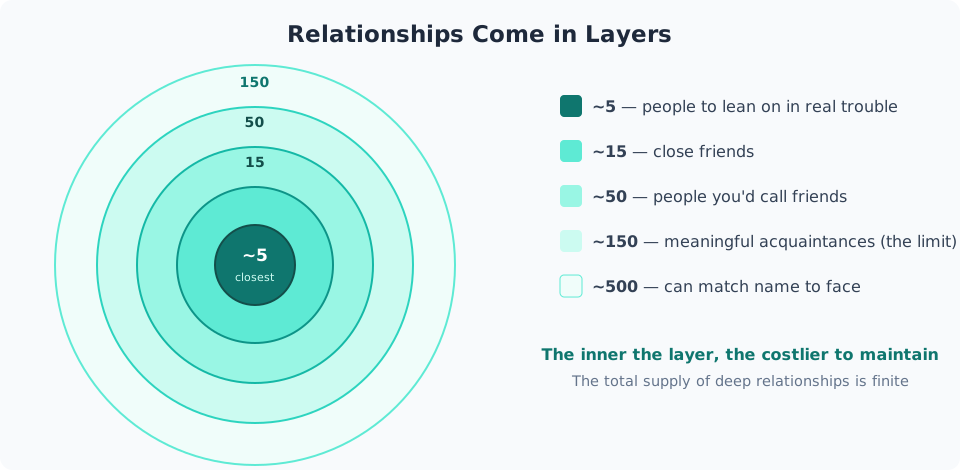
The commonly cited nesting: innermost, about 5 people you can lean on in real trouble; then about 15 close friends; then about 50 you’d call friends; then about 150 meaningful acquaintances. Beyond that: about 500 whose names and faces you can match, and about 1,500 faces you recognize.
The layers ring true against experience. The people you can truly open up to are a handful, and ties thin as you move outward. Moreover, inner layers cost more to maintain: keeping intimacy with five close friends takes real time and emotional bandwidth. Which is why growing close to someone new often quietly widens the distance to someone else. The total supply of relationship is finite. More than the number 150 itself, this layered view is, I think, the genuinely interesting heart of Dunbar’s number.
Dunbar’s Number in the Social Media Age
Dunbar’s number returned to the spotlight with the rise of social media, where friend and follower counts routinely reach thousands or tens of thousands. Has technology broken the ceiling?
The answer is almost certainly no. With ten thousand followers, could you pick up an easy, current conversation with each one after a year’s silence? Hardly. Social media brilliantly expanded the outer layers — the “I know the face and name” zone. But the brain’s capacity for maintaining inner, intimate ties appears unchanged. The number you can connect with grew; the ceiling on those you can be close to did not budge.
In practice, even with hundreds or thousands of connections, the people you actually exchange messages with and share your life with remain few. Dunbar himself, studying online networks, is reported to have concluded that the number of actively sustained relationships stays about what it was in the face-to-face era. Technology widened the doorway to connection — it did not add the capacity to grow intimacy on the other side. Our brains, then and now, can hold only about the same number of people close.
Since learning this, I have honestly lost interest in growing my count of acquaintances. Instead I want to spend my finite time and attention properly on the people in the inner layers. If relationships cannot be extended without limit, the only real question is where to invest. Dunbar’s number is practical wisdom for setting those priorities.
Common Questions About Dunbar’s Number
Is 150 an Exact Figure?
No — and honesty requires saying so. Dunbar’s number is a ballpark, and researchers quote ranges from roughly 100 to 250. In recent years, critical studies have argued that the evidence does not support pinning down any single crisp number. So “exactly 150 is the limit” is not accurate. What matters more than the precise value is the idea: the number of people you can know deeply has a brain-rooted, approximate ceiling. Take the number as a tendency, not gospel.
Is Maintaining Many Shallow Connections Pointless?
Not at all. The wide outer layers — acquaintances and loose ties — carry value of a different kind from intimacy. New information and unexpected opportunities famously arrive through “weak ties” more often than through close friends. Dunbar’s number does not say “abandon broad networks”; it says “know that deep ones are limited.” Understanding the distinct roles of the wide layer and the deep layer, and keeping both in balance, is what a rich social life looks like.
Can the Limit Be Expanded with Effort?
Not by much, it is believed. Dunbar’s number rests not on personality or sociability but on the information-processing capacity of the human brain — a biological foundation. Sociable people may carry somewhat larger outer layers, but nobody multiplies the inner circle indefinitely. The practical use of this law is the opposite of straining against the ceiling: precisely because capacity is finite, choose carefully who gets the deep investment. Knowing the limit is not resignation — it is the starting point for setting priorities.
Related Laws and Biases
See the “worker ant rule (the 2-6-2 law)” on role skew in groups, “in-group bias” on our tilt toward our own circle, and “Hanlon’s razor” on charitable readings of others’ behavior.
Summary
This article covered “Dunbar’s number.”
The ceiling on stable human relationships sits at roughly 150, a figure derived from the relationship between brain size and group size. And relationships stack in layers of intimacy — from the five closest to five hundred nodding acquaintances. Inner layers cost more to keep, and the total supply is finite. However large the follower count grows, the ceiling on genuine closeness barely moves.
Remember, though: 150 is an approximation, and its precision is debated. What matters is not the number but the posture it teaches: “deep connection is limited, so choose where your time and heart go.” Knowing you cannot extend relationships infinitely is not a sad fact — it is a gentle yardstick for treasuring the people right in front of you.
To return to the full list of laws, follow the link below.
Thank you for reading. We hope to see you in the next article.

Also popular with readers
📚 Series: Famous & Fascinating Laws (14/25)