
Thank you for visiting this site. This article covers a rule of thumb you can’t help nodding along to: “Sturgeon’s law.”
“Music these days is garbage.” “Comics are for children.” “Everything online is shallow.” The world overflows with criticism that dismisses entire genres as “worthless.” There exists a law that rebuts all of it in a single sentence: Sturgeon’s law — “ninety percent of everything is crap.” It sounds like an insult to everything; in fact it is a shield protecting every genre from unfair attack — a paradoxical, delightful law. Here are its origins and its uses.
What Is Sturgeon’s Law?
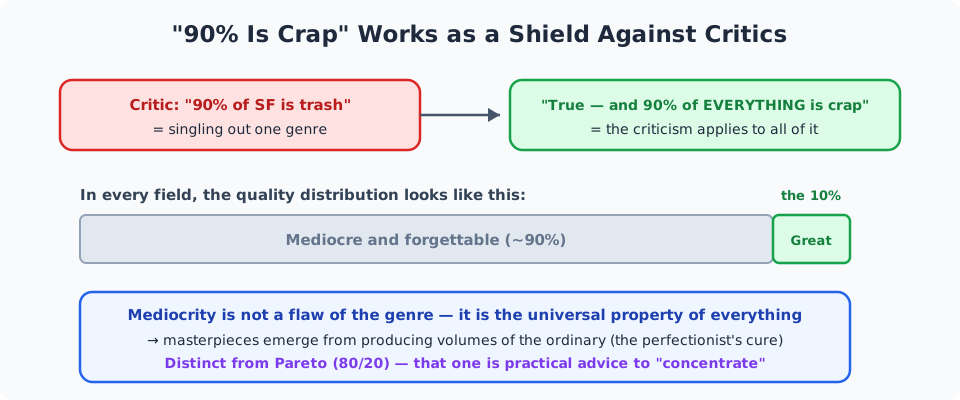
Sturgeon’s law is the rule of thumb that “ninety percent of everything is crap” — the original formulation being exactly that blunt.
The crucial point: this is not the pessimism of “therefore the world is terrible.” Quite the opposite. What the law asserts is: “since the bulk of every field is mediocre, the fact that 90% of some genre is crap is not a defect of that genre — it is a property common to absolutely everything.”
In other words, against the attack “most science fiction is garbage,” the law arms you with: “true — and most music, most literature, most film, and most cooking are garbage too. This is not a fact about science fiction.” Not denying the criticism but showing that it applies indiscriminately to everything, and thereby neutralizing it. That elegant maneuver is Sturgeon’s law at full power.
Born in Defense of Science Fiction
The origin is exactly what the name suggests. The American science fiction writer Theodore Sturgeon coined the line in the 1950s while defending the genre he loved.
At the time, science fiction was held in far lower esteem than today. Literary critics looked down on it — “childish, preposterous pulp” — and the jab “90% of SF is trash” was a commonplace.
Sturgeon’s reply: “Ninety percent of SF is crud — but then, ninety percent of everything is crud.” In literature, film, painting — the masterpieces that survive are a sliver, and the bulk is forgettable mediocrity. That is not a fact about SF; it is a fact about all human creation. He took the very weapon used to demean SF — “90% is trash” — and converted it into a lens that treats everything equally. The riposte was initially called “Sturgeon’s Revelation” and later spread as Sturgeon’s law.
I love this origin story. When something you cherish is unfairly trashed, don’t retaliate emotionally — reply from one level higher: “you realize that criticism applies to the entire world?” Wrapping the opponent in intellectual humor: it is a masterclass in how to live with criticism.
The Liberating Power of Admitting Mediocrity
Accept Sturgeon’s law and the world tilts slightly — toward the mind-lightening view that “mostly mediocre is neither shame nor defect.”
Say you create or publish things. When most of your posts go unread and most of your works draw no response, the thought creeps in: “maybe I have no talent.” But by Sturgeon’s law, even first-rank writers and artists produce mostly mediocre work. The great novelists wrote mountains of duds on the way to their handful of masterpieces. The rare masterpiece emerges precisely from the process of producing volumes of the ordinary. For anyone who keeps creating, this is enormous encouragement.
The same lens improves your relationship with information. Most content online is thin — true, but that is not the internet’s flaw; it is the universal property of every information source. Most television, most newspapers, most books are likewise negligible. So the move is never to wail “90% is crap” and discard the medium — it is to train the eye that finds the buried 10% of quality in every source. Sturgeon’s law doesn’t just neutralize critics; it teaches the posture of hunting value in the sea of the ordinary.
How It Differs from the Pareto Principle
The numbers may remind you of the “Pareto principle (the 80/20 rule)” — “80% of results come from 20% of causes.” Similar-sounding, but aimed at different targets.
Pareto is about skew in contribution and efficiency — a minority of causes producing the majority of results: top clients driving most revenue, a few tasks driving most outcomes. It is a tool for deciding where to concentrate effort in practical work.
Sturgeon’s law is about the distribution of quality — “most things are poor” — and its purpose is rebutting unfair criticism. The similar numbers (90%, 80%) invite confusion, but Pareto says “concentrate” (practical advice), while Sturgeon says “mediocrity is universal” (a critical stance). Different purposes, different arenas. When you meet a numbered law, ask “what was this law coined to accomplish?” and the confusion dissolves.
Common Questions About Sturgeon’s Law
Is It Really Exactly 90%?
No — the figure has no rigorous basis. Sturgeon’s 90% is a vivid way of saying “the vast majority,” not a measured statistic. It could be 95%, or 85%. The law’s essence is not the precise ratio but the qualitative insight: in every field, masterpieces are a sliver and mediocrity is the bulk. Take the idea — “mediocrity is universal” — and let the digits be decoration.
Can I Use It as an Excuse to Slack Off?
Careful there. “90% is crap anyway, so who cares” misses Sturgeon’s intent. What the law describes is the reality of creation: masterpieces emerge, rarely, out of the process of producing large amounts of ordinary work. Which means continuing to produce, unafraid of the 90%, is the only road that reaches the 10%. Read it not as permission to give up but as encouragement to keep making things without fearing the duds.
Doesn’t ‘My Work Is 90% Crap Too’ Hurt?
In my experience, it liberates. Straining to produce only masterpieces makes the first step so heavy that nothing gets made at all. But once you can think “most of it will be ordinary — the occasional good one is enough,” volume becomes easy. Even the professionals’ batting average is low; there is no reason to mourn each of your own duds. Permitting mediocrity is precisely what raises the probability of excellence — the law’s most practical paradox. For anyone suffering under perfectionism, Sturgeon’s law is strong medicine.
Related Laws and Biases
See “survivorship bias” (judging by the visible successes only), the “decoy effect” (the difficulty of judging quality), and “Murphy’s law” (another law born of wry field experience).



Summary
This article covered “Sturgeon’s law.”
The brutal-sounding “90% of everything is crap” turns out to be an astonishingly positive law: it shields what you love from unfair attack, dissolves the shame of widespread mediocrity, and grants the courage to keep producing without fear of duds. That a science fiction writer’s witty parry, fired in defense of his genre, still lightens hearts across the decades is a lovely piece of history.
When someone dismisses your whole genre as “worthless,” or when most of what you make falls flat — remember this law. The mediocrity is not a defect of your genre or of you; it is the ordinary property of everything in the world. Hold that, and both criticism and failure become far easier to face with a level gaze.
To return to the full list of laws, follow the link below.
Thank you for reading. We hope to see you in the next article.

Also popular with readers
📚 Series: Famous & Fascinating Laws (15/25)