Thank you for visiting this site. This article covers the internet era’s signature rule of thumb: “Godwin’s law.”
You have surely watched a disagreement grind on and on in a forum or on social media. And as the argument curdles, someone reliably says it: “that’s exactly how the Nazis thought,” “you sound like Hitler.” The phenomenon — “the longer an online argument runs, the more surely the Nazis appear” — was formulated as Godwin’s law. It looks like a joke about internet culture, but it is in fact a sharp, genuinely intellectual point about the danger of cheap analogies. Here is the full story.
What Is Godwin’s Law?
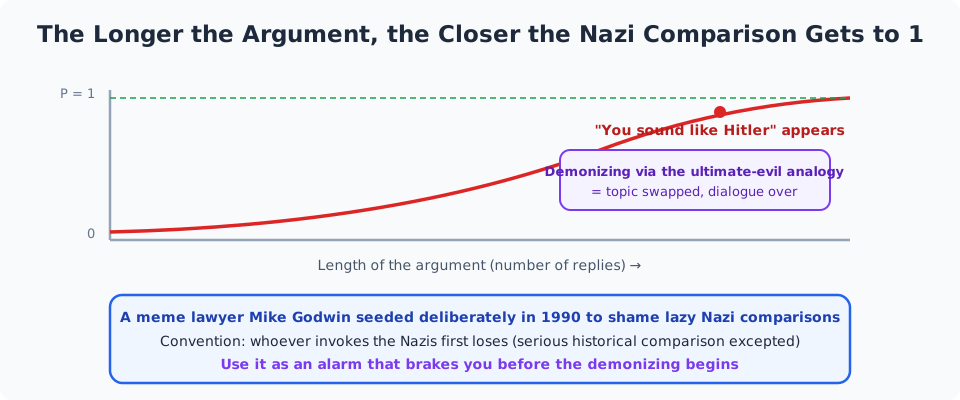
Godwin’s law is the rule of thumb that “as an online discussion grows longer, the probability of a comparison involving Nazis or Hitler approaches 1 (100%).”
Plainly: “keep an internet fight going long enough, and someone will eventually call someone else a Nazi.” Politics, hobbies, anything — however unrelated the original topic, once the argument heats up and stretches on, the Nazi comparison arrives. The law formalizes this eerily universal pattern.
Why Nazis? Because Nazis and Hitler are the most widely shared symbol of ultimate evil. When someone wants to condemn an opponent maximally, the shortcut is comparison to “the worst evil in history.” So as tempers rise, thousands of arguers independently converge on the same destination. Godwin’s law captures the short-circuit pattern of human thought under emotional load.
A Meme a Lawyer Spread on Purpose
Unlike most laws, Godwin’s law has a fully documented origin — who, when, and why. And the “why” is wonderful.
The author is the American attorney Mike Godwin. In 1990, when the internet still belonged to a small community, he had grown sick of how casually Nazis and the Holocaust were being thrown around as debate props on the bulletin boards of the day. A profound historical tragedy, cheapened into a rhetorical cudgel for petty squabbles — he considered it a real problem.
So Godwin ran a unique experiment. He coined the law himself — “as a discussion grows longer, the probability of a Nazi comparison approaches 1” — and deliberately seeded it across the internet. The goal: to equip everyone to point and say “ah, Godwin’s law!” the moment a lazy Nazi comparison appeared — building a mechanism for the crowd to gently ridicule cheap comparisons.
The experiment succeeded spectacularly as a meme. Godwin’s law spread everywhere and is now entrenched enough to appear in the Oxford English Dictionary. He took a serious concern — stop trivializing atrocity — and packaged it not as a sermon but as humor everyone could wield. A rare case of a law engineered for a purpose, working exactly as designed.
What’s Actually Wrong with Cheap Analogies?
Beneath Godwin’s law lies a deep question about how analogies should be used — a question at the heart of all debate.
Analogy itself is a powerful tool for making the complex clear. But an extreme analogy deployed purely to degrade an opponent doesn’t advance a debate — it demolishes it. The instant you brand your opponent “the same as the Nazis,” the exchange stops being a discussion and becomes a declaration that the other party is irredeemable evil beyond dialogue. Nothing can proceed from there.
Worse, the extreme analogy swaps out the original question. A debate over, say, a tax increase, once someone deploys “that’s like the Nazis,” mutates into “were the Nazis bad?” — a question nobody disputes. The actual topic — the tax — evaporates. This is kin to the classic logical fallacy of distorting an opponent’s position into a grotesque and attacking the grotesque.
And one more harm: casually invoking a historical tragedy dilutes its weight. If every minor disagreement is “literally the Nazis,” then when the true gravity of those crimes must be spoken of, the words have lost their force. This was precisely Godwin’s concern. Behind the humorous law stands a sincere respect for history.
The Convention: Whoever Says ‘Nazi’ First Loses
Godwin’s law spawned a wonderful derivative custom in internet culture:
“whoever first drags Nazis or Hitler into the argument is deemed, at that moment, to have lost it.” The lazy Nazi comparison gets read as “a declaration of defeat — out of actual arguments, reduced to demonizing the opponent.” Thanks to this convention, a deterrent operates in online debate: “reach carelessly for the Nazis and the joke lands on you.” Godwin’s original intent bore fruit in this form too.
One caution, though — and Godwin himself has said this explicitly in later years: not every Nazi comparison is illegitimate. Invoked seriously — as a lesson history genuinely teaches, or to flag genuinely parallel warning signs — the comparison can be entirely valid. What Godwin condemned was the empty, purely derogatory version, never the sincere historical argument. Crying “Godwin’s law!” must not itself become a tool for silencing serious warnings. Those of us who wield the law should keep that firmly in mind.
Questions About Godwin’s Law
Does It Apply Outside the English-Speaking Internet?
Yes, with local coloring. Godwin’s law taps the psychology of “comparing opponents to the ultimate symbol of evil,” and the symbol varies by culture. Where Nazis aren’t the default reference, heated arguments still converge on “whatever that community considers the worst evil” — the phenomenon is universal. When someone starts calling their opponent “a dictator” or “a cult,” Godwin’s law is operating in translation. Whatever the symbol, the skill is noticing: “this debate has begun sliding into demonization by analogy.”
Does Knowing This Law Make Me Better at Arguing?
I believe so — not in the sense of defeating people, but in the sense of detecting the moment a debate starts rolling downhill. When you or your opponent begin reaching for the extreme analogy, recognizing “we are entering the Godwin pattern” lets you step back and return to the actual question. The purpose of debate is not conquest but a better conclusion. Use the law as an alarm that brakes you before the mud-wrestling begins — that is its smartest application.
Are There Other Internet Laws Like This?
Plenty — internet culture is a treasury of such humorous rules. Cunningham’s law: “the fastest way to get a right answer is to post a wrong one (someone will be compelled to correct it).” Skitt’s law: “any post correcting an error in another post will contain at least one error itself.” Godwin’s law is the pioneer of the genre and its most successful specimen. Collect these laws and a portrait emerges of profoundly human behavior online — and it is very entertaining reading.
Related Laws and Biases
See “in-group bias” (our side as righteousness), the “bandwagon effect” (swept along by the majority), and “Sturgeon’s law” (another law with an ironic bite).
Summary
This article covered “Godwin’s law.”
What looks like a mere internet in-joke — long arguments always reach the Nazis — carries a serious double payload: the way cheap analogies destroy debate, and a rebuke of treating historical tragedy lightly. And its author spread it not as a sermon but as a meme — a strategy that worked to perfection. Rare is the law whose content and origin story are equally good.
Next time an online argument overheats and the extreme analogies start flying, whisper to yourself: “ah — Godwin’s law.” And when you feel yourself about to be the one who reaches for it, apply the quiet brake. This law is a small piece of wisdom for making the frequently savage internet just a little calmer and kinder.
To return to the full list of laws, follow the link below.
Thank you for reading. We hope to see you in the next article.
Also popular with readers
📚 Series: Famous & Fascinating Laws (16/25)