Thank you for visiting this site. This article covers a delightful rule of thumb about internet psychology: “Cunningham’s law.”
When you want to know something online, asking politely — “could someone explain X?” — often gets you silence. But post, with total confidence, something wrong — “X works like this, right?” — and experts materialize instantly: “no, that’s wrong. Actually…” Cunningham’s law names this strange phenomenon: “the best way to get the right answer on the internet is not to ask a question — it’s to post the wrong answer.” A slightly sneaky, thoroughly entertaining law about how people actually work.
What Is Cunningham’s Law?
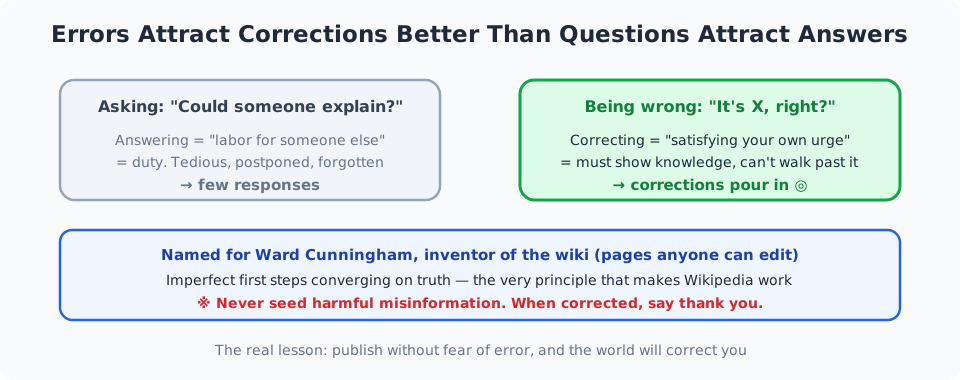
Cunningham’s law is the rule of thumb that “the best way to get the right answer on the internet is not to ask a question, but to post the wrong answer.”
It sounds backwards. If you want an answer, asking is the honest route. Yet on the real internet, polite questions get ignored while confident errors attract corrections at ferocious speed. The law skewers this asymmetry precisely.
Why does it happen? The key: “answering a question” and “correcting an error” trigger completely different machinery in the mind. Answering a question is a mildly tedious kindness performed for someone else — skip it and nobody suffers. But a boldly displayed error changes everything. To someone knowledgeable, it becomes a thing that cannot be left standing. “I know this and I cannot stay silent.” “I cannot walk past a mistake.” Cunningham’s law is a life hack built on judo-flipping that irrepressible human urge.
Named for the Man Who Made Wikipedia Possible
The law’s name comes from Ward Cunningham, an engineer responsible for one of the internet’s landmark inventions.
Cunningham created the “wiki” — a then-revolutionary system where anyone can edit any page. That mechanism later became the foundation of Wikipedia, the largest encyclopedia in history. Cunningham, in other words, is one of the architects of the modern internet’s collaborative culture: “everyone fixing each other’s mistakes, little by little, until the information is good.”
The naming is deliciously apt. “Post an error and corrections will come” is precisely the principle by which Wikipedia functions. Someone writes something imperfect; someone else improves it; a third person improves it further. The imperfect first step is what lets the collective converge on correctness. Fitting, then, that the law carrying this collaborative spirit bears the wiki inventor’s name. The kicker, entirely worthy of the law itself: the phrase was popularized by someone else, and Cunningham himself has said he cannot reliably remember ever saying it.
Why Can’t We Resist Correcting?
Several fascinating psychological gears turn behind Cunningham’s law. Why does a visible error make us itch?
First, the desire to display knowledge. Answering a question is service to another; correcting an error is self-expression — “I know this correctly.” Given a chance to demonstrate competence, people move. Second, the sense of justice about misinformation: especially online, letting a falsehood stand and spread feels intolerable. Third, errors are simply conspicuous. Correct information slides by; a blatant mistake snags the brain and won’t let go.
This psychology harmonizes with other laws on this site. “Godwin’s law” — where heated internet arguments escalate to extreme comparisons — likewise runs on the online compulsions of “must win” and “can’t stay silent.” Cunningham’s law taps the same truth: online, people are far less able to not-react than they believe. Its cleverness lies in converting the urge-to-correct into an engine for extracting knowledge.
Etiquette and Warnings
Cunningham’s law is a handy trick, but misused, it wastes others’ goodwill and burns your credibility. Know the ground rules.
First, keep the self-awareness that deliberately being wrong to farm corrections is, at bottom, a little unfair. Your correctors are spending genuine goodwill and effort. Knowing you baited them on purpose should keep you grateful. Second, seeding harmful misinformation is completely off the table. In medicine, safety, law — domains where a false claim can hurt someone before the correction lands — never use this technique. Third, when corrected, accept it gracefully and say thanks. Start defending the error and you become, simply, “a person who insists on being wrong.”
The best use of this law, I believe, is not deliberate error at all, but the encouragement it offers: “speak your understanding out loud without fearing mistakes.” You don’t need the perfect question. Post “here’s my understanding — is this right?” in all its imperfection, and the knowledgeable will fill the gaps. Airing your errors and having them fixed beats silent perfectionism as a way to get smart, every time. That is the collaborative spirit Wikipedia embodied — and the essence of learning itself.
Questions About Cunningham’s Law
Why Do Errors Outperform Polite Questions?
Because answering a question is “labor for someone else,” while correcting an error is “satisfying your own urge.” Desire moves people harder than obligation. A question generates the dutiful feeling of “I suppose I should answer” — easily deferred, easily forgotten. An error triggers the internal itch — “must fix,” “must demonstrate” — and itch converts to action. To extract the same information, stimulating desire beats appealing to duty — a wonderfully wry corner of human psychology.
Does the Law Still Apply in the Age of AI?
With humans, absolutely — forums and social feeds still fill with corrections under every confident error. With AI, the trick is unnecessary: the model answers questions without resentment, so there is nothing to bait. The more interesting point: the underlying psychology — humans respond to errors more readily than to questions — is untouched by AI. However far the technology advances, wherever humans gather, the deeply human laws keep operating. Cunningham’s law is a standing reminder.
What About When I’m the One Itching to Correct?
An excellent angle. Knowing Cunningham’s law lets you catch yourself mid-itch — “I am currently being baited by an error.” That awareness is valuable. If your correction is a genuine kindness to the other person, deliver it politely. But if the impulse contains “I want to win” or “I want to display my brilliance,” one breath of pause is worth taking. The correcting urge can be goodwill or self-display. Learn to tell which is driving, and your online conduct gets calmer and more constructive. The law serves not only for nudging others — it serves for auditing yourself.
Related Laws and Biases
See “Godwin’s law” (another law of internet psychology), the “Dunning-Kruger effect” (overconfidence in one’s knowledge), and “confirmation bias” (why admitting error is hard).
Summary
This article covered “Cunningham’s law.”
The seemingly flippant rule — “want the right answer? Don’t ask; be wrong” — turns out to rest on a sharp psychological truth: people won’t answer questions, but they cannot leave an error standing. And the name honors the inventor of the wiki, the culture of collectively correcting one another — symbolizing the internet at its best: imperfect first steps converging, together, on truth.
Deliberate wrongness is a trick to use with manners. But the law’s deepest value is the learning posture it endorses: “publish without fear of error, and the world will correct you.” Speaking imperfectly beats waiting silently for perfection. That may be the unexpected shortcut to getting smarter in the internet age.
To return to the full list of laws, follow the link below.
Thank you for reading. We hope to see you in the next article.
Also popular with readers
📚 Series: Famous & Fascinating Laws (17/25)