Thank you for visiting this site. This article covers a law that skewers communication in the internet age: “Poe’s law.”
You have seen it happen online: a post plainly meant as a joke gets taken dead seriously and ignites a pile-on — or the reverse, a sincere statement gets waved off with “obviously satire.” Poe’s law names the phenomenon: “without a clear marker, a parody of an extreme view is indistinguishable from a sincere expression of it.” Born on an internet forum, the law lands harder than ever in the age of social media. Let’s lay out what it says.
What Is Poe’s Law?
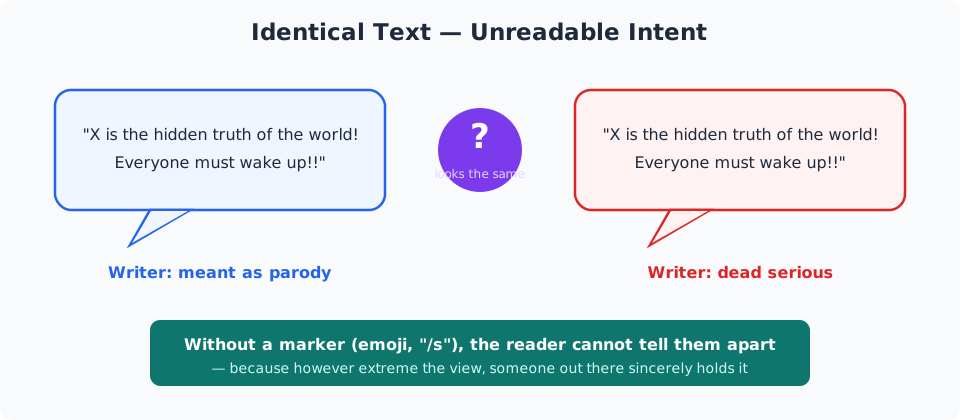
Poe’s law is the rule of thumb that “without an unmistakable signal of humor — a winking emoji, an explicit tag — a parody mocking an extreme position cannot be told apart from a genuine statement of that position.”
The law is said to have been born in 2005, mid-argument on an internet forum. During a debate over extreme claims, a poster named Nathan Poe observed, in essence: “without a blatant display of humor, it is impossible to parody an extreme view in a way that someone won’t mistake for the real thing.” The remark was later canonized as “Poe’s law.”
The crucial point: it cuts both ways. Jokes get read as sincerity, and sincerity gets read as jokes. Around extreme opinions, the writer’s true intent simply fails to reach the reader. This “undecidability of intent” — the signature failure mode of online communication — is what Poe’s law captures.
Why Doesn’t Intent Get Through?
Why is intent so fragile online? Because text-only communication is stripped of most of its cues.
Face to face, we receive floods of information beyond the words: tone, expression, gesture, the mood of the room. The signal “I’m kidding” usually rides on exactly these nonverbal channels. As the Mehrabian rule article showed, when words and demeanor conflict, people read the truth from the demeanor. In text-only exchanges, the entire demeanor channel is missing.
Add one heavier fact: on the internet, someone genuinely holds every opinion, however extreme. So the commonsense filter — “surely nobody means this” — stops working. However absurd the claim, real people sincerely assert it somewhere — so parody and sincerity become impossible to separate in principle. Thin text plus the full breadth of human opinion: those two together produce Poe’s law.
And the indistinguishability wobbles further with the reader’s own stance. The same post reads as “obviously a bit” to someone amused, and “they mean it” to someone offended by the view. With the writer’s intent and the reader’s guard both in play, the judgment gets even harder. Which is why the writer’s assumption — “everyone will obviously see this is a joke” — gets betrayed online so regularly. Your self-evident joke is someone else’s sincere outrage. Poe’s law measures that gap.
What Emojis and “/s” Actually Do
Here is the delightful flip side: Poe’s law also says that with a marker, the distinction survives. Attach an unambiguous humor signal, and the misread is preventable.
Our online habits — “lol,” “/s,” winking emojis, “(joking)” — do exactly this work. They restore, in symbol form, the “this is a bit” demeanor information that text destroys. What a face does in person, a marker does online.
Seen this way, those little symbols carry surprising weight. Remove the marker from irony, and it instantly becomes indistinguishable from sincerity. My own rule online: the more divisive the joke, the more explicit the marker. Flagging in advance beats apologizing afterward, every time. Poe’s law doubles as etiquette advice.
Fittingly, the law itself was born from exactly such a misreading. In a long-running argument on a contentious topic, posts mocking an extreme position kept being mistaken for the real thing, until the observation crystallized: without a blatant marker, parody cannot be told from belief. Knowing it emerged from a text-only forum makes the emphasis on markers click completely.
The Connection to Pile-Ons and Misinformation
Poe’s law is not just a comedy of manners — it plugs directly into the serious problems of pile-ons and misinformation.
An extreme post written as a bit, circulating without its marker, gets read as sincere by strangers — and their anger becomes a pile-on. The author protests “it was a joke,” but the readers had no clue available to know that. By Poe’s law, the outcome was predictable.
The reverse danger is quieter: a genuinely dangerous, sincere post gets waved off — “surely satire” — while it steadily accumulates true believers. The ambiguity of “bit or belief?” can itself be weaponized — extremism dressed in irony’s plausible deniability. Which is why, encountering charged content online, the wise posture is: don’t snap-classify it as joke or sincerity; verify before reacting. Knowing Poe’s law is a real defense against these traps.
Common Questions About Poe’s Law
Does This Apply to All Opinions?
No — the law bites specifically on extreme opinions. Moderate, commonsense claims transmit their sincerity well enough even when clumsily written. The trouble starts with content too radical to believe anyone means it — because no matter how absurd, someone somewhere genuinely does. The more extreme the content and the fewer the markers, the harder Poe’s law bites. Milder content, milder risk.
Is This Related to the Mehrabian Rule?
Deeply. The Mehrabian rule showed that when words and demeanor conflict, people read truth from the demeanor — the face and the voice. Poe’s law happens precisely because online text deletes the demeanor channel. The “just kidding” that a face conveys in person simply ceases to exist in plain text — hence undecidable intent. Emojis and “/s” are prosthetic demeanor — and viewed that way, the two laws snap together into one picture.
How Do I Live with This Law?
One practice for each direction. When posting: give any misreadable joke or irony an explicit marker (emoji, “/s”, “(joking)”). Skipping the marker to preserve the aesthetic invites the misfire. When reading: suspend the verdict — don’t instantly classify bit versus belief. Especially for posts engineered to enrage, one breath before reacting is wisdom. The intent behind the screen is far less legible than it feels. Just internalizing that fact eliminates a remarkable share of pointless collisions.
Related Laws
See the “Mehrabian rule” (words versus demeanor), “Godwin’s law” (the derailment of online arguments), and “Hanlon’s razor” (don’t default to assuming malice).
Summary
This article covered “Poe’s law.”
Without a clear marker, a parody of an extreme view cannot be told from the sincere article. Born on a forum, the law cuts deepest in the social media era: text-only exchange deletes the vocal and facial signals of “just kidding,” and since every extreme view has genuine believers somewhere, intent becomes undecidable.
Hence the outsized importance of the humble markers — emojis, “/s”, “(joking).” Mark what could be misread when you write; suspend the bit-or-belief verdict when you read. The intent across the screen is never as legible as it feels. Poe’s law is a small, reliable piece of equipment for navigating the internet without being swept into pile-ons or fooled by irony-cloaked extremism.
To return to the full list of laws, follow the link below.
Thank you for reading. We hope to see you in the next article.
Also popular with readers
📚 Series: Famous & Fascinating Laws (18/25)