Thank you for visiting this site. This article covers the psychology rule that is famous and misunderstood in equal measure: “the Mehrabian rule.”
“Communication is 93% nonverbal.” “Only 7% of your message is the words.” This law is the usual citation behind such phrases — also known as the “7-38-55 rule”: words 7%, tone of voice 38%, appearance 55%. What few people know is that these numbers spread with a meaning utterly different from the original experiment. This article traces what the research actually showed. Clear away the misunderstanding, and the law’s real value comes into focus.
What Is the Mehrabian Rule?
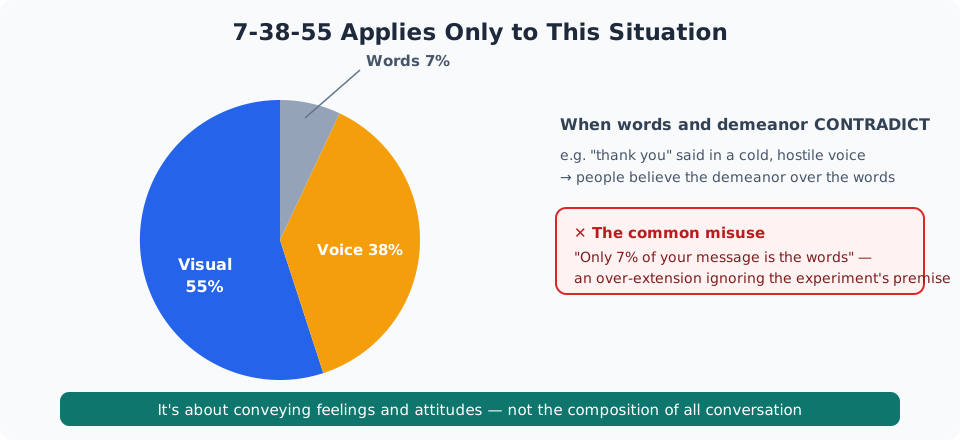
The Mehrabian rule is based on experiments run in the 1960s by the American psychologist Albert Mehrabian. The popular version quotes these figures:
| Channel | Share |
|---|---|
| The words themselves (content) | 7% |
| Tone of voice, delivery | 38% |
| Facial expression, appearance (visual) | 55% |
Since voice and visuals total 93%, the numbers have been endlessly cited in business books and presentation seminars as proof that “communication is decided almost entirely by look and delivery, not words.”
That interpretation is the textbook misuse. Mehrabian himself has explicitly rejected this popularization. So what did the original experiments actually study?
What the Original Experiments Really Showed
Mehrabian’s experiments concerned not everyday conversation but one narrow, special situation: when the meaning of the words and the tone or expression contradict each other — which does the listener believe?
Imagine being told “thank you” in a cold, irritated voice. The words are gratitude; the tone is barbed. Is the person grateful or angry — and what do we judge by? Mehrabian’s results showed that in such contradictory situations, people tend to trust tone and expression over the words. The relative weights in those judgments came out roughly 7 : 38 : 55.
So what the numbers describe is “when words and demeanor conflict, which impression wins” — an extremely narrow question. Moreover, the experiments dealt only with the communication of feelings and attitudes — liking and disliking. They measured nothing about substantive information exchange — giving directions, explaining facts, anything of the kind.
To add detail: the experiments used stimuli deliberately constructed so that words, tone, and expression conflicted — say, warm words delivered with a cold face, combinations rare in real life. Receivers judged the speaker’s feelings, and the conclusion was that under contradiction, face and voice outweighed words. An experiment about “the weighting of conflicting cues,” never about what percentage of ordinary conversation travels through which channel. Miss that distinction, and you end up asserting something else entirely.
Why “Content Is Only 7%” Is Wrong
This section is the heart of the article. “Words convey only 7% of the message” is an over-extension that ignores the experiment’s premises.
A moment’s thought exposes the absurdity. If words truly carried only 7% of information, telephones and radio would be useless, and reading this article would communicate less than a tenth of its content. Obviously not so. We exchange intricate, precise information through words alone every day. Words are the lead actor of information transfer.
Mehrabian himself has repeatedly warned against this misuse of his figures. What he measured was how feelings are read when words and demeanor conflict. Recasting that as “the composition of all communication” is a different claim altogether. The more famous the number, the more easily it gets clipped into a catchy shape and sent off to live its own life. The Mehrabian rule is the canonical case.
What the Law Genuinely Teaches
Strip away the misuse — does anything of value remain? Absolutely. In fact, the correct reading is far more useful.
What the original experiments established: “when words and demeanor disagree, people take the demeanor as the truth.” That insight matters enormously in human relationships. Say “it’s fine, really, don’t worry” with a stiff face, and the resentment transmits anyway. Conversely, words of thanks or encouragement land only when carried by a matching voice and expression.
Picture thanking a team member. Eyes on your monitor, voice flat — “thanks for the hard work” — and no appreciation arrives; what arrives is “they don’t actually care.” The same sentence with eye contact and warmth in the voice stays with the person all day. Identical words; the accompanying demeanor decides what is actually communicated. That is Mehrabian’s finding as it appears in real life.
Since learning this, I try to align words and demeanor when something matters. Not forced smiles — just holding onto the plain fact that “when what you say and what leaks out of you disagree, people notice instantly.” Freed from the tyranny of the numbers, the Mehrabian rule becomes a fine tool teaching the importance of matching words to feeling.
Common Misunderstandings About the Mehrabian Rule
So Appearance and First Impressions Don’t Matter?
They matter — the error is citing “55% per Mehrabian” as the reason. The importance of appearance is solidly explained by other psychology — notably the halo effect (a good look inflating judgments of competence), covered on this site. The claim “looks matter” is true; the theory being cited for it is wrong. Just avoid wielding Mehrabian’s numbers as a universal warrant, and you’re fine.
Should I Still Focus on Delivery in Presentations and Interviews?
Yes — but not because “words are only 7%.” Interviews and presentations are precisely the situations where feelings and attitudes — enthusiasm, trustworthiness — are being judged, so alignment between the words and the voice and face carrying them counts double. Say “I’m passionate about this” in a defeated voice, and the listener believes the voice. Hence: substantive content, delivered in a manner worthy of it. Never “content is 7%, so skimp on it.”
Why Did the Misreading Spread So Far?
Because the numbers were simple, surprising, and commercially convenient. “It’s all about appearance,” “delivery is everything” — irresistible messaging for image consultants and communication seminars. Attach the concrete-sounding “7-38-55” and it looks scientifically certified. As with Heinrich’s ratios, catchy numbers detach from their context and roam free. The more famous the law, the more worthwhile the trip back to the original source. The Mehrabian rule is the perfect object lesson.
Related Laws and Biases
See the “halo effect” (looks distorting evaluations — the correct citation for “appearance matters”), “Heinrich’s law” (another famously over-quoted ratio), and “Hanlon’s razor” (charitable readings of behavior).
Summary
This article covered “the Mehrabian rule.”
The famous 7-38-55 does not mean “only 7% of your message is the words.” The original experiments examined one narrow question about feelings: when words and demeanor contradict, which do people believe? The researcher himself condemns the popular misuse — few laws have been bent so far in transit.
Read correctly, though, a valuable lesson survives: “when words and feeling don’t match, people believe the feeling.” When it matters most, align the two. Refusing to be dazzled by a runaway number, and receiving the law’s actual content — that is the wisest relationship to have with this famous rule.
To return to the full list of laws, follow the link below.
Thank you for reading. We hope to see you in the next article.

Also popular with readers
📚 Series: Famous & Fascinating Laws (12/25)