Thank you for visiting this site. This article covers the most famous law in safety management: “Heinrich’s law.”
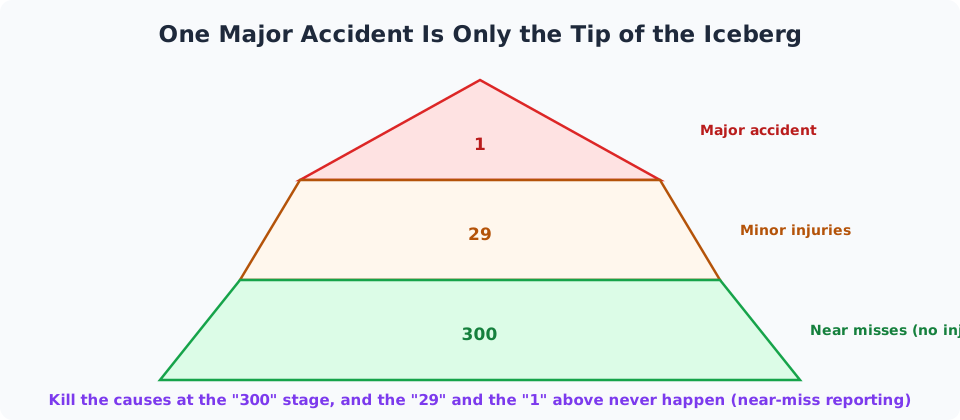
Everyone has experienced a near miss — the moment something almost became an accident. A stumble caught on the stairs, a car darting from a blind spot, the wrong file nearly attached to the email. Heinrich’s law teaches that these small “close calls” must never be shrugged off: “behind 1 major accident hide 29 minor injuries and 300 harmless near misses.” The ratio 1 : 29 : 300 expresses the essence of risk management — major accidents do not strike out of nowhere; they are merely the peak of countless small warnings.
What Is Heinrich’s Law?
Heinrich’s law is the rule of thumb that “behind every major workplace injury lie 29 minor injuries — and behind those, 300 no-injury near misses.” From the ratio it is also called the “1:29:300 rule” or “Heinrich’s accident triangle.”
Its author was Herbert William Heinrich, an engineer at an American insurance company. Around 1930, analyzing enormous volumes of industrial accident records for his insurance work, he noticed a regularity: a consistent ratio between severe injuries, minor injuries, and no-injury incidents.
What matters is the message the law carries: “the one major accident was not random bad luck. Beneath it, piled high, are masses of small near misses born from the same cause.” Put differently, the major accident is the tip of an iceberg, with countless warnings hidden below the waterline. So — intervene at the level of the 300 near misses, and you prevent the 1 catastrophe above them. This is why safety management has treasured Heinrich’s law for over ninety years.
The Origin of Near-Miss Reporting
Heinrich’s law’s greatest practical legacy is the concept of “near-miss reporting” — the safety practice used across manufacturing, medicine, and transport worldwide. Its theoretical foundation is this law.
Near-miss reporting means each person on the ground reports and shares the dangerous moments that hurt no one — the “that was close” incidents. The aim: collect and analyze information at the “300” stage, remove the causes, and thereby prevent the “29” injuries and the “1” catastrophe before they occur.
The revolutionary move here is finding value in events where nothing happened. Normally we respond only after an accident occurs — a reaction that arrives after the casualties. Heinrich’s law taught that “the near miss that ended harmlessly is the most precious information source for preventing harm.” The root is shared with Murphy’s law’s safety doctrine — “whatever can fail will fail, so prepare in advance.” Don’t fix after the disaster; prune at the stage of small omens. This philosophy of prevention has saved a great many lives.
The Three Layers Share One Root
One more essential insight: the layers of 1:29:300 are not unrelated events — most grow from the same cause.
Suppose a factory floor has “spilled oil making the floor slippery.” From this single cause, most people merely skid and gasp (the 300). Occasionally someone actually falls and takes a minor injury (the 29). And rarely — landing badly, in a bad spot — a fall becomes a grave injury or a death (the 1). The same “spilled oil” branches into a near miss, a bruise, or a catastrophe purely by luck.
The takeaway: to prevent the catastrophe, don’t chase catastrophes — eliminate the dangerous conditions and behaviors at the root. Rather than treating the badly injured one by one, a rule that gets spills wiped up immediately prevents every branch of the tree at once. Heinrich himself analyzed that most accidents arise from unsafe acts and unsafe conditions — and that the majority are removable. Refuse to file accidents under “luck”; look for the common cause underneath. That is the law’s practical core.
The Honesty Clause: Don’t Worship the Numbers
An honest caveat this law deserves: the specific figures 1:29:300 should not be taken too literally.
Heinrich derived the ratio from data of a particular era and particular industries, around 1930. It does not transfer exactly to every modern workplace. Ratios differ by industry, and later researchers have raised legitimate questions about how the original data was collected and analyzed. Subsequent studies proposed revised ratios such as 1:10:30:600.
But the shakiness of the digits does not diminish the law’s essential value one bit. What matters is not the precise arithmetic but the qualitative insight: “behind every major accident hide small warnings numbering tens or hundreds of times more.” Hold onto the “iceberg” picture, and you stop ignoring the daily close calls. Don’t memorize the law as a numerical incantation — absorb the philosophy of prevention behind it. That, I believe, is the wise way to treat every empirical rule.
Common Questions About Heinrich’s Law
Is It Useful Outside of Work?
Extremely. The law’s essence is “don’t overlook small omens,” which applies almost everywhere. In health, the major illness (the 1) is usually preceded by minor complaints (the 29) and vague unease (the 300). In relationships, the big rupture follows countless small frictions. In work, the major blunder is preceded by repeated near-slips nobody recorded. The habit of “pausing at the stage of small wrongness” heads off large trouble in every domain.
How Do You Get People to Actually Report Near Misses?
A crucial question of management. A near miss often reads as “a confession of my own mistake,” so in a workplace where reporting invites scolding, nobody reports — and the precious “300” data never accumulates. What works is building a culture where the near-miss report is welcomed as “valuable information that protects everyone,” never as ammunition for blame. Don’t punish the reporter — praise them: “good catch, thank you for sharing.” As Hanlon’s razor teaches, treating mistakes as systems problems rather than personal failings is the foundation of a safe organization.
Why Do We Dismiss Small Close Calls?
Human psychology. The near miss that ended fine is quickly forgotten and lightly filed, because “it worked out.” Here operates “normalcy bias” — the tendency to assume “I’ll be fine” even as danger approaches. “It was just a close call this time; next time will be fine too” — and the fix is postponed. Heinrich’s law answers that complacency with the warning: “that close call was, with some probability, the catastrophe — you just drew a lucky number.” Whether you can receive today’s luck as a gift of information for tomorrow — that is what separates the people who prevent accidents from the people who have them.
Related Laws and Biases
See “Murphy’s law” (the sibling safety doctrine), “normalcy bias” (underestimating approaching danger), and “Hanlon’s razor” (fix systems, not people).


Summary
This article covered “Heinrich’s law.”
Behind one major accident hide 29 minor injuries and 300 harmless near misses. The ratio 1:29:300 teaches the truth that catastrophe is not sudden misfortune but the summit of countless small warnings. The exact numbers are debatable — the philosophy is not: act at the stage of small signs, and the great disaster never arrives. Ninety years on, it has not aged.
Someone who knows this law receives each small “close call” not as an annoyance but as “a free warning that prevents a catastrophe.” Next time something makes you flinch, before laughing it off, think once: “the same thing, next time, could be the big one.” That small habit will someday protect you — or someone near you.
To return to the full list of laws, follow the link below.
Thank you for reading. We hope to see you in the next article.

Also popular with readers
📚 Series: Famous & Fascinating Laws (5/25)