Thank you for visiting this site. This article covers a law that makes everyone who works in an organization nod along: “the Peter principle.”
“Why is my boss so incompetent?” Anyone with an office job has thought it at least once. There is a law arguing that the “flood of incompetent managers” is not a matter of individual failings but a structural inevitability produced by the promotion system itself. That law is the Peter principle: “in a hierarchy, every employee tends to rise to their level of incompetence.” A little cruel — but once you know it, organizations never look the same.
What Is the Peter Principle?
The Peter principle is the rule of thumb that “in a merit-based hierarchy, every employee rises to the level at which they become incompetent.” American educator Laurence J. Peter proposed it in a 1969 book co-written with author Raymond Hull, which became a worldwide bestseller.
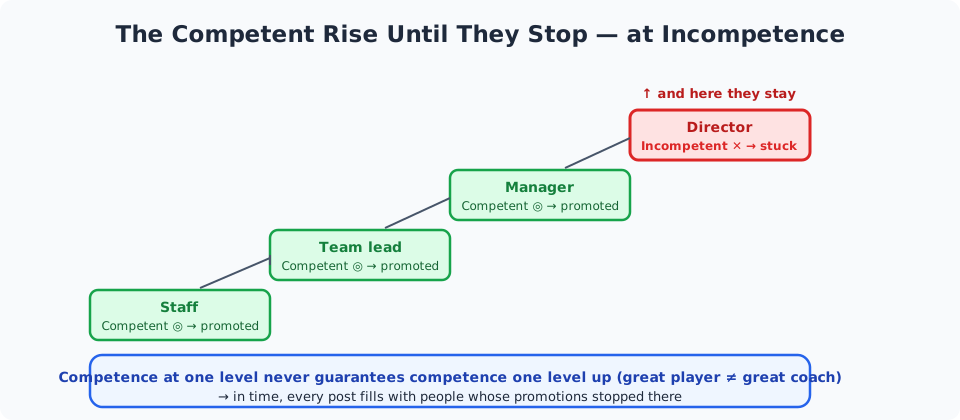
Walk through the logic. Competent people who deliver results get promoted. Perform well in the new post, and you get promoted again. Repeat, and what happens? Promotion stops precisely when the person reaches a post they can no longer perform well. Which means everyone eventually settles into “the position one step above their ability.”
Extend the logic across the whole organization and a chilling conclusion drops out: over time, every post fills with people whose promotions stopped there — that is, people who stopped being competent there. Peter put it with maximum irony: “in time, every post tends to be occupied by an employee who is incompetent to carry out its duties.” If your boss looks incompetent, it may not be a character flaw — it may be that this is exactly the spot where their promotions stopped, and there they remain.
Great Players Rarely Make Great Managers
The heart of the Peter principle is a single point: competence at one level and competence one level up are entirely different abilities.
Sports make it obvious. As the saying goes, great players seldom become great coaches. What a player needs is mastery of their own performance. What a coach needs is a wholly different skill set — developing others, unifying a team, building strategy. Appoint someone manager because they were a brilliant player, and nothing guarantees the second skill set comes along.
The same happens in every workplace. A star salesperson does not necessarily make a good sales director. The star needs the ability to sell; the director needs the ability to make others sell, to manage numbers, to move a team. Yet organizations promote on the logic of “they had the best numbers.” The result: the organization loses one excellent player and gains one struggling manager. Mastery of the craft and mastery of leading people are different things — an obvious fact our promotion systems routinely ignore.
The Dilbert Principle: The Incompetent Get Promoted First
The Peter principle has an even more sardonic descendant: the “Dilbert principle,” proposed by Scott Adams, creator of the satirical comic strip Dilbert.
The Dilbert principle gives the screw one more turn: “companies systematically promote their least competent employees to the place where they can do the least damage — management.” Where Peter’s version says “the competent rise until they turn incompetent,” Dilbert’s says “the people who can’t function on the front line get pushed upward to minimize the harm” — a considerably darker reading.
Someone who causes losses when allowed near products or customers is safest “quarantined” in a conference room, away from real work. This is, of course, savage satire channeling workers’ frustrations rather than a scientifically validated law. Its horror lies in how many people mutter “…now that you mention it.” Put the Peter and Dilbert principles side by side, and the existence of incompetent bosses gets explained from both directions — the climb and the sideways shove.
What Organizations and Individuals Can Do
Is there an escape from the Peter principle? There are moves on both the organizational and the personal side.
The most effective organizational fix is “more than one ladder.” In many organizations the only route upward is “become a manager.” So excellent players must become managers to raise their pay and standing — and turn incompetent there. The prevention is the professional track (the “IC ladder”): a parallel route where a specialist keeps rising in recognition, pay, and rank without ever taking a management post. Tech companies that maintain dual career paths — management and individual-contributor — are applying exactly this fix, sparing their best engineers and sellers from being stuffed into unfamiliar management roles.
The personal fix is simpler: when the promotion offer arrives, stop and ask whether you can genuinely thrive in that post. Promotions are flattering and hard to refuse. But whether giving up work you love and excel at, for management duties you may not, actually makes you happier deserves one serious think. People who know the Peter principle are free of the assumption that “promotion = the right answer.” In my own experience, rising in rank and feeling effective-and-satisfied do not necessarily coincide. Perhaps the greatest practical payoff of this law is the realization that up is not the only direction a career can go.
Questions About the Peter Principle
Do Organizations Really Fill Up Entirely with the Incompetent?
Push the theory to its limit and yes — but reality applies several brakes. People who plateau get demoted, change jobs, retire — or grow into the new role and become competent after all. The Peter principle is a sharp identification of a pressure — promotion systems tend to park people at posts they can’t perform — not a deterministic prophecy that every organization must drown in incompetence. Knowing the tendency lets organizations build counter-mechanisms. Read the law as a warning that enables fixes, not as a curse.
Won’t Declining a Promotion Hurt My Career?
A realistic worry. But work styles and values have diversified, and careers that don’t aim at management are increasingly respected; more companies now maintain the professional ladder described above. What matters is deciding “promotion or not” by your own aptitude and preferred way of working — not by others’ expectations or appearances. And some people genuinely bloom after promotion, so blanket refusal is not the answer either. What the Peter principle offers is the pause: don’t stamp “unconditionally good” on a promotion before thinking it through. Accept or decline — but do it deliberately.
How Should I Deal with a Boss Who Hit Their Ceiling?
Here the site’s article on “Hanlon’s razor” earns its keep. The boss who looks incompetent is probably not clinging to the post out of malice — they simply got placed one step above their limit. Framed that way, the urge to blame the individual softens. More productively: respect the domain where they used to excel (the work that earned the promotion), and let the team quietly compensate for the management gaps. Structural problems are almost never solved by attacking individuals.
Related Laws and Biases
See “Parkinson’s law” (organizational bloat from the same era), “Hanlon’s razor” (don’t attribute to malice what incompetence explains), and the “Dunning-Kruger effect” (the least able overrate themselves most).
Summary
This article covered “the Peter principle.”
The flood of incompetent bosses is not a parade of bad character — it is the structural product of a system that keeps promoting competent people until they stop being competent. Just as great players rarely make great managers, excellence at one level guarantees nothing about the level above. Our promotion systems ignore this obvious fact to an astonishing degree.
The greatest value in knowing this law, I think, is the realization that “up is not the only right answer.” Shining in the place where your abilities actually apply is a career to be proud of. When the promotion offer comes — or when the boss’s incompetence is grinding you down — recall this principle, and both the organization and your own path will come into calmer focus.
To return to the full list of laws, follow the link below.
Thank you for reading. We hope to see you in the next article.

Also popular with readers
📚 Series: Famous & Fascinating Laws (4/25)