Thank you for visiting this site. This article covers the classic maxim of productivity: “Parkinson’s law.”
Did you ever leave summer homework untouched until the very last day? Whether you have a month or three days, the work somehow takes exactly until the deadline. Parkinson’s law nails this universally familiar phenomenon: “work expands so as to fill the time available for its completion.” It looks like a self-deprecating joke — but the law began as something less funny: an analysis of a British government office where the number of officials kept growing with no relation to the work. Let’s unpack it.
What Is Parkinson’s Law?
Parkinson’s law is the rule of thumb that “work expands so as to fill the time available for its completion.” The British historian and management writer Cyril Northcote Parkinson opened a satirical essay in The Economist with the line in 1955, later collecting it in his 1958 book.
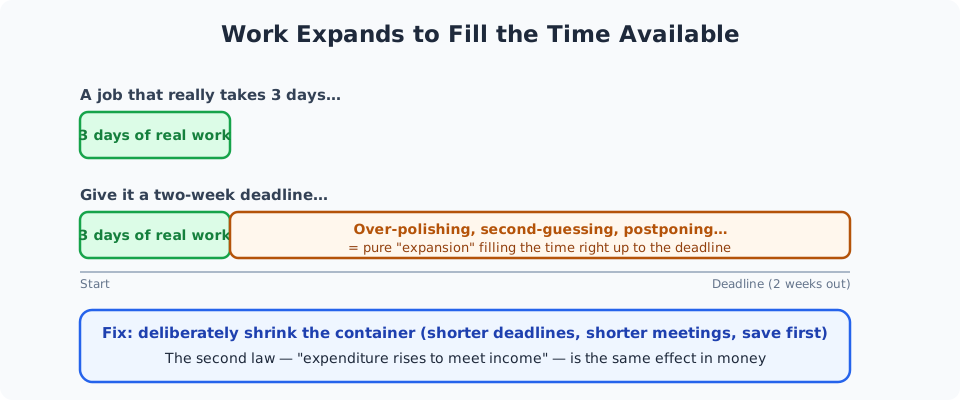
The meaning is simple: a job that takes three days will take two weeks if the deadline is two weeks away. Given time, we unconsciously over-polish, extend our deliberations, and postpone — inflating the work until it uses up the allotted time exactly. Homework, slide decks, meetings: nothing escapes.
Parkinson himself wrote the law not as stern theory but as satire mocking the inefficiency of bureaucracies and big organizations. But so many readers slapped their knees — “that’s me exactly” — that the satire outgrew itself and settled in as a universal principle of how work behaves. A sharp observation wrapped in humor, surviving the decades: a fine example of the genre.
Officials Multiply Even When the Work Shrinks
Parkinson arrived at his law by analyzing a strange dataset from the British bureaucracy.
He looked at staffing in the British Admiralty. From World War I through the interwar years, the Royal Navy’s warships and sailors had both declined sharply. Less work should mean fewer administrators. Instead, the number of Admiralty officials kept growing at 5–6% per year. The work shrank; the managers multiplied. Parkinson dissected the paradox with relish.
His explanation is deliciously cruel. Two instincts operate in any organization. First: “an official wants to multiply subordinates, not rivals.” Adding people beneath you raises your importance; adding peers threatens it. Second: “officials make work for each other.” More subordinates means new work managing them — memos to route, approvals to collect, reviews to conduct. Thus the organization self-propagates work and headcount, entirely decoupled from external demand. Parkinson painted expansion driven not by necessity but by the organization’s own internal logic.
This is not just a joke about government. Companies that grew large, projects that swelled, gradually finding themselves busy with internal activity unrelated to their original purpose — the scene repeats in every modern organization. Nearly seventy years on, Parkinson’s observation has not aged a day.
The Second Law: It Works on Money Too
Parkinson’s law has a lesser-known second face: the same thing happens to money.
Known as “Parkinson’s second law,” it states: “expenditure rises to meet income.” Your income grows, yet somehow nothing accumulates. The raise lifts your standard of living, the wish list lengthens, and before you notice, spending has expanded to fill the income exactly. Recognize yourself?
The time law and the money law share one root: “given a container (time or money), humans expand consumption until the container is full.” Flip it over and you get the strategy: shrink the container first, and consumption shrinks to match. That inversion is the hint behind the countermeasures below.
The Bike Shed Debate Outshines the Nuclear Reactor
Parkinson left one more scathing, hilarious observation about organizational inefficiency: the “law of triviality.”
His example: a committee reviews two agenda items. One is a nuclear power plant with an enormous budget. The other is how to build the staff bicycle shed. Which debate catches fire?
By Parkinson’s observation, the reactor sails through while the bicycle shed consumes endless hours. The reason is plain. The reactor is too technical — most members cannot understand it, so they cannot comment. But a bike shed? Everyone knows bicycles, and everyone has opinions about roofing materials and paint colors. So everyone speaks, and the debate never ends.
This phenomenon — important, difficult questions wave through while trivial, accessible ones get over-debated — is now famous, especially in the software world, as “bikeshedding.” Everyone has lived it: the core architecture decision takes five minutes, then the meeting spends an hour on a button color or email wording. People gravitate to topics they can have opinions about. Knowing this lets you watch a meeting’s dynamics from one step back.
The Fix: Cut the Deadline Short
How do you fight Parkinson’s law? Once you see the structure, the countermeasure suggests itself.
The core of the law is “we use up whatever container we are given.” So: deliberately make the container smaller. Concretely:
- Set deadlines shorter than the time actually available. Given two weeks, privately commit to finishing in three days
- Split big jobs into small deadlines. Not just the final due date — set several intermediate checkpoints
- Book shorter meetings. Schedule the one-hour meeting for 30 minutes, and it mysteriously finishes in 30
- For money, divert savings automatically on payday and live on the remainder (shrink the container first)
I have the tendency myself — give me abundant time and I will inflate the work without limit — so I make a point of imposing deliberately tight deadlines on myself. Deadlines are pressure, yes; but see them as allies that halt the expansion of work rather than enemies, and your relationship with them changes. Parkinson’s law is smartest used not as a lament but as a tool for controlling your own time and money.
Questions About Parkinson’s Law
Won’t Overly Short Deadlines Just Produce Sloppy Work?
A fair concern. Cut deadlines to the extreme and quality obviously suffers. What Parkinson’s law teaches is the tendency that “most people grant their work far more time than it needs” — not the claim that “any job can be done instantly.” The right deadline depends on the work. The technique: set it slightly shorter than your estimate, try it, then calibrate. In most cases our first estimate carries a generous layer of expansion fat.
Why Do Organizations Expand Even Knowing It’s Inefficient?
The sharpest part of Parkinson’s analysis is his point that no malice or laziness is required. Wanting more subordinates, wanting your work to look important — these are natural motives held by most people. With not a single villain present, individually rational behaviors compound into collectively inefficient bloat. The structure echoes the “fallacy of composition” covered on this site (what is right for each individual becomes wrong for the whole). Hence the need for deliberate braking mechanisms.
Does It Apply to Remote Work?
If anything, more strongly. When nobody can see you working, “time visibly spent” tends to become the performance of working, making remote work an expansion-friendly environment. On the other hand, remote work is also the easiest arrangement to evaluate by output. Build the habit of measuring yourself by what got finished rather than hours logged, and Parkinson’s expansion pressure becomes easier to repel than in the office. Don’t bound yourself with time; bound yourself with deliverables. That is Parkinson-proofing for the remote era.
Related Laws and Biases
See “Murphy’s law,” another law born on the job; “hyperbolic discounting,” the pull of present ease; and the “fallacy of composition,” where individual rationality sums to collective irrationality.



Summary
This article covered “Parkinson’s law.”
Born as satire about officials multiplying without work to do, the law skewers a universal human trait: “we use up whatever container we are given.” Time and money both expand to fill their limits if left alone. So deliberately cutting the container smaller becomes the key to controlling your own life.
Leaving the summer homework to the last day was never weak willpower — it is a law of our species. That thought is consoling, and it points to the fix. Next time a big piece of work lands on you, start by asking: “could this actually be done in less?”
To return to the full list of laws, follow the link below.
Thank you for reading. We hope to see you in the next article.

Also popular with readers
📚 Series: Famous & Fascinating Laws (3/25)