Thank you for visiting this site. This article covers the world’s most famous rule of thumb: “Murphy’s law.”
“Wash the car, and it rains.” “The light turns red exactly when you’re in a hurry.” “Toast always lands butter-side down.” Murphy’s law compresses this feeling — “why does everything go wrong?” — into a single line. The world loves it as a humorous grumble, but the law has a surprising true face: it was not born as pessimism at all, but on a rocket test range, as a lesson for preventing accidents. Here is the real story.
What Is Murphy’s Law?
Murphy’s law is the rule of thumb that “anything that can go wrong will go wrong.”
The law is beloved because it nails misfortunes everyone recognizes. The laptop that won’t boot on presentation day. The rain that comes only on days you left the umbrella home. The next checkout line moving faster than yours. Murphy’s law spread worldwide as the handy phrase for laughing off these small daily calamities — “ah, Murphy strikes again.”
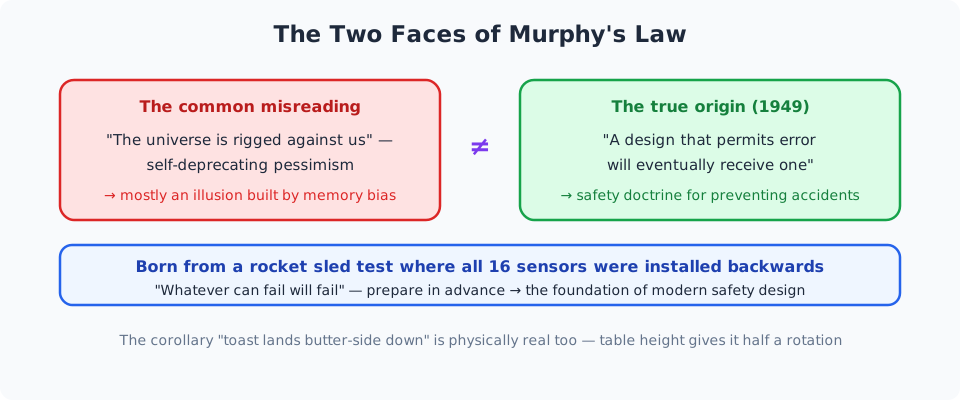
The law spawned countless humorous corollaries, most famously “buttered toast always lands butter-side down.” Most people take the whole thing as self-deprecating comedy — “the universe is rigged against us.” But the scene of its birth was no laughing matter.
Born on a Rocket Sled Test Track
Murphy’s law has a well-documented origin story: 1949, U.S. Air Force rocket sled experiments.
To find the limits of human tolerance for rapid deceleration, researchers were running a dangerous program: accelerate a sled with rockets, slam it to a stop, and measure the forces on the human aboard. An aerospace engineer named Edward Murphy was involved, responsible for the acceleration sensors.
In one test, all 16 of the installed sensors returned nothing but bad data — every single one. Investigation revealed that each sensor could be mounted in two orientations — and all 16 had been mounted the wrong way. Murphy is said to have remarked of the technician, in essence: “if there are two ways to do it and one leads to disaster, he’ll do it that way.” That remark is considered the prototype of Murphy’s law.
So the original meaning was never the passive lament “the world is cruel.” It was an active design philosophy: “as long as the design permits wrong installation, someone will eventually install it wrong — so design it so that wrong installation is impossible.” Not a grumble; the exact opposite of one.
It Went Public as the Reason Accidents DIDN’T Happen
How the phrase reached the public is the delicious part.
The rocket sled program’s leader, flight surgeon John Stapp, was famous for strapping his own body into the sled in a brutal series of deceleration studies. He completed one dangerous experiment after another without a major accident. Asked at a press conference for the secret of that safety record, Stapp answered: “we always take Murphy’s law into account.”
Assume constantly that whatever can fail will fail, and hunt down every failure mode in advance. That is why the dangerous experiments produced no accidents. Murphy’s law entered the world not as pessimism, but as a philosophy of superb safety management.
The idea lives on in every corner of modern safety design. Plugs shaped so they cannot be inserted upside down; confirmation dialogs on destructive operations — all products of the Murphy-style premise that “if a mistake is possible, someone will eventually make it.” This philosophy — “prevent slips with mechanisms, not with human vigilance” — is known in engineering as fool-proofing (or poka-yoke), a foundational principle of product design. A law dismissed as a grumble turns out to be part of the thinking that keeps our daily lives safe.
Does Toast Really Land Butter-Side Down?
So is the famous corollary — “it lands butter-side down” — just a joke? Delightfully, scientists took it on in earnest.
British physicist Robert Matthews demonstrated that toast really does tend to land butter-side down — and the physics is real. The culprit is not the weight of the butter. It is the height of the table.
When toast slides off a standard table (roughly 28–30 inches high), it begins to rotate as it falls. And from table height, it completes almost exactly half a rotation — 180 degrees — before hitting the floor. Since toast sits butter-up on the table, half a rotation delivers it butter-down. A much taller table would allow a full rotation and a butter-up landing — but tables built for human height are simply not tall enough. The true villain of the tragedy is the height of tables, which is set by the height of humans. The research won an Ig Nobel Prize, the award for science that makes you laugh and then think.
Not every corollary of Murphy’s law survives scientific scrutiny, but this one teaches something lovely: even a silly-sounding question can hide a wonderful truth if you investigate it seriously. Of all the stories attached to Murphy’s law, this toast story is my favorite.
Why Does It Feel Like Bad Things Always Happen?
That said, most everyday Murphy moments are produced not by physics but by the machinery of our own minds. This is the most practical part of understanding the law.
“It rains whenever I wash the car” feels true because we completely fail to remember the many days we washed the car and no rain came. Only the aggravating coincidence — wash plus rain — sticks. This mental tilt — “only the inconvenient coincidences are remembered; the uneventful days are never counted” — creates the illusion of a spiteful universe.
These are the workings of “confirmation bias” and the “availability heuristic,” both covered on this site. We collect only the events that fit the belief “bad things really do pile up” and never tally the peaceful days that contradict it. You could even say the more strongly you feel Murphy’s law, the bigger your opportunity to catch your own memory bias red-handed. Before cursing your luck, ask: “have I forgotten to count the days when things went fine?” The world may prove less spiteful than it looked.
Questions About Murphy’s Law
So Is Murphy’s Law Actually True?
Sort it into three layers. First, as a lesson in design and safety management, it is genuinely valid — “a design that permits error will eventually receive one” is an iron rule of accident prevention. Second, some corollaries are physically true (the toast). Third, however, most of the Murphy’s law we feel in daily life is an illusion manufactured by memory bias. The universe is not targeting you. Keep the three layers separate, and you can use the law wisely.
Is There a Countermeasure — or a Way to Use It?
Yes. As safety doctrine, Murphy’s law translates into daily life as “assume the worst first, and prepare.” Back up the important files. Pad the deadline. Pack the medicine. Run the assumption “whatever can fail will fail” once, then prepare — and when something does happen, you won’t be scrambling. The right use of this law is not to freeze in pessimism but to convert pessimism into preemptive preparation.
Was There a Real Murphy?
There was. The leading account traces it to the aerospace engineer Edward Murphy described above. That said, the exact words he spoke and the fine history of how the law got its name vary between tellings, and the participants’ recollections conflict. The idea itself — “whatever can fail will fail” — was proverbial among engineers and sailors long before Murphy. Closer to the truth than “one man’s invention”: wisdom long shared by people with field experience happened to catch Murphy’s name.
Related Laws and Biases
See “confirmation bias” (the mental machinery that makes misfortune look clustered), the “availability heuristic” (recall ease distorting judgment), and “Parkinson’s law,” another law born on the job.

Summary
This article covered “Murphy’s law.”
The self-deprecating joke that the world is rigged began, at its origin, as the forward-looking safety doctrine: “so build things that cannot fail.” That reversal is the most delightful thing about Murphy’s law. Laugh at it as a grumble if you like — but carry home the wisdom underneath, “assume the worst and prepare,” and the law transforms into a genuinely practical tool.
Next time your toast hits the floor and you stare at the butter side, remember both culprits: the height of the table, and the bias of your memory. The world is not out to get you — and that thought alone should lighten the day a little.
To return to the full list of laws, follow the link below.
Thank you for reading. We hope to see you in the next article.

Also popular with readers
📚 Series: Famous & Fascinating Laws (2/25)