Thank you for visiting this site. This article covers a strange regularity hiding in the world of numbers: “Benford’s law.”
Take the numbers all around us — river lengths, national populations, stock prices, utility bills, building heights — and look at their leading (leftmost) digit. You would expect the digits 1 through 9 to appear about equally. In reality, numbers starting with “1” dominate, at about 30%, while numbers starting with “9” account for less than 5%. This counterintuitive phenomenon is Benford’s law — and remarkably, it doubles as a working tool for exposing accounting fraud and election rigging.
What Is Benford’s Law?
Benford’s law is the statistical regularity that “in many numerical datasets arising in nature and society, the leading digit is most likely to be 1, with the probability falling as the digit grows.” It is also called the “first-digit law.”
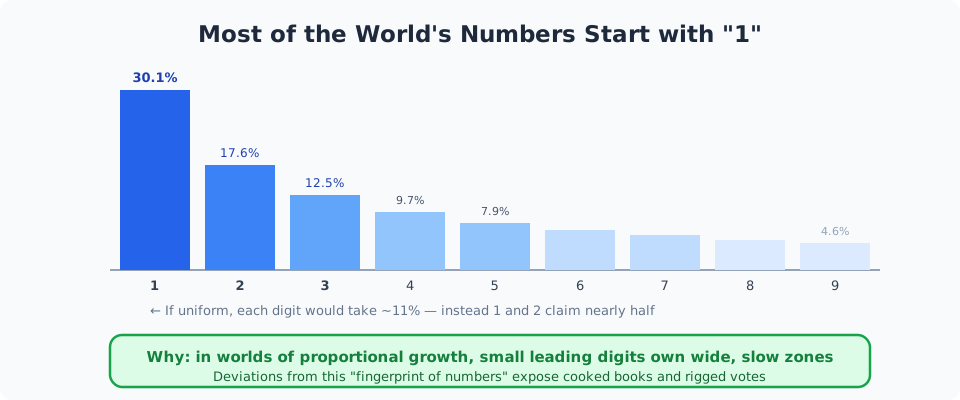
The actual numbers are startling. Across many datasets, leading digits appear at roughly these rates:
| Leading digit | Frequency |
|---|---|
| 1 | ~30.1% |
| 2 | ~17.6% |
| 3 | ~12.5% |
| 4 | ~9.7% |
| 5 | ~7.9% |
| 6–9 | ~22% combined |
Numbers beginning with 1 or 2 alone account for nearly half of everything (~48%). If digits were uniform, each would take about 11% — so this is a massive skew. Stranger still, the same skew shows up in river lengths, in populations, in physical constants, in corporate ledgers. Convert meters to miles, yen to dollars — the distribution survives. It reads like a hidden blueprint of the numerical world.
Why Is 1 So Common?
Where does the skew come from? The intuitive picture is “a number growing over time.”
Imagine your savings start at $1,000 and grow steadily. To move from the $1,000s (leading digit 1) into the $2,000s (leading digit 2), your savings must double — all the way to $2,000. But moving from the $9,000s (leading 9) into the $10,000s (leading 1 again) takes only about a 10% gain.
In other words, the “leading 1” zone ($1,000–2,000) is wide, and numbers linger there, while the “leading 9” zone ($9,000–10,000) is narrow — passed through in a blink. In any world where quantities grow multiplicatively, the smaller the leading digit, the longer a number dwells in its zone. Snapshot the world at a random moment, and leading-1 numbers are the most likely catch.
The mathematics underneath is the logarithm: Benford’s law says precisely that leading-digit probabilities follow a logarithmic distribution. If that sounds heavy, the one takeaway is: “in a world of proportional growth, small digits own wide territories.” Grasp that intuition and the abundance of 1s makes sense. Because so many natural and economic processes grow or shrink by percentages, the law holds astonishingly broadly.
The “Fingerprint of Numbers” That Catches Fraud
The biggest reason for Benford’s fame: it genuinely works as a fraud detector. This is the law’s most practical — and most thrilling — face.
The principle: honestly recorded, real accounting data shows Benford-distributed leading digits. But when humans invent numbers, they deviate from the natural distribution. Fabricating amounts, people unconsciously spread digits evenly or overuse middling digits like 5 and 6. Artificially reproducing the natural skew — “1 takes thirty percent” — is surprisingly hard.
So auditors collect a firm’s ledger entries or tax filings, chart the leading digits, and if the distribution strays far from Benford, the numbers are flagged as possibly manipulated. The technique sees real use in financial audits, tax investigations, and fraud prosecutions. It has been applied to vote tallies and suspect economic statistics too — serving as a “fingerprint of numbers” distinguishing data born naturally from data forged by hand. A pure mathematical regularity moonlighting as a detective’s tool — that unexpected utility is why people love this law.
It Does Not Apply to Everything
To understand the law properly, know where it fails. Benford is not a universal key.
The law fits best with naturally arising data spread across many orders of magnitude — datasets mixing tens with millions: populations, monetary amounts, areas, physical measurements.
It does not fit the following. First, data confined to a narrow range. Adult heights cluster between 150–190 cm; the leading digit skews to 1, but that is a different kind of skew, not Benford. Second, numbers assigned by human rules — phone numbers, employee IDs, postal codes. These are allocated, not grown, so the law does not bind them. Wherever data lacks the “grows by percentages” character, Benford breaks down.
Knowing the conditions of validity matters enormously in practice. Run Benford tests indiscriminately and you will brand innocent, non-Benford data as “fraudulent.” As with every rule of thumb: only when you know where it holds and where it fails does it become a proper tool.
Questions About Benford’s Law
Who Discovered It?
The name honors the physicist Frank Benford — who was not the first discoverer. More than half a century earlier, in 1881, astronomer Simon Newcomb noticed the same phenomenon. He observed that in books of logarithm tables, the early pages (covering numbers starting with 1) were far more thumb-worn and grimy than the later ones — people were looking up numbers starting with 1 more often. Benford confirmed the pattern across mountains of real data in 1938 and popularized it, so his name stuck. Laws named after someone other than their first discoverer are a running tradition in science — itself a fine anecdote.
Can I Verify It Myself?
Easily. Gather numbers within reach and tally the leading digits. Good sources: figures in newspapers and magazines (populations, amounts, areas), household budget entries, statistics from the news. Collect a few dozen or more, count the first digits, and you will find far more numbers starting with 1 than with 9. The effect is cleanest in datasets whose values sprawl across many orders of magnitude. Discovering a hidden order of the numerical world with your own hands — it is a genuinely fun little experiment.
Why Can’t Fraudsters Just Reproduce the Law?
Because human intuition is miscalibrated against natural number distributions. When we invent “random-looking numbers,” we unconsciously spread the digits evenly — trying to look random makes us unnaturally uniform. It is the same psychology as in the gambler’s fallacy article, where human-generated “random sequences” alternate more politely than true randomness. Deliberately faking the genuine skew — “use 1 thirty percent of the time” — is very difficult. Humans are worse forgers of “nature” than they think, and that failure is what makes the fingerprint of numbers work.
Related Laws and Biases
See the “gambler’s fallacy” (the unnaturalness of human-made randomness), the “birthday paradox” (intuition betrayed by numbers), and the “Riemann hypothesis” (the great unsolved question of numerical regularity).


Summary
This article covered “Benford’s law.”
About 30% of the world’s numbers begin with “1,” and larger digits lead ever more rarely. The counterintuitive skew flows from a property of logarithms: “in worlds of proportional growth, small digits own wide territories.” And the delight of this law is that pure mathematics moonlights as the “fingerprint of numbers” that exposes cooked books and rigged elections.
But it does not govern every dataset. Knowing the conditions under which the law holds is the price of using it correctly — the iron rule of every rule of thumb. Next time a table of figures crosses your screen, count the leading digits. The discovery that 1 is everywhere will make the familiar world of numbers feel suddenly, delightfully strange.
To return to the full list of laws, follow the link below.
Thank you for reading. We hope to see you in the next article.

Also popular with readers
📚 Series: Famous & Fascinating Laws (20/25)