Thank you for visiting this site. This article covers what is often called mathematics’ greatest unsolved problem: “the Riemann hypothesis.”
2, 3, 5, 7, 11, 13… The sequence of primes shows no pattern, however you stare at it. No formula exists that tells you where the next prime will appear. Yet in 1859, the German mathematician Riemann showed, in a paper of just eight pages, that behind this seemingly random sequence there may hide a terrifyingly precise blueprint. The claim that this blueprint is perfect — that is the Riemann hypothesis. More than 160 years later it remains unsolved, and a proof carries a one-million-dollar prize.
Just How “Random” Are the Primes?
The doorway into the Riemann hypothesis is the primes’ troublesome character. A prime is a number of 2 or more divisible only by 1 and itself — the building blocks of all numbers, since every number decomposes into a product of primes (12 is 2×2×3).
You would hope the building blocks came neatly arranged, but the actual primes are capricious. They show up side by side, like 3 and 5 or 11 and 13, then go silent for a stretch. The 25 primes below 100 thin out as numbers grow, but nobody possesses a formula that declares “the next prime lands here.”
Step back, though, and the scenery changes. The position of any individual prime is unpredictable, yet the collective behavior — “roughly how many primes exist up to a given number” — rides a surprisingly smooth curve. By the end of the 19th century, the prime number theorem approximating this count was proven. The question is how small the approximation’s error is. In fact, the Riemann hypothesis can be restated as a conjecture about precisely this error.
Concrete numbers give the feel. Up to one million there are 78,498 primes. The prime number theorem’s naive formula misses somewhat at about 72,382, but the refined approximation (the logarithmic integral) gives about 78,628 — an error of just 130 out of a million. What the Riemann hypothesis asserts is that errors of this kind stay, no matter how large the numbers grow, at “roughly the square root of the scale” — essentially the theoretical minimum. If the hypothesis fails, the error runs unexpectedly wild at some scale.
The Time Bomb Planted in an 8-Page Paper
In 1859, Bernhard Riemann submitted to the Berlin Academy a paper titled “On the Number of Primes Less Than a Given Magnitude.” It was his only number theory paper in his lifetime — a mere eight pages. In it, Riemann derived a formula for the count of primes using a function called the zeta function as his key.
The zeta function is built from the infinite sum 1 + 1/2 + 1/3 + … (with each term raised to a power). At first glance it has nothing to do with primes, but through a transformation discovered by Euler, the function can be rewritten as a product running over all the primes. The zeta function, in other words, is a database with the primes’ information compressed inside it whole.
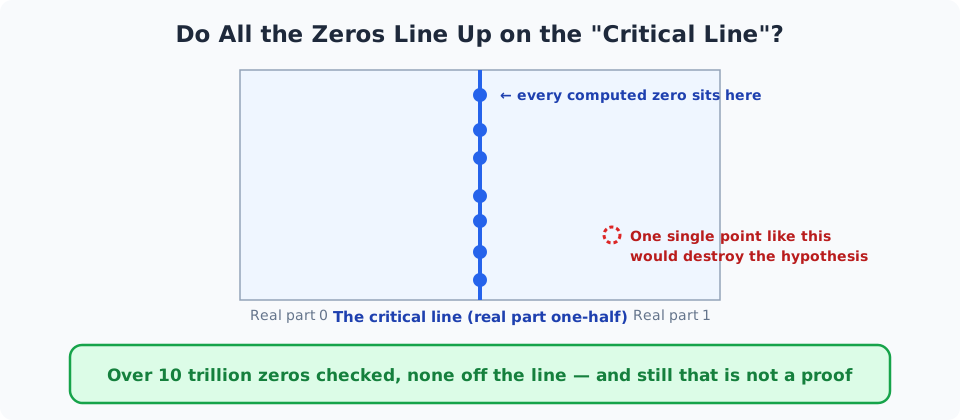
What Riemann showed is that the key to this database is “the points where the zeta function’s value becomes zero (its zeros).” Know the zeros’ positions, and the error in the prime-counting formula is completely determined. And when he plotted the zeros like a map on a plane, he noticed the few zeros he could compute all lined up on a single vertical line, and left this note: “It is very probable that all zeros lie on this line. I have attempted a proof, but set the fleeting attempts aside.” That sentence became a time bomb that has ticked for more than 160 years.
Ten Trillion on the Line, Not One Off It
The “horizontal position” on the map of zeros is what mathematicians call the “real part.” With that term, the Riemann hypothesis fits on one line:
All (non-trivial) zeros of the zeta function have horizontal position (real part) equal to one-half.
That line is called the “critical line.” If the hypothesis is right, the prime count is guaranteed to deviate from the prime number theorem’s formula by only the theoretical minimum error, and the primes’ arrangement stands confirmed as “seemingly random, yet impeccably well-behaved.” Conversely, if even one zero is found off the line, the hypothesis collapses, and the world of primes contains disorder no one bargained for.
The history of attempted proofs is the history of number theory itself. In 1914, England’s Hardy proved that infinitely many zeros lie on the critical line. In 1989, Conrey showed that at least 40 percent of the zeros lie on it. Computer verification has confirmed that more than 10 trillion zeros all sit on the critical line. Counterexamples: zero. The circumstantial evidence is overwhelming.
Still, mathematicians do not settle for “almost certainly.” Hilbert chose it as one of his “23 problems” in 1900; in 2000 the Clay Mathematics Institute named it a “Millennium Prize Problem” with a million dollars attached — and the prize remains unclaimed. Hilbert reportedly said that if he woke after sleeping 500 years, his first question would be whether the Riemann hypothesis had been proven.
Why One Conjecture Carries This Much Weight
The Riemann hypothesis is not called “mathematics’ greatest” because of the money. There are two big reasons.
First, an enormous amount of mathematics is built on top of it. Number theory contains hundreds of theorems proven conditionally — “assuming the Riemann hypothesis is true.” Prove the hypothesis, and they all ascend at once to unconditional theorems. Produce a counterexample, and the whole building falls. Modern number theory has, in effect, built its city first, on the unverified foundation named Riemann.
Second, the connections to unexpected fields. In the 1970s came the astonishing discovery that the statistics of the spacings between the zeta zeros match the statistics of energy levels in heavy atomic nuclei (famously born from a teatime chat between Montgomery and Dyson). Primes — objects of pure mathematics — obey the same statistics as the quantum world. The meaning of this link is still unexplained, and research attacking the Riemann hypothesis with the tools of physics continues today.
One more note: the zeros carry the poetic nickname “the music of the primes.” Mathematically, each zero corresponds to one “wave” composing the staircase graph of the prime count, and it is known that superimposing the waves of all the zeros reconstructs the prime staircase exactly. The zeta zeros are, so to speak, the list of pure tones composing the song called the primes.
For me, the deepest appeal of this conjecture is the worldview itself: order hiding beneath apparent disorder. Behind a prime distribution that looks like a stock chart, the zeros stand in perfect formation. The intuition of Riemann, who first glimpsed that vision, frankly gives me goosebumps.
Would a Proof Break Encryption?
Let me answer the questions that always come up around the Riemann hypothesis.
Is It True That Internet Encryption Would Be in Danger?
Half a misunderstanding. The security of RSA encryption on the internet rests on “factoring large numbers is hard,” but the Riemann hypothesis is a statement about the distribution of primes — proving it would not make factoring any faster. The popular claim that a proof would immediately break encryption is a leap. That said, if the process of proving it fundamentally deepened our understanding of primes, long-term ripples into cryptography research cannot be ruled out. “Not tomorrow’s crisis, but not unrelated either” is about right.
Don’t Prize-Hunters Submit Proofs?
They flood in. The Clay Institute and specialist journals are known to receive a constant stream of “I proved it” submissions from amateurs, and famous mathematicians reportedly get regular letters too. So far, not one proof has survived expert peer review. In 2018, the eminent mathematician Atiyah announced a proof, making worldwide news — experts identified flaws, and it was not accepted. The million dollars sits unclaimed today.
Can a Layperson Grasp Even the Outline?
The paraphrase in this article — “the prime-counting approximation has an error, and the Riemann hypothesis claims that error is the theoretical minimum” — is the standard explanation experts use too. Skip the zeta function and complex numbers entirely, and that one sentence still captures the conjecture’s essence. If your interest holds, the relationship between zeros and primes is told through the beautiful image of “infinitely many waves superimposed to reproduce the prime staircase” — a well-illustrated introductory book is the way in.
Related Unsolved Problems and Puzzles
See the fellow prime mysteries “the Goldbach conjecture” and “the twin prime conjecture,” and for a taste of handling infinity, “Hilbert’s infinite hotel.”

Summary
This article covered “the Riemann hypothesis.”
One sentence inside an 8-page paper has repelled humanity’s finest minds for over 160 years. And what hangs on it is the blueprint of the primes — the building blocks of every number. Including the integrity of a mathematics that keeps saying “we still don’t know” despite 10 trillion pieces of circumstantial evidence, I consider this problem one of the summits of the intellectual world.
When the day of proof comes, the news will race around the globe. If this article leaves you with enough of the lay of the land to explain “what makes it a big deal,” I will be glad.
To return to the full list of unsolved problems, follow the link below.
Thank you for reading. We hope to see you in the next article.

Also popular with readers
📚 Series: Unsolved Problems in Math & Science (2/16)