Thank you for visiting this site. This article covers “the Collatz conjecture” — a problem once described as one “mathematics is not yet ready for.”
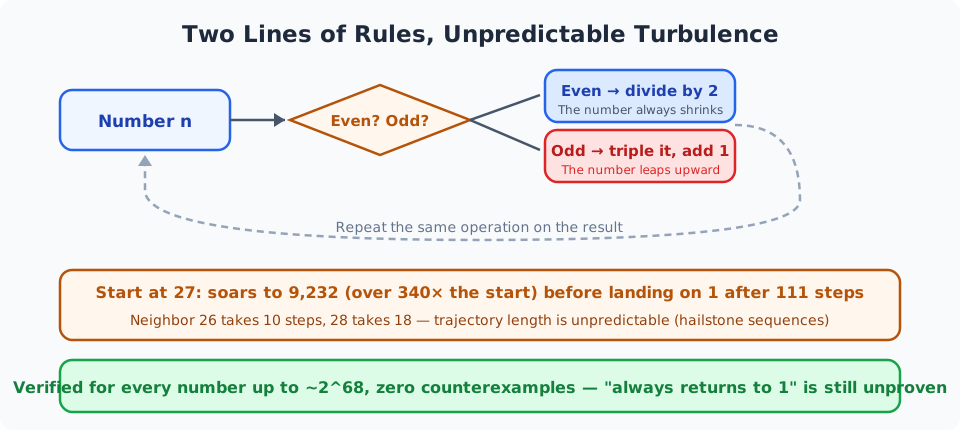
Here are the rules. Pick any positive integer you like. If it’s even, divide by 2. If it’s odd, triple it and add 1. Repeat the same operation on the result. Take 6: 6→3→10→5→16→8→4→2→1. Take 7: 7→22→11→34→17→52→26→13→40→20→10→5→16→8→4→2→1. Both arrive at 1. The conjecture says: “start from any number whatsoever, and you will always reach 1.” That’s it. That is the entire rulebook. And mathematics has failed to prove this game-like claim for more than 80 years.
The Wild Ride of 27
The eeriness of this conjecture is best felt by chasing numbers yourself. The recommended starting point is 27.
27 is a small number, but start the operations and it just won’t come down: 27→82→41→124→62→31→94→47→… If anything it swells, at one point launching up to 9,232 — more than 340 times its starting value. Eventually it does land on 1, but only after 111 steps.
Its neighbor 26 arrives in 10 steps, and 28 in 18 — yet 27 alone takes the 111-step grand tour. This behavior, where a tiny change in the starting point changes the trajectory’s length unpredictably, is the core difficulty of the Collatz conjecture. No pattern is visible in the sequences’ motion, and their resemblance to hailstones tumbling up and down inside a storm cloud before falling has earned them the nickname “hailstone sequences.”
And yet every number falls to 1 in the end. Computer verification has confirmed that every number up to roughly 2 to the 68th power (about 3×10^20 — a 21-digit scale) reaches 1. No counterexample has ever been found.
”Mathematics Is Not Yet Ready for Such Problems”
The conjecture is named for the German mathematician Lothar Collatz, believed to have considered it in the 1930s. But its origins are hazily documented; it spread by word of mouth among postwar mathematicians, picking up aliases by country and era — “Kakutani’s problem” (after Japan’s Shizuo Kakutani), “Ulam’s conjecture,” and more. It spread so widely that a joke reportedly circulated: “this is a Soviet trap designed to stall Western mathematicians’ research.”
The danger is symbolized by the famous words of the wandering genius Paul Erdős:
Mathematics is not yet ready for such problems.
Erdős was famous for posting cash prizes on interesting problems, and on Collatz he offered $500. The sum is beside the point — the words survive among mathematicians as a warning: “this is a problem you may not come back from.” Indeed, brilliant young researchers sinking into it has been half-jokingly dreaded as “Collatz disease.”
Meanwhile, in 1972, John Conway — of “Game of Life” fame — proved that generalized Collatz-style rule systems can be undecidable in principle. In other words, within this family of “simple rules fiddling with numbers,” regions genuinely beyond the reach of logic really do exist. Whether the Collatz conjecture itself has fallen into one of them, nobody knows.
Why Can’t Such a Simple Problem Be Proven?
The natural question: the rules are two lines long — what is so hard?
The biggest reason is that the operations destroy the structure of digits. Dividing by 2 gets along beautifully with the world of base 2; tripling and adding 1 gets along with base 3. But when the two alternate, the number’s structure is scrambled unpredictably in both worlds at once. Number theory’s traditional tools advance by leaning on structural regularities — and a Collatz sequence, demolishing structure as it goes, offers no foothold.
The second reason: a counterexample could take two different shapes. If the conjecture is false, there must exist either “a sequence that diverges to infinity” or “a separate loop that never passes through 1” — and you must rule out both simultaneously. Demonstrating an “average tendency” toward 1 cannot exclude one exceptional runaway.
Statistically, sequences are known to trend downward. Tripling an odd number and adding 1 always yields an even number, which is promptly halved; averaged out, each step shrinks the number on balance. “On average, everything sinks. But no one can swear that a single exception doesn’t float forever.” This shape — probabilistically near-black, logically uncheckmatable — is a classic landscape of unsolved problems, shared with others in this series.
Terence Tao’s “Almost All”
In 2019, after long stagnation, one of the greatest living mathematicians, Terence Tao, carved out a major step.
What Tao proved, roughly summarized: “for almost every starting point, the sequence descends to arbitrarily small values.” It stops short of “every number reaches 1,” but it established “almost all numbers almost surely sink” in the strongest form to date. Experts have called it “close to the best result one could hope for, short of a full solution.”
The delicious part is that Tao brought probabilistic tools into a deterministic problem — attacking a rule-based question as a question of chance. Changing the arena when the wall won’t break head-on: a model for how to fight unsolved problems. And yet Tao himself remains careful, saying a complete solution may be “beyond the reach of current mathematics” — Erdős’s warning still carries its weight.
Look Backward from 1, and a Giant Tree Grows
Followed forward, the sequences are all turbulence. But there is a view that flips the perspective: trace backward from 1.
The number just before 1 is 2; before that 4, 8, 16… The reverse operations are “double it,” plus — only when the arithmetic allows — “subtract 1 and divide by 3.” From 16 you can branch to both 32 and 5, so tracing backward grows a giant tree rooted at 1, spreading its branches. The Collatz conjecture restates as the claim that this tree “contains every positive integer somewhere in its branches.” Miss even one number, and the conjecture falls.
Drawings of this “Collatz tree” are famous as the conjecture’s emblem: irregular in its branching yet orderly in its overall reach, likened to blood vessels, lightning, and the limbs of plants. As complex form born of a simple rule, it can be enjoyed as an honorary fractal.
Incidentally, the record-setting exhaustive verifications rest on a clever move too: once a starting point’s sequence dips below its starting value even once, verification can stop right there (everything smaller is already verified). Most numbers dip below their start quickly, so this shortcut alone slashes the computation dramatically. Even the world records of a simple problem are held up by an engineering war of accumulated tricks and purpose-built programs.
Questions to Answer While You Play
What Happens After You Reach 1?
1 is odd, so tripling and adding 1 gives 4, which returns 4→2→1. Strictly, the sequences’ destination is the eternal loop “4→2→1.” Precisely stated, the conjecture reads “every positive integer eventually enters this loop.” Conversely, a counterexample means “a number that never enters this loop” — either a different loop or an infinite ascent.
What About Negative Numbers, or Multiplying by 5 Instead of 3?
Extend to negative integers and the scene transforms: on the negative side, several independent loops with no analogue of 1 have been found, making the positive side’s good manners look like the exception. Switch the rule to “multiply by 5 and add 1,” and sequences from many starting points are believed to diverge. The coefficient 3 seems to sit exactly at the knife-edge where the sinking force and the floating force balance. This rule-tinkering is playable with paper and a calculator, which is why I recommend Collatz as an unsolved problem for hands-on experience, not just admiration.
I Think I’ve Seen This as a Programming Exercise
Exactly right — the Collatz sequence needs only a loop and a conditional, making it a staple of programming courses. A few lines of code reproduce the same scenery as the research frontier (27’s wild ride included). But aim for world-record exhaustive verification and it instantly becomes a contest of optimization technology — the check up to 2^68 was the fruit of GPU-powered custom programs. Ten minutes to write, run, and watch; a lifetime to chase the record. That breadth of foothills is part of why this problem is so loved.
Related Unsolved Problems and Puzzles
See “the Tower of Hanoi,” where a simple rule erupts into cosmic numbers; “the Goldbach conjecture,” which shares the shape of mountains-of-evidence-without-proof; and “Russell’s paradox,” a brush with the world of the undecidable.

Summary
This article covered “the Collatz conjecture.”
Two lines of rules, verification to 2^68, a $500 prize, and zero proof. That mismatch is the whole of the Collatz conjecture. I know of no other problem that demonstrates so vividly that simplicity and easiness are entirely different things.
Best of all, anyone with a calculator can view the same scenery as the frontline. Start with 27 and experience the hailstone turbulence yourself. The moment it finally touches down on 1 after its 111-step journey carries a small but real thrill.
To return to the full list of unsolved problems, follow the link below.
Thank you for reading. We hope to see you in the next article.
Also popular with readers
📚 Series: Unsolved Problems in Math & Science (7/16)