Thank you for visiting this site. This article covers the problem in the strangest predicament in all of mathematics: “the ABC conjecture.”
Normally an open problem has two possible states: “unsolved” or “solved.” The ABC conjecture occupies an unprecedented third state: more than a decade after Shinichi Mochizuki of Kyoto University published a proof exceeding 600 pages in 2012, the mathematical community remains split on the question of whether it has been proven at all. This article first explains the conjecture itself as a story about addition and multiplication, then lays out the standoff without taking either side.
Addition and Multiplication Are Not on Speaking Terms
The protagonist of the ABC conjecture is the relationship between the world of addition and the world of multiplication.
The integers have two faces. Seen through addition, 9 is “1 + 8.” Seen through multiplication, 9 is “3 × 3” and 8 is “2 × 2 × 2.” Prime factorization is information belonging to the multiplication world, running on principles entirely alien to addition. The question “when a and b add up to c, is there any relationship among the three numbers’ prime factors?” looks simple — and is in fact a monumental problem of bridging two worlds.
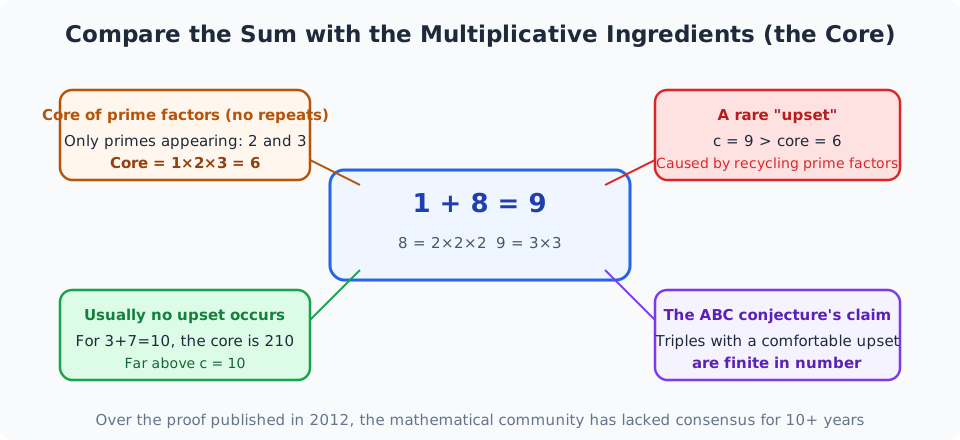
Here we introduce a tool: the “core of prime factors” — the product of every prime factor that appears, counted once each with no repeats (the technical term is the radical). For the equation 1 + 8 = 9, the only primes appearing are 2 and 3, so the core is 1×2×3 = 6. Even though 2 is used three times inside 8 and 3 twice inside 9, the core counts each just once.
The Claim: “c Exceeding the Core Is Rare”
With the setup done, here is the conjecture. Consider a and b sharing no prime factors, and their sum c (a + b = c).
In most cases, c is smaller than the core of the three numbers’ prime factors. For 3 + 7 = 10, the core is 3×7×2×5 = 210, dwarfing c = 10. But occasionally the tables turn. In our 1 + 8 = 9, the core is 6 while c = 9 — c has overtaken the core. This happens in the special situation where “a few kinds of prime factors get recycled over and over,” as in 8 = 2×2×2 and 9 = 3×3.
What the ABC conjecture asserts, roughly:
Exceptional triples where c exceeds the core (by any fixed margin) are finite in number.
In other words: “there is a limit to how large a number built by addition can grow purely by recycling multiplicative ingredients.” Formulated in 1985 by Oesterlé of France and Masser of Britain, the conjecture came to be called number theory’s “Swiss Army knife” for the power with which it binds addition to multiplication in a single stroke. The name, by the way, really does come from the initials of the three numbers a, b, c. For a conjecture of the century, the naming is almost comically plain — which is part of why I like it.
What Falls Like Dominoes If It Is Proven
The ABC conjecture’s importance lies in the opulence of its consequences. Prove this one conjecture, and famous hard problems of number theory are demoted wholesale to corollaries — bonus theorems.
The flagship example is Fermat’s Last Theorem, proven in 1995 after 360 years. If ABC holds, the bulk of Fermat’s Last Theorem (all sufficiently large exponents) is known to follow in a few lines of argument. The feat that cost Wiles over 100 pages becomes exercise-grade in ABC’s presence. Beyond that, multiple major theorems and open conjectures about the finiteness of integer solutions to equations follow from ABC all at once.
For this reason, ABC has been rated “number theory’s most important conjecture alongside the Riemann hypothesis.” Which also means: when someone claimed to have proven a monster of this order, it was inevitable that verification would carry extraordinary weight.
2012, and Then the Unprecedented Standoff
In August 2012, Shinichi Mochizuki of Kyoto University’s Research Institute for Mathematical Sciences posted to his website a four-paper series exceeding 600 pages in total: a proof of the ABC conjecture via an almost entirely self-built theoretical framework named “Inter-universal Teichmüller theory.”
What made the affair extraordinary came next. Normally, experts worldwide verify, and within a few years the proof is accepted or rejected. But this theory’s vocabulary and thinking stood so far apart from existing mathematics that a state of “almost no one can read it” persisted. Verification workshops convened in several countries; mathematicians traveled to Kyoto to attempt comprehension; consensus never arrived.
In 2018, Fields Medalist Peter Scholze and a colleague, after debating Mochizuki directly in Kyoto, published the criticism that “the proof’s core contains a gap that cannot be filled.” Mochizuki’s side countered in full: “the criticism rests on a misunderstanding of the theory.” The papers were formally published in a specialist journal in 2021, but the journal’s being issued by Mochizuki’s own institution drew further controversy, and the international mathematical mainstream still does not accept the proof. Meanwhile a group supporting the theory continues research, and in recent years a privately funded bounty was even established for anyone who finds a flaw in it — an affair irregular at every turn.
I watch this situation as an event that lays bare the essence of what mathematics is. A mathematical proof is not complete merely by being logically correct: it becomes a “theorem” only when the community understands and accepts it. The ABC conjecture is a live, ongoing lesson in that social dimension — the most piercing one we have.
What Is Inter-universal Teichmüller Theory?
A taste of the theory blocking the verification, atmosphere only.
The root difficulty of ABC is that addition and multiplication are tightly entangled on the very same numbers — you cannot move one without the other. What Mochizuki’s theory attempts, brutally summarized, is a rebuild from the foundations: “prepare multiple copies of the mathematical universe itself, and untangle addition from multiplication by joining the copies with slight offsets.” The words “inter-universal” come from this idea of traveling between the mathematical world (universe) and its copies.
The grandeur of the vision comes through, I think — but executing it rigorously demanded masses of custom concepts and notation, producing a theory said to require an investment of years merely to read. International verification workshops were held in Britain in 2015 and Kyoto in 2016, yet even frontline mathematicians in attendance kept reporting “the closer to the core, the harder to follow,” and the circle of the initiated remains small.
Then in 2023, funded by a businessman, a private prize of up to one million dollars was created for a researcher who discovers a serious flaw in the theory. Prize money staked not on “proving correctness” but on “finding the error” — an anomaly even in the history of mathematics. Which is itself a measure of how far this deadlock exceeds what the ordinary peer-review process can resolve.
So Is It Proven or Not?
Neutrally Speaking, What Is the Current State?
The bare facts: (1) the papers claiming the proof passed peer review and are published in a specialist journal; (2) at the same time, several frontline mathematicians, including a Fields Medalist, have identified what they consider gaps and have not withdrawn the criticism; (3) international textbooks and surveys still commonly list the ABC conjecture as “open.” The summary fairest to both camps is “published, but without the consensus of the mathematical community.” This article’s classification of ABC among unsolved problems follows that prevailing convention.
Can an Amateur Play at Hunting Exceptional Triples?
You can. Beyond the article’s 1 + 8 = 9, representative exceptions include 5 + 27 = 32 and 1 + 48 = 49; with small numbers you can compare against the “core” by hand. One of the most extreme known examples is the triple “2 + (3^10 × 109) = 23^5,” famous for c leaving the core far behind. Check it on a calculator and you can feel the “magic of recycling” that this conjecture is trying to shackle.
Fermat’s Last Theorem Is Already Proven — Why Does ABC Still Matter?
Because proving individual theorems and proving the principle that mass-produces them are different in kind. Fermat’s Last Theorem was a single summit; the ABC conjecture is a high ridge overlooking the entire range. Should a universally accepted proof ever be established, a multitude of problems about integer equations would become tractable from one unified vantage. The reason mathematicians have stayed with this deadlock for over a decade is that the stakes are exactly that large.
Related Unsolved Problems and Puzzles
See the fellow summit of number theory, “the Riemann hypothesis”; the shared theme of verifying proofs in “P vs NP”; and the day mathematics’ foundations shook, “Russell’s paradox.”

Summary
This article covered “the ABC conjecture.”
That a mystery this deep lies between addition and multiplication — grade-school tools. And that a situation can exist where the words “it has been proven” are this hard to say. In both its mathematical content and its human drama, the ABC conjecture is off every scale.
How the standoff resolves, I cannot predict. What is certain is that the day it does, the news will rank with Fermat’s Last Theorem. Keep the little equation 1 + 8 = 9 in your pocket, and that day’s headlines will feel much closer to home.
To return to the full list of unsolved problems, follow the link below.
Thank you for reading. We hope to see you in the next article.

Also popular with readers
📚 Series: Unsolved Problems in Math & Science (6/16)