Thank you for visiting this site. This article covers one of the Millennium Prize Problems: “the BSD conjecture” (the Birch and Swinnerton-Dyer conjecture).
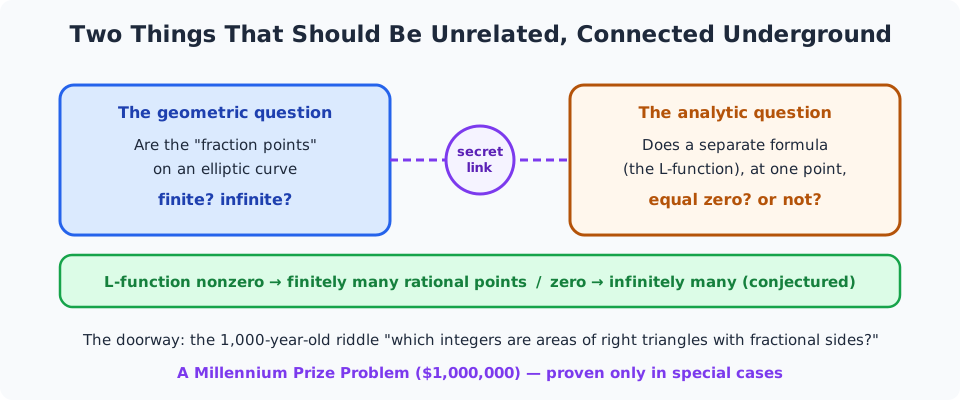
Does a given equation have finitely many answers expressible as fractions — or infinitely many? This plain question can be shockingly stubborn. What the BSD conjecture asserts is a strange correspondence: the answer to this “how many solutions” question is secretly predicted by the behavior of an entirely different formula. It is a conjecture that exposes a hidden tunnel between distant districts of mathematics, and its proof carries one million dollars. The problem is a bit abstract — but enter through the homely riddle of “which numbers can be the area of a right triangle,” and its delights come within reach.
The Doorway: Which Numbers Can Be a Right Triangle’s Area?
Before any abstraction, let’s start with a concrete riddle known for over a thousand years: the “congruent number problem.”
Consider right triangles whose three sides are fractions (rational numbers). The triangle with sides 3, 4, 5, for example, has area 6. So: which whole numbers can be the area of such a triangle? Integers that can are called “congruent numbers.”
Try it, and it refuses to go smoothly. 6 is congruent (sides 3, 4, 5). 5 is congruent too — but the right triangle realizing it has fractional sides and is far from easy to find. 7 is also congruent. Yet 1, 2, and 3 can be proven non-congruent. A simple test for “is this integer congruent?” went unfound through a millennium of searching. Tackled by a 10th-century Arab mathematician and attempted by Fibonacci, this classical problem, despite its innocent looks, ran down into the depths of number theory.
And the congruent number problem, it turns out, translates exactly into a problem of counting solutions on the objects we are about to meet — elliptic curves. A thousand-year-old triangle riddle wired directly into a Millennium Prize Problem: that unexpected connection is where the BSD story begins.
Elliptic Curves and “Finite or Infinite”
The protagonist of BSD is an equation called an “elliptic curve.” Despite the name, it is not an ellipse — it is a relatively simple equation of the form “y squared = x cubed + (something).” Plotted, it draws a smooth curve.
What mathematicians want to know about the curve is the number of “rational points” on it — points expressible with fractions. Are the points whose x and y coordinates are both fractions finitely many, or infinite? That is the field’s central question — and the congruent number problem rewrites precisely into asking “does the corresponding elliptic curve have infinitely many rational points?”
But telling “finite or infinite” apart is fearsomely hard. Staring at the curve, or even finding several points, tells you nothing about whether the supply stops or runs forever. The wall this series keeps hitting — “no finite amount of observation yields a conclusion about infinity” — stands here as well.
The 1960s: a Computer Finds the Secret Correspondence
The decisive hint emerged from experiments at the dawn of computing. In the 1960s, Bryan Birch and Peter Swinnerton-Dyer of Britain used a state-of-the-art computer to calculate a certain other quantity for many elliptic curves, comparing it against the counts of rational points.
That other quantity is the “L-function” — an entirely separate formula built from the elliptic curve (think of it as a cousin of the zeta function from this series’ Riemann hypothesis article). What the pair discovered was an astonishing correspondence: whether this L-function equals zero at one particular point appears to lock in step with whether the curve’s rational points are infinite.
A little more concretely: if the L-function is not zero there, the rational points are finite; if it is zero, they are infinite. And beyond that: how deeply the L-function vanishes at that point even calls the “richness” of the rational points. The count of an equation’s solutions, and the value of an unrelated formula — two things with no visible connection, joined by a secret tunnel. That is the BSD conjecture, named for Birch and Swinnerton-Dyer’s initials.
Why This “Bridge” Matters So Much
BSD ranks among mathematics’ most important problems because it is a bridge between different territories of mathematics.
On one bank sits a plain, geometric problem: counting an equation’s solutions. On the other bank sits something utterly alien: the analytic behavior of an L-function. BSD claims the two banks are the same landscape described in different languages. Discoveries of such bridges — “different fields were secretly one” — are modern mathematics’ deepest and most productive theme. Fermat’s Last Theorem fell after 360 years precisely because a bridge of this kind (a conjecture linking elliptic curves to another class of objects) was built.
BSD has been proven in the easy special cases: when the L-function’s zero is shallow, the conjecture is known to hold. But the general case remains untouched. Most mathematicians believe it; massive computational experiments all support it; the full proof stays distant. The familiar scenery of Goldbach and the twin primes — “everyone believes it, no one can prove it” — spreads out at the feet of this most abstract of problems too.
The Invention That Measures “Hidden Counts”
BSD’s full statement contains one more curious character that has long tormented mathematicians. To state the conjecture precisely — to square the L-function’s value with the count of rational points — you need a quantity called the “Tate–Shafarevich group,” which measures, so to speak, “the count of hard-to-see solutions.”
It is an odd creature: it measures the size of the mismatch where “solutions look like they should exist, yet no rational solution actually does” — and for a long time no one even knew whether it was finite. A ghost: present or absent, and if present, how large — ungraspable. The complete form of BSD is the grand claim that everything balances, ghost included.
This craft of “defining and taming quantities that cannot be seen” is, I think, mathematics showing its teeth. Unable to observe the thing directly, you constrain its existence and size indirectly through its bookkeeping with visible quantities. The same reasoning by which astronomers deduced an unseen planet from wobbles in nearby orbits, at work deep in abstract mathematics.
Plain Questions About an Abstract Conjecture
Honestly, I Can’t Feel Why This Is Amazing
Fair enough. The conjecture’s power lies not in everyday usefulness but in exposing invisible correspondences. It is the joy of discovery you get when an astronomer realizes the geometric motion of planets and the separate law of universal gravitation are one thing — different parts of the world running on the same hidden principle. A full proof of BSD would completely solve the thousand-year congruent number problem and deepen understanding of the elliptic curves used in cryptography. But the best entrance to savoring this problem is not utility — it is the pure strangeness of “why do two unrelated things move in lockstep?”
I’ve Heard Elliptic Curves Are Used in Cryptography?
Correct — and this is one of the few practical points of contact. Part of the cryptography securing smartphone communications and credit card payments (elliptic curve cryptography) exploits exactly these curves. The computation of walking along rational points is “easy in one direction, extremely hard in reverse” — and that asymmetry is the key. Deeper understanding of the structure of rational points — BSD’s subject — bears, in the long run, on cryptography’s foundations. That the elliptic curve, seemingly the most otherworldly object in pure mathematics, guards our daily communications is a delicious fact.
Does This Problem Look Solvable Someday?
Even experts split on the outlook. It sits on the extension of the machinery that solved Fermat’s Last Theorem (the theory surrounding elliptic curves), so it is not without footholds, and proofs of special cases advance steadily. On the other hand, some point out that the mathematics needed for the general case may simply not exist in humanity’s hands yet. Partial successes accumulating while the citadel stays out of reach — the situation shared by so many problems in this series. When, by whom, and with what new idea it falls is unpredictable — and that unpredictability, I think, is the whole pleasure of following unsolved problems.
Related Unsolved Problems and Puzzles
See “the Riemann hypothesis,” starring the L-function’s kin; the fellow Millennium problem “the Poincaré conjecture”; and a test of intuition about infinity and counting, “Hilbert’s infinite hotel.”

Summary
This article covered “the BSD conjecture.”
Whether an equation’s answers are finite or infinite — secretly foretold by the behavior of an entirely different formula. Two worlds that should have nothing to do with each other, connected underground. The charm of BSD is the discovery of that secret tunnel — with the bonus fact that its entrance is a thousand-year-old riddle about right triangles, giving you the feeling of mathematics as a single connected whole.
Honestly, this is one of the most abstract, least graspable problems in the series. But if you carry away just the one strangeness — “why do unrelated things move together?” — you have touched the conjecture’s heart. What mathematicians see on the far side of the million dollars is precisely the identity of that strangeness.
To return to the full list of unsolved problems, follow the link below.
Thank you for reading. We hope to see you in the next article.

Also popular with readers
📚 Series: Unsolved Problems in Math & Science (10/16)