Thank you for visiting this site. This article covers “the Hodge conjecture” — famous as the “hardest to explain” of the Millennium Prize Problems.
Let me be honest up front: this problem is by far the most abstract in this series. The Riemann hypothesis and P vs NP translated into everyday language; the Hodge conjecture is one where even experts agree that “an accurate popular explanation is nearly impossible,” and understanding its content requires several graduate-level fields of mathematics. So this article’s goal is not to make you understand it. The aim is to send you home, as honestly as possible, with just the feel of it: “a problem of this flavor, in this position, exists.”
Start with the Idea of “Counting Holes”
The core is unreachable head-on, so we approach from a distance. The starting point is the mathematical idea of counting a shape’s “holes.”
A donut has one hole; a figure-eight pretzel has two. The field that studies features like “number of holes” — unchanged by stretching and squeezing — is topology, which we met in this series’ Poincaré article. Mathematicians have built precision instruments for counting and classifying such holes — not just simple ones, but the various invisible kinds of “hole-like things” that complex, high-dimensional shapes possess, all catalogued systematically.
The shapes on stage here are not homely donuts. They are figures defined by equations in the world of complex numbers — abstract objects of very high dimension. Still, the one image you need to proceed is simply: “complicated shapes are pierced by holes of many different kinds.”
Which Holes Are “Made from Well-Behaved Materials”?
What the Hodge conjecture asks, broadly:
Of the many holes in a complicated shape, which ones can be built by gluing together “well-behaved shapes writable as equations”?
A little more imagery. Holes come with different “pedigrees.” One hole may be assembled from parts that equations describe cleanly (mathematics calls these algebraic) — built, so to speak, from honest materials. Another hole may be something stranger, impossible to build from such tidy parts.
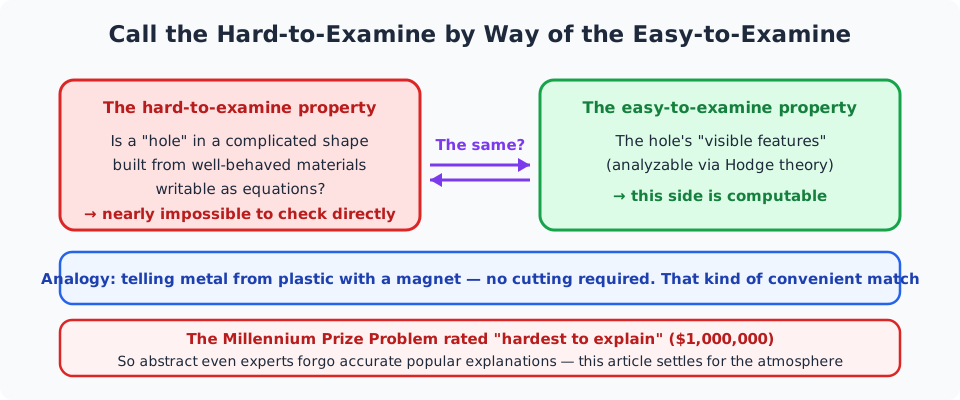
Meanwhile, mathematicians own a completely different toolkit — an analytic method called Hodge theory — that examines a hole’s “visible features.” The Hodge conjecture claims a correspondence: examining only those visible features is enough to tell whether the hole is built from honest materials.
The shape of the claim closely resembles this series’ BSD conjecture. A geometric property (is the hole built of honest materials?) and an analytic property (the hole’s visible features), investigated by different methods — and the conjecture says the two verdicts must always agree. An invisible bridge between disciplines: modern mathematics’ most beloved theme sits at the center once again.
An analogy. Suppose you could tell whether a part is made of metal just by holding a magnet near it, without ever cutting it open. Convenient, right? The Hodge conjecture says a convenience of exactly that kind should hold: judge the hard-to-examine property (“is this hole made of honest materials?”) purely from the easy-to-examine one (“its visible features”). The real objects are nothing like magnets, of course — but the skeleton of the idea, “call the uninspectable by way of the inspectable,” is exactly this.
Why Is It So Hard?
The difficulty has clear sources.
First, the objects live in a high-dimensional, complex-number world beyond intuition’s reach. Even Poincaré’s three dimensions strained the imagination; Hodge’s stage lies further out still. Testing ideas on touchable examples is barely possible.
Second, the conjecture demands that you “actually build the thing that should be buildable.” For a hole with the right visible features, you must show the honest materials composing it genuinely exist — and concretely constructing something that merely “ought to exist” is among the hardest kinds of work in mathematics. Call it a more tangled version of the odd-perfect-number bind we saw earlier: “should exist but can’t be found / shouldn’t exist but can’t be disproven.”
To add honestly: I do not fully understand this conjecture’s technical interior myself. So this article’s policy is no pretending — “what is hard is hard.” There exist peaks of knowledge whose full shape even specialists cannot take in within a lifetime. Simply knowing that fact cultivates intellectual humility, I think — and being able to say “I don’t understand” plainly is, if anything, refreshing.
What the “Hardness to Explain” Itself Teaches
Since we’re here, let’s savor the incomprehensibility itself. Why can the Riemann hypothesis be explained to a general audience while the Hodge conjecture cannot?
The reason is the difference in the number of prerequisites. Riemann stars “the sequence of primes,” which everyone meets in grade school. P vs NP opens from the daily feel of “solving versus checking.” But Hodge’s protagonist is an object that only comes into view atop stacked stories of abstraction. It sits like the top floor of a tower built on foundations upon foundations; climbing the stairs from the ground floor, the explanation of each intermediate floor fills a textbook.
This is not a defect. It is evidence of how high human knowledge has been stacked. Over millennia, mathematics has built a tower of abstraction upon abstraction. There are views visible only from the top floor, and the Hodge conjecture lives there. The fact that “knowledge exists that cannot be understood in one leap” stings a little — and is at the same time deeply reassuring. Humanity cannot yet fully survey the top of its own tower.
Questions for Savoring What We Don’t Understand
So What Should We Actually Take Home?
Three things suffice. First: this is a Millennium Prize Problem — one of mathematics’ most important questions, with a million dollars on it. Second: its content is a bridge problem between disciplines — “can we tell, by a different method, which holes in a complicated shape are made from honest materials?” Third: it is so abstract that even experts give up on accurate popular explanations. Grasp those three points and you have more than enough as general knowledge. The very feel of it — such problems really exist in the world — is this article’s gift.
Why Put a Million Dollars on Something So Obscure?
Because obscurity and importance are different things. The Hodge conjecture sits at the root of the field of algebraic geometry, and its proof is expected to organize an enormous body of mathematics about shapes and equations under one roof. The same shape as the Riemann hypothesis, whose proof would firm up the foundations under all of number theory. The plainer and more obscure the foundation, the greater both the damage when it fails and the payoff when it sets. What mathematicians prize is not flash but whether a result can bear the weight of many others.
How Would a Layperson Go Deeper?
Honestly, I would say the Hodge conjecture is “not the mountain to climb first.” The same intellectual thrill is healthier to seek on more climbable peaks. This series’ Poincaré conjecture has the tactile pull of “the shape of the universe”; P vs NP opens from “solving versus checking.” For the delight of bridges between disciplines, BSD — which at least has concrete examples — makes the better gateway. Treat Hodge as a marker on the map, admired from a distance after enjoying the others: “apparently the world contains peaks like that too.” That is exactly the right distance.
Related Unsolved Problems and Puzzles
See “the BSD conjecture,” which shares the bridge-between-fields architecture; the fellow shape-wrangling Millennium problem “the Poincaré conjecture”; and intuition about infinity and existence shaken hard in “the Banach–Tarski paradox.”

Summary
This article covered “the Hodge conjecture.”
This is the one article in the series that never set “making you understand the content” as its goal. Facing a problem whose accurate popular explanation even experts forgo, it seemed more honest to say plainly “this is genuinely difficult” than to manufacture the feeling of understanding.
Even so: can the holes of a complicated shape be told apart by a different method? That one-line theme, and the problem’s standing as a pillar of the Millennium Prize list, should have made it home with you. To respect what we do not understand, while it stays not understood — that too, I think, is a rich way to live alongside the high peaks of unsolved knowledge.
To return to the full list of unsolved problems, follow the link below.
Thank you for reading. We hope to see you in the next article.

Also popular with readers
📚 Series: Unsolved Problems in Math & Science (11/16)