Thank you for visiting this site. This article covers an unsolved problem standing on the border of physics and mathematics: “the Navier–Stokes equations.”
Turn a faucet gently and the water falls straight, like a transparent rod. Turn it a little further and, at some instant, the flow breaks up, spins into eddies, and never repeats the same shape again. Governing that “disorder” is the Navier–Stokes equation, written down about 200 years ago. Weather forecasting and aircraft design use it every day. Yet through mathematics’ eyes, the equation lacks a proof for even the entrance-level question: “do its answers (solutions) keep existing forever?” On that question rides a one-million-dollar Millennium Prize.
The Equation of Motion for Water and Air
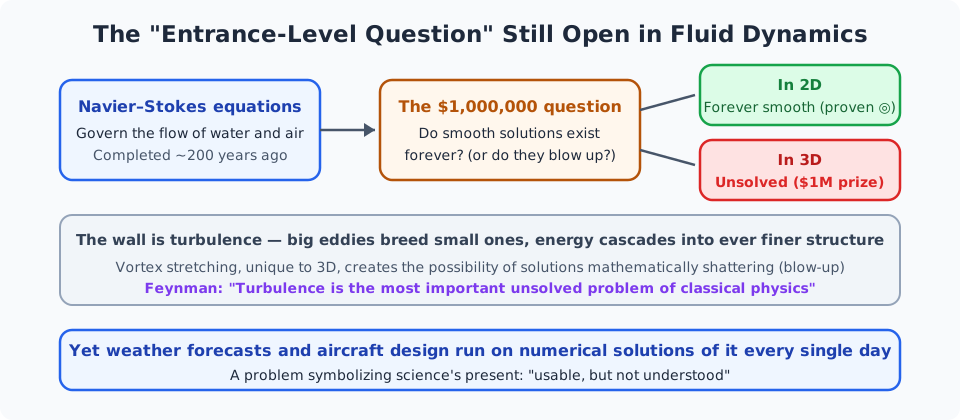
The Navier–Stokes equations describe how the velocity of a fluid — water, air — changes over time. In the early 19th century the French engineer Navier built the prototype and the British physicist Stokes completed it. At heart it is Newton’s equation of motion in fluid form: “each parcel of fluid moves according to the forces pushing it and its viscosity,” rendered in mathematics.
Its dominion is overwhelming. Water in a glass, blood in vessels, air around a wing, typhoons, ocean currents, the gas of galaxies — virtually every visible-scale flow is governed by this one equation. Weather forecasting applies it (or its close kin) to the Earth’s atmosphere on supercomputers, and in aircraft and automobile design, much of wind-tunnel testing has been replaced by numerical simulation of the equations.
In the sense of “using” it, then, humanity has tamed this equation completely. The problem is that in the sense of “understanding” it, we are stalled at the front door.
The Million-Dollar Question: “Do Solutions Blow Up?”
In 2000, the Clay Mathematics Institute selected the equations as one of its Millennium Prize Problems. The prize question is surprisingly plain:
In three-dimensional space, starting from smooth initial conditions, does a smooth solution of the Navier–Stokes equations exist for all time — or can it break down (blow up) in finite time?
“Blow-up” means the velocity or vorticity at some point of the solution diverges to infinity within finite time. Physically: you start from a calm water surface, yet on paper the flow might mathematically shatter after a finite time. Real water shows no hint of such behavior. But a guarantee that the equation’s solutions never do — no one has supplied one in 200 years.
Here is what is known. In 1934, France’s Leray proved that “weak solutions” — solutions in a relaxed sense — exist for all time. But weak solutions are a compromise, with neither smoothness nor uniqueness (a single determined answer) guaranteed. Also, in two dimensions — a world confined to a plane — smooth solutions are proven to exist forever. The heart of the problem hides in three dimensions alone. In 2014 the mathematician Terence Tao showed that an “averaged” modification of the equations really does admit solutions that blow up in finite time, energizing the research direction that “the true equations might blow up too.” Experts remain split between the “forever smooth” camp and the “blow-up possible” camp.
Turbulence: “Classical Physics’ Last Great Problem”
Why is three dimensions alone so hard? The key is turbulence.
Flow has two faces. Slow flow, called laminar, is well-mannered, smooth, and mathematically docile. But raise the speed and flow abruptly transitions to turbulence. Big eddies spawn smaller eddies, which spawn smaller ones still. This “cascade of eddies” carries energy to ever finer scales, so three-dimensional turbulence can generate structure as fine as you please. If blow-up happens, it is precisely inside this structure straining toward the infinitely small. (In two dimensions the mechanism of vortex stretching is absent, and this runaway never starts.)
The transition from laminar to turbulent flow was first studied systematically by Reynolds in the 19th century. With the humble experiment of streaming dye through water in a glass tube, he showed the dye holds a single thread at low speed and is abruptly churned apart past a threshold. The governing index is called the Reynolds number, still the lingua franca of fluid dynamics. The experiment can be reproduced in a middle-school science room, while the mathematics behind it is a million-dollar open problem — a depth of field typical of this subject.
Turbulence is also famous for Feynman’s description of it as “the most important unsolved problem of classical physics.” After the “distant worlds” of quantum mechanics and relativity were built out, complete understanding of the “nearest world” — a glass of water — remained. That irony is, I think, the narrative charm of the Navier–Stokes problem.
On Airplanes Flying with Unguaranteed Tools
An obvious question arises: if even the existence of solutions is unguaranteed, how do weather forecasts and aircraft design function?
What practice uses is not exact solutions but numerical approximations. Carve space and time into a fine grid and trace the equations across it. The latest global weather models reach grid points in the hundreds of millions — still nowhere near turbulence’s smallest eddies, so the too-fine eddies are replaced with empirical approximations called “turbulence models.” This all-out engineering campaign is validated against experiment and observation, and is known to be reliable enough for practical use.
Still, the absence of mathematical guarantees casts a shadow over practice too. How close numerical results come to true solutions, how large the turbulence models’ errors run — fundamental answers require understanding the solutions themselves. Improving forecast accuracy and controlling turbulence (aircraft fuel economy hangs directly on this) will eventually demand mathematical progress. The million-dollar question is, in fact, plumbed into industry’s foundations.
I love this problem’s shape — “used every day, understood by no one.” The gap between understanding and utility is wider than we assume. Whenever I meet code in the software world that “works, but no one can explain why,” I think a little of Navier–Stokes.
Why the Forecast Still Verifies Today
If a Solution “Blows Up,” Does Real Water Explode?
No. This is the easy misreading: blow-up is strictly a breakdown of the equation as a model. Real water is made of molecules; infinitely fine eddies cannot physically exist. If blow-up were proven, the discovery would be that “Navier–Stokes fails as a model beyond the limits of the continuum approximation” — not an anomaly of real water but a discovered mismatch between equation and reality. Either outcome is a windfall for physics: that is the fun of this prize problem.
Are Missed Forecasts the Fault of This Unsolved Problem?
The main culprits lie elsewhere. Forecasts miss chiefly because the atmosphere is chaotic — tiny errors in initial conditions amplify within days (the butterfly effect) — and because observation data and grid resolution have limits. These are separate difficulties from the existence problem; solving the Millennium Prize would not make the weekly forecast suddenly reliable. That said, mathematical progress on turbulence could improve the approximation layers of forecast models. “Not unrelated, but not directly wired together” is the accurate distance.
How Is Progress Going, as Millennium Problems Rank?
Among the seven, this one is known for the scarcity of footholds. The Riemann hypothesis has masses of partial results; P vs NP has its wall theorems declaring “not by this method.” Navier–Stokes lacks even a settled direction — affirm (forever smooth) or refute (blow-up exists)? Recent years brought Tao’s averaged-equation work and constructions of genuine blow-up solutions in related fluid equations, so circumstantial evidence has been inching toward “blow-up possible.” The prevailing view: the finish line is still far away.
Related Unsolved Problems and Puzzles
See “the three-body problem,” where unpredictability likewise takes the lead role; the fellow Millennium problem “P vs NP”; and a cut into the physics of heat and information, “Maxwell’s demon.”

Summary
This article covered the unsolved problem of “the Navier–Stokes equations.”
A 200-year-old equation ruling everything from faucet water to typhoons — and its very first question, “do the answers keep existing,” is still open. Meanwhile it runs at full throttle in practice, every day. This inversion — utility sprinting ahead of understanding — is, the problem teaches us, not rare at all in working science.
Next time you look at a typhoon track forecast’s circle, remember the equation spinning behind it with a million-dollar mystery asleep inside — and the weather map should feel just a bit more thrilling.
To return to the full list of unsolved problems, follow the link below.
Thank you for reading. We hope to see you in the next article.

Also popular with readers
📚 Series: Unsolved Problems in Math & Science (12/16)