Thank you for visiting this site. This article covers the legendary problem of celestial mechanics: “the three-body problem.”
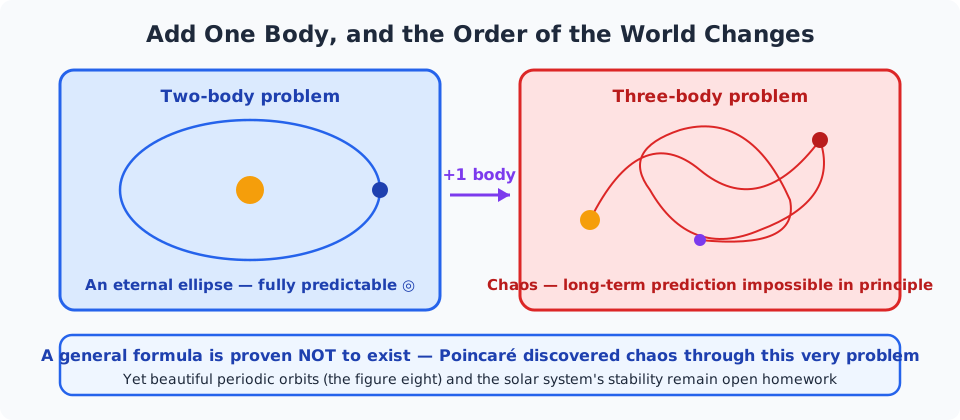
With just two bodies — the Sun and the Earth — orbits can be computed perfectly. Newton solved it 350 years ago, and the answer is a clean ellipse. Now add the Moon. The moment the count reaches a mere three bodies, no general formula for the orbits exists, and the motion can become impossible to predict in principle. This problem — which lent its name to a famous science fiction novel — is not merely “too hard to solve.” It carries the notoriety that its unsolvability has itself been mathematically proven. And even so, mysteries remain.
Two Bodies: Perfection. Three: a Swamp
The three-body problem asks: what orbits do three bodies trace when bound by nothing but their mutual gravity?
The starting point was a dazzling success. From the law of universal gravitation, Newton solved two-body motion completely. A planet circles the Sun in an ellipse whose orbit can be written down, by formula, into the eternal future. The laws Kepler had distilled from observation were reproduced whole by calculation — one of the most beautiful victories in the history of physics, I think.
Naturally, three came next. Sun, Earth, Moon. Newton himself attacked the calculation and suffered; legend has him saying the Moon’s motion was “the only problem that made his head ache.” For the following two centuries, giants — Euler, Lagrange, Jacobi — took their turns, and none reached the two-body-style “universal formula for the orbits.” What they found were only exceptional solutions where the three bodies orbit while holding special configurations. Lagrange’s equilateral-triangle solution was later discovered in the flesh as the Trojan asteroids on Jupiter’s orbit, and today serves practically as parking spots for space telescopes (the Lagrange points).
”Chaos” Was Born from an Error in a Prize Paper
The decisive turn came in 1889, in a prize competition King Oscar II of Sweden staked on hard mathematical problems. France’s Henri Poincaré submitted the winning paper on the three-body problem (strictly, the n-body problem) and took the crown.
Then came an incident that lives on in the history of science. At the printing stage, Poincaré himself noticed a grave error in his proof. He paid out of his own pocket to recall and reprint the published copies — a sum reported to exceed the prize itself.
But the work of repairing the error is what changed history. In fixing it, Poincaré discovered that three-body orbits have the property that the slightest difference in initial conditions can lead to entirely different fates. Shift the starting position by a hair’s breadth, and the orbit a century later is unrecognizable. Since observation can never drive error to zero, long-term orbits are unpredictable in principle. This was the discovery of the concept now called “chaos.” Half a century later the property was rediscovered in the meteorologist Lorenz’s computer experiments and spread worldwide as the butterfly effect, after his lecture title “Does the flap of a butterfly’s wings in Brazil set off a tornado in Texas?” Chaos’s birthplace was not the weather — it was the three-body problem. A failed prize paper became the discovery report of the new continent of 20th-century chaos theory. As stories of unsolved problems breeding new mathematics go, they don’t come better.
The “no formula exists” part has its own proof, too. In 1887, Bruns proved that the traditional method — building solution formulas from combinations of “quantities that stay constant throughout the motion,” like energy — cannot write down the three-body problem’s solutions. The three-body problem is thus not “unsolved so far”: it is settled that it cannot be solved in the same sense the two-body problem was.
The People Who Gave Their Lives to Computing the Moon
The three-body problem’s history is not abstract mathematics alone. It developed under the life-or-death pressure of navigation: “predict the Moon’s position accurately.” To fix one’s position on the open ocean, lunar tables were the critical infrastructure of the 18th century.
The obsession with precision reached deranged heights. France’s Delaunay spent about 20 years expanding an approximation of the lunar motion by hand, filling two thick volumes with the result alone — single formulas running hundreds of pages, one of the summits of human hand computation. And in the 18th century came a crisis when the computed precession of the lunar orbit matched only half the observed value — enough to raise the suspicion that “Newton’s law of gravity might be wrong” (it was later traced to insufficient precision in the approximations, and the law was saved).
Today, lunar and planetary tables are produced by supercomputer computation, and the Earth–Moon distance is monitored by laser ranging at centimeter precision. A problem with no formula, wrestled to practical submission by hand-computation obsession and machine power: the three-body problem is also a 200-year demonstration that “unsolvable” and “unusable” are entirely different things.
The Mysteries That Remain, and the Miraculous Solutions
“If unsolvability is proven, isn’t the story over?” You might think so. But the fun of the three-body problem starts here.
First, the hunt for exceptionally beautiful solutions continues today. In 2000, the existence of an astonishing periodic solution was rigorously proven: three bodies chasing one another while forever tracing a single figure eight. With advances in computer search, recent years have brought reports of hundreds to over a thousand new families of periodic solutions — an ongoing mapping of “islands of order floating in a sea of chaos.” That so much pristine motion lay hidden inside an unsolvable problem shows the three-body problem is far from exhausted, a century after the proofs.
And the greatest homework of all: “is the solar system stable?” With eight planets, the solar system is a many-body problem incarnate, under chaos’s rule. Long-term supercomputer simulations show solar-system orbit prediction becomes effectively impossible beyond a few tens of millions of years. Computations have even reported a small but nonzero probability that, within the next few billion years, Mercury’s orbit destabilizes toward collision with Venus or the Sun. The stability under our feet is no proven eternity — it rests on an accumulation of observation and computation saying “apparently fine for now.”
Questions About Chaos and Computation
With No Formula, How Are Space Probe Trajectories Computed?
By numerically stacking up the future a little at a time. The equations themselves are known exactly, so compute “the next instant” in short time steps, repeat, and the orbit can be tracked to high precision. This is why probe navigation and eclipse prediction work. Chaos bares its fangs only over long time scales; in probe operations spanning years, course corrections come long before error amplification bites. “No formula” and “cannot compute” are different things — make that distinction and the whole problem snaps into focus.
Could the Setting of the Novel “The Three-Body Problem” Really Exist?
That setting — a planet tossed about by the gravity of three suns — uses the problem’s chaotic nature head-on. Triple-star systems are genuinely common, and the tendency of planetary orbits to destabilize in systems of three or more stars is an active research topic. That said, most real triple systems settle into a hierarchical arrangement — “a close pair plus a distant third” — which approximates as nested two-body problems, so environments as lawless as the novel’s are not the rule. If anything, the evolutionary view — unstable configurations get culled over eons and only stable ones survive — seems closer to the real universe.
I’ve Heard There Is a “Solution” by Sundman
Sharp of you — in 1912 Finland’s Sundman did succeed in expressing the three-body problem’s solution as an infinite series (a sum that never ends). Mathematically, one may say “a general solution exists.” Why doesn’t that count as a resolution? Because the series converges hopelessly slowly — astronomical numbers of terms are needed for practical precision — and it is useless for reading off the orbits’ behavior. “The formula for the answer is written, and it tells us nothing”: one of mathematics’ most ironic results, and a fine prompt for pondering what “solving” even means.
Related Unsolved Problems and Puzzles
See “the Navier–Stokes equations,” where unpredictability is likewise the crux; the universe’s invisible protagonist, “dark matter”; and determinism versus prediction pushed to its limit in “Laplace’s demon.”

Summary
This article covered “the three-body problem.”
Increase the bodies from two to three, and the world of perfect prediction gives way to the world of chaos. The steepness of that cliff teaches that nature’s complexity is born not of the number of parts but of their entanglement. And the story of Poincaré’s error embodies the essence of research itself: new concepts are born precisely out of failure.
When you look up at the Moon, remember now and then that its placid orbit tormented Newton — and remains the protagonist of a problem humanity still cannot claim to have solved.
To return to the full list of unsolved problems, follow the link below.
Thank you for reading. We hope to see you in the next article.
Also popular with readers
📚 Series: Unsolved Problems in Math & Science (13/16)