Thank you for visiting this site. This article covers the largest and most enigmatic presence in the universe: “dark energy.”
Recall the universe’s energy budget: ordinary matter — stars, the Earth — is 5%; invisible dark matter, 27%. And the remaining 68% — fully two-thirds — is dark energy. The runaway lead role of the cosmos, yet its identity is understood even less than dark matter’s. Only one thing is known: this mysterious something is accelerating the universe’s expansion, faster and faster. When the acceleration was discovered in 1998, the astronomers reportedly could not believe their own data. Let’s walk through what is happening, step by step.
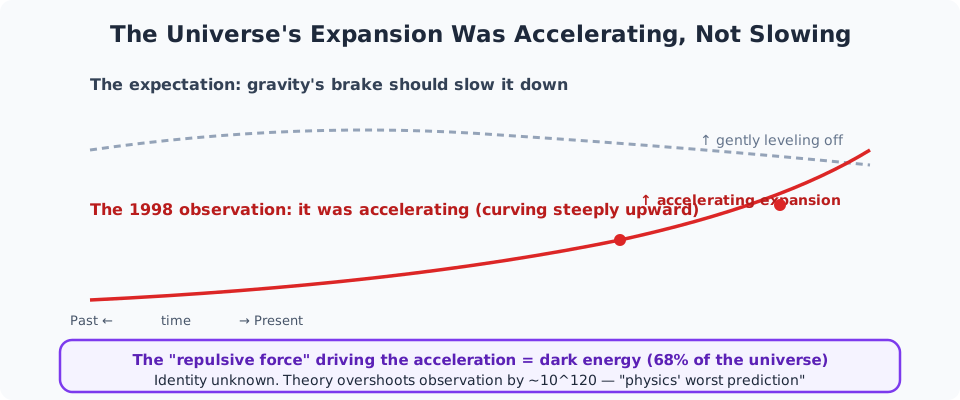
The Universe That “Should Be Slowing” Was Speeding Up
That the universe is expanding has been common knowledge since Hubble’s discovery in 1929. Begun in the Big Bang, the cosmos still spreads in every direction. At the end of the 20th century, what astronomers set out to measure was how fast that expansion was decelerating.
Expecting deceleration was perfectly reasonable. The matter in the universe pulls on itself by gravity, so — like a ball thrown upward slowing under gravity — the expansion ought to be braking. The question was only whether the brake was strong enough to someday reverse the expansion into collapse, or weak enough that expansion runs forever.
The tool for the job was a special stellar explosion: the “Type Ia supernova.” These explosions shine at nearly identical intrinsic brightness, so their apparent dimness yields accurate distances — a cosmic yardstick. In 1998, two independent teams measured the deep universe with this yardstick and got a staggering result. The distant supernovae were dimmer than predicted — farther away than they should be. Which meant the universe’s expansion was not decelerating but accelerating. They went looking for the brake and found the accelerator. No wonder the researchers doubted their own eyes. The discovery won the 2011 Nobel Prize in Physics.
Einstein’s “Greatest Blunder” Rises Again
Something is accelerating the expansion. If gravity pulls everything together, then a repulsive force pushing space apart must fill the universe to overcome it. This unidentified repulsion was named dark energy.
Delightfully, the concept has a prehistory starring Einstein. In 1917, applying his theory of gravity (general relativity) to the universe as a whole, Einstein realized the equations left the cosmos collapsing under its own gravity. So he added a repulsive term — the “cosmological constant” — to prop it up. Then Hubble discovered the expansion, the collapse worry evaporated, and Einstein withdrew the constant, reportedly calling it “the greatest blunder of my life.”
The 1998 discovery of acceleration resurrected that shelved cosmological constant after 80 years. The most straightforward reading of dark energy is exactly Einstein’s constant: “a fixed energy possessed by empty space itself.” As the universe expands and space increases, the repulsive energy increases with it — hence the more the expansion proceeds, the harder it accelerates. An idea a genius discarded as a failure may in fact be the universe’s lead actor. As payoffs of long-buried foreshadowing go, the history of science offers few finer.
The Worst Prediction in the History of Physics
If dark energy is “the energy of empty space,” it should be theoretically computable. Modern physics holds that the vacuum is not perfect nothingness but seethes with microscopic fluctuations carrying energy. So theorists computed the vacuum’s energy and compared it with the observed amount of dark energy.
The result froze physicists solid. The theoretical value exceeded the observed one by a factor of roughly 10^120 — a 1 followed by 120 zeros. “Off by orders of magnitude” does not begin to cover a discrepancy of cosmic proportions. It is regarded as the most divergent prediction between theory and observation in the entire history of physics, known as the “cosmological constant problem” — or, with rueful self-mockery, “the worst prediction in physics.”
That preposterous mismatch means we fundamentally misunderstand something about the vacuum — the most familiar “nothing” there is. The riddle of dark energy is a story of the deep cosmos and, simultaneously, a riddle underfoot: what fills the empty space of this very room? If this series’ dark matter is the mystery of “something missing from the universe,” dark energy is the mystery of “something inexplicable in vast oversupply.”
The Mystery Holding the Universe’s Fate
Dark energy is no mere academic puzzle: it decides the future of the entire universe.
If its repulsion stays constant, the universe accelerates forever, distant galaxies slipping one by one beyond the horizon of visibility. In the far future, it is predicted, no other galaxy will remain visible in the night sky. If the repulsion strengthens with time, a finale called the “Big Rip” may wait — galaxies, stars, even atoms torn apart. If instead it weakens and reverses, the universe could turn back toward contraction. Whether the cosmos expands forever or is one day ripped apart — the fork in that road is held by dark energy’s identity.
That is why astronomers worldwide are on the attack. Large telescopes and survey satellites mapping the expansion history with precision have come online one after another, working to determine whether dark energy is truly constant or changing with time. In the 2020s, observations have begun to appear hinting that dark energy may be varying slightly, and the debate has caught fire. If confirmed, the tidy cosmological-constant interpretation collapses, and cosmology faces another rewrite.
Why Would a “Repulsive Force” Even Arise?
Gravity pulls things together — so why does dark energy push space apart? This defies intuition, so a supplement is in order.
The key is that in Einstein’s theory of gravity, energy and pressure are themselves sources of gravity. Ordinary matter carries positive pressure, which generates attractive gravity. But if something exists with negative pressure — a tendency to push back on its surroundings rather than pull — it generates repulsive gravity. Dark energy — the energy of empty space — is believed to carry exactly this negative pressure.
Everyday sense insists that “more energy means stronger attraction,” so repulsion via negative pressure goes down hard. Yet it follows straightforwardly from Einstein’s theory. Where everyday intuition fails is precisely where the universe’s true face hides. Dark energy’s repulsion is the emblem of that. No need to force it down — it is enough to take away the fact: “the energy of space itself apparently works in the direction of pushing space apart.”
Questions About Dark Energy
What’s the Difference Between Dark Matter and Dark Energy?
Similar names, opposite jobs. Dark matter pulls — gathering matter by gravity, holding galaxies together. Dark energy pushes — spreading space, accelerating expansion. They live in different places too: dark matter clumps densely around galaxies, while dark energy is thought to spread uniformly and thinly through all of space. Their only common ground is “identity unknown” and the branding “dark” — remembering it that bluntly is the accurate way. Read alongside this site’s dark matter article, the contrast between the two mysteries that make up 95% of the cosmos comes through sharply.
Can We Feel Dark Energy in Daily Life?
No. Its repulsion is so weak it registers only at cosmic vastness. In regions tightly bound by gravity — solar systems, galaxies — dark energy’s push loses to gravity completely, and its influence is entirely imperceptible. No fear of the Earth being pried away from the Sun, or your body being stretched. Dark energy takes the lead role only in the empty, echoing gulfs between galaxies, where gravity barely reaches.
It’s Called “Dark” — Is It Dangerous?
Not in the least — nor is it some malevolent force from science fiction. The word “dark” was attached to mean “unseen and unidentified” — it emits no light and evades observation. An honest label from scientists, nothing more. It sounds ominous, but the content is a humble confession: “something we cannot yet name.” I take it as a mark of science’s integrity — calling the unknown, precisely, unknown.
Related Unsolved Problems and Puzzles
See the universe’s other invisible protagonist, “dark matter”; the unpredictability of cosmic motion in “the three-body problem”; and cosmology’s classic of why the night sky is dark, “Olbers’ paradox.”

Summary
This article covered “dark energy.”
The runaway lead of the universe at 68%, yet its identity ranks among physics’ greatest riddles. An idea Einstein threw away rose again 80 years later, and its theoretical value misses observation by 10 to the 120th power. With dark energy, the scale of what we don’t know is literally cosmic.
Stars, the Earth, ourselves — just 5% of the universe. The remaining 95% belongs to the twin mysteries of dark matter and dark energy. The fact sounds a little unsettling, but I hear it instead as the declaration of an outrageously rich intellectual frontier: 95% of the universe still waits, untouched, to be understood.
To return to the full list of unsolved problems, follow the link below.
Thank you for reading. We hope to see you in the next article.

Also popular with readers
📚 Series: Unsolved Problems in Math & Science (15/16)