Thank you for visiting this site. This article covers the oddball among the Millennium Prize Problems: “Yang–Mills theory and the mass gap problem.”
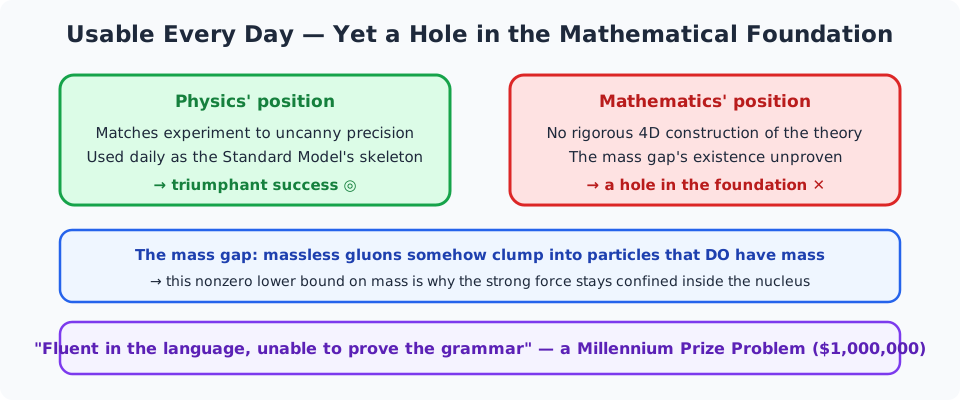
The strangeness of this problem: physicists use the theory every day and get correct answers, while mathematicians still cannot prove that the theory stands soundly on its own foundations. Yang–Mills theory describes what happens at matter’s deepest level, inside the atomic nucleus — it is the backbone of modern physics. Triumphant in both experiment and computation, it stands over a mathematical hole in its own floor. On this curious state — “usable, but unproven” — rides one million dollars.
The Theory That Writes the Blueprint of All Matter
First, what the theory does. Divide the world finer and finer and you reach molecules, atoms, nuclei, then protons and neutrons, and inside them the elementary particles called quarks. The theoretical edifice describing how these particles behave and what forces bind them — modern physics’ high-water mark — is called the “Standard Model.”
Yang–Mills theory is the Standard Model’s mathematical skeleton. Built by the physicists Yang and Mills in 1954, the framework proved astonishingly universal, describing three of nature’s four forces in one language (electromagnetism, the strong force binding nuclei, and the weak force behind radioactive decay). Why doesn’t the nucleus fly apart? How do elementary particles push and pull on one another? Every answer is written in Yang–Mills. It is no exaggeration to say the theory underwrites the very reason matter can exist.
And it agrees with experiment terrifyingly well. Results from particle collisions in accelerators have matched Yang–Mills-based calculations to precision of a different order. As physics, success does not come any larger.
The Mystery of Mass Born from Massless Particles
The problem lies in this triumphant theory’s mathematical foundation. What the prize problem specifically demands is a proof of a property called the “mass gap.”
Here is a strange story. The strong force binding quarks inside the nucleus is carried by particles called “gluons.” On paper, the gluon’s own mass is zero. Massless particles normally reach to infinite distance, the way light (the photon) does. Yet the strong force reaches only across the vanishingly small span of a nucleus. Carried by massless particles, yet confined to the shortest of ranges — on its face, a contradiction.
The key to the riddle is the mass gap. Treat the theory rigorously, and the real particles that massless gluons clump into (called glueballs and the like) are believed to always carry mass above some fixed positive value. That lower bound on mass — “even the lightest particle weighs at least this much, never zero” — is the mass gap. Forces carried by massive particles reach only short distances, and so the strong force’s confinement to the nucleus is explained.
Physicists know the mass gap exists with full confidence, from experiment (nuclei do hold together) and from supercomputer computation alike. What the prize demands is something else: prove it with mathematical rigor.
Why Is “Building It Rigorously” So Hard?
This is the least obvious and, I think, most interesting part of the problem. Physicists use the theory — so why have mathematicians not yet managed to “build” it?
Physics calculations typically run on approximations, plus techniques for taming the infinities that appear midway. The method produces answers that match experiment beautifully — but through mathematics’ eyes, the foundational question has been skipped: “does this theory even exist, consistently, in the first place?” A cooking analogy: the recipe reliably produces a delicious dish, yet no one can prove, scientifically, what nutrients the dish is made of.
The prize problem comes in two stages. First, construct Yang–Mills theory in four-dimensional spacetime in mathematically airtight form. Second, prove that the theory so constructed genuinely has a mass gap. That first stage — rigorously constructing a quantum field theory at all — has been a towering problem since the late 20th century. It is the work of bridging the language of physics and the language of mathematics; the finest minds of both fields have tried, and it stands unfinished.
I think this problem concentrates the charm of how science actually advances. Humanity often learns to use before it fully understands. Airplanes flew before aerodynamics was complete; steam engines ran before thermodynamics was born. Yang–Mills, likewise, works splendidly as the universe’s blueprint before its mathematical footing has set. Utility sprinting ahead of understanding — science’s dynamic posture, on full display.
The Problem of Mathematicians and Physicists “Not Speaking the Same Language”
Behind this problem lies another rich theme: the difference in how mathematicians and physicists think.
For a physicist, what certifies a theory is agreement with experiment. If the calculation matches the data, the theory is right — dubious mathematical moves along the way are not held against it. For a mathematician, what certifies a theory is logical airtightness. However right the answers, a hole in the middle of the logic means “not yet proven.”
These two value systems are not ranked — they have different jobs, I think. Physicists hold the reins of experimental reality and gallop the theory forward; mathematicians come after, laying rigorous track and certifying safety. The Yang–Mills problem is one of the widest gaps ever opened between physics’ advance and mathematics’ pursuit. History shows both fields growing dramatically richer whenever mathematicians rigorize the rough-hewn ideas physics drags in. The day this problem is solved will also be the day physics and mathematics can converse in one language.
Answering “Why Bother Proving It?”
If Experiments Confirm It, Why Do We Need a Proof?
As physics, indeed, no one doubts the mass gap exists. But the value of this problem lies exactly in the point that “physical correctness” and “mathematical proof of existence” are different things. The same shape as this series’ Navier–Stokes article: that reality behaves a certain way, and that the theory describing it stands consistent as mathematics, are entirely different jobs. And the process of laying rigorous foundations usually births mathematics no one anticipated. Attempts to mathematically formalize physical theories have repeatedly produced major advances in geometry and analysis. The mathematician’s view: the treasures gathered on the road toward the proof are worth more than the proof itself.
Why the Insistence on Four Dimensions?
Because our universe is built of four — three of space plus one of time. Interestingly, in reduced dimensions (2D or 3D spacetime), rigorously constructing Yang–Mills theory has partly succeeded. But the four dimensions we actually inhabit are decisively harder. Just as dimension three held out longest in the Poincaré conjecture, the genre’s familiar paradox surfaces here too: “the dimension nearest home is the toughest.” Nature, it seems, likes digging its deepest hole directly beneath where we stand.
Is There a Good Analogy for a Layperson?
“Fluent in the language, unable to state the grammar” comes close. A native speaker talks flawlessly, yet writing out the language’s complete grammar is a linguist’s life work. Physicists “speak” the language of Yang–Mills perfectly; its “grammar” is what mathematicians have yet to write down rigorously. Between mastery in use and complete logical articulation of the foundations lies that much distance. This problem embodies the gap between everyday skill and full understanding of principle — at the universe’s deepest level.
Related Unsolved Problems and Puzzles
See “the Navier–Stokes equations,” sharing the “usable but unproven” shape; the fellow Millennium problem “the Poincaré conjecture”; and the particle world’s intuition-shaker, “Schrödinger’s cat.”

Summary
This article covered “Yang–Mills theory and the mass gap problem.”
It describes the very reason matter can exist, matches experiment to uncanny precision — and still has a hole in its mathematical floor. That a theory this successful is this unfinished at the root teaches how precarious our sense of “having understood” really is.
Being able to use a thing, and understanding it. The slippage between the two, as we saw with Navier–Stokes, lurks throughout science. The Yang–Mills problem exhibits that slippage at the universe’s deepest stratum — a problem off every scale. The million dollars waits, on hold, until the day physics and mathematics can truly shake hands.
To return to the full list of unsolved problems, follow the link below.
Thank you for reading. We hope to see you in the next article.

Also popular with readers
📚 Series: Unsolved Problems in Math & Science (16/16)