Thank you for visiting this site. This article covers the only Millennium Prize Problem ever solved: “the Poincaré conjecture.”
Seven supreme problems of mathematics, each carrying a million-dollar bounty — the Millennium Prize Problems. Of the seven, exactly one has been solved to date: this one. And the story is dazzlingly dramatic: the mathematician who proved the century-old problem declined the Fields Medal — mathematics’ highest honor — declined the million dollars, declined everything, and withdrew into seclusion. The problem itself is a riddle both grand and tactile: “how do you tell the shape of a universe?” Let’s reach its heart with no prerequisites.
Telling “Hole or No Hole” with a Rope
The key to the Poincaré conjecture is the idea of distinguishing shapes by stretching and squeezing alone. Mathematics calls this topology. Like clay work — no cutting, no gluing — shapes that can be deformed into each other purely by stretching count as “the same shape.” In this view, a coffee cup and a donut are the same: both share the single feature “one hole,” and as clay, either can be kneaded into the other.
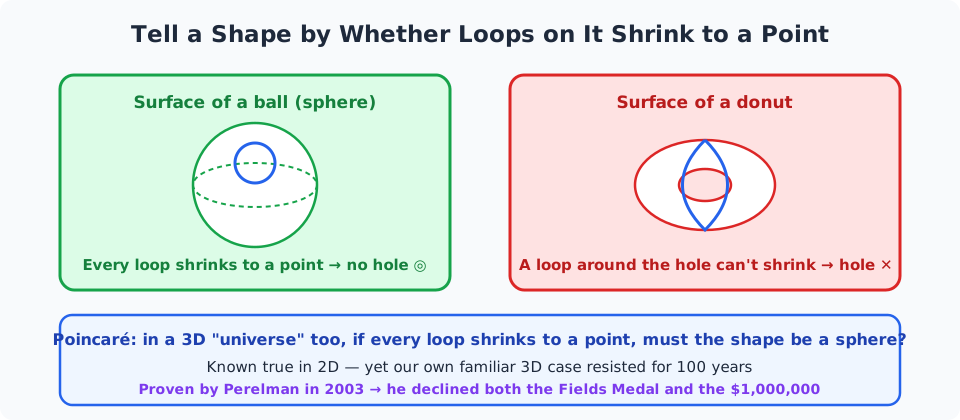
There is a way to test for “holes” without touching the shape at all: lay a loop of rope along the surface and try to reel it in.
Consider the surface of a ball. Lay a loop anywhere on it, and the loop reels in smoothly, shrinking at last to a single point — the ball’s surface has no hole to snag it. But on a donut’s surface, a loop threaded around the hole can never be reeled to a point, no matter how you pull; the hole catches it. If every loop laid on a surface can shrink to a point, the shape has no hole, and stretching alone can return it to a ball. Mathematics calls this property “simply connected.”
One Dimension Up, and a Century-Long Problem Is Born
So far this concerns the ball’s “surface” — a two-dimensional skin. For 2D surfaces, it was long known that “if every loop shrinks to a point, the surface is a sphere.” What Poincaré asked in 1904 was: what happens when you lift this one dimension higher?
It is hard for us to picture directly, but mathematicians consider an object called the “3-sphere.” Think of it as one candidate for the shape of the universe — a version of our own 3D space that, travel far enough, closes around and returns you to your starting point. Poincaré’s question, in plain terms:
If, inside some universe (a closed 3-dimensional space), every possible loop of rope can be reeled in to a single point, can we conclude the universe’s shape must be the “3-sphere”?
Obviously true in two dimensions, the claim spent nearly a century in three dimensions with neither proof nor refutation. Strangely, the higher-dimensional cases (five and up, then four) were settled within the 20th century, while the three dimensions closest to home held out to the very end. The intuition that lower dimensions should be easier gets betrayed here too.
Smoothing the Universe’s Wrinkles Like Flowing Heat
The man who settled it was the Russian mathematician Grigori Perelman. Across 2002 and 2003, he simply posted three papers to the internet — and thereby presented the world with a proof of the super-problem. No journal submission. No press conference.
The core of his method was “Ricci flow” — in effect, an operation that irons out a shape’s wrinkles the way heat spreads. As stirring hot soup gradually evens out its temperature, one applies a kind of heat flow to a lumpy space, smoothing it bit by bit. A space in which every loop shrinks to a point, groomed by this flow, settles at last into the clean shape of a sphere — that is the rough plot of what Perelman showed.
The technique itself had been pioneered by the American mathematician Hamilton, but it had run aground on “singularities” — places where the shape spikes to infinite sharpness mid-flow. Perelman invented a surgical technique: carefully excise the spikes and let the flow continue — and broke through the wall. Verifying the proof took mathematicians worldwide several years; by 2006 the consensus stood: “the proof is correct.” It remains the only Millennium Prize Problem whose solution has been vetted and accepted.
The “Small Hole” That Survived a Hundred Years
The century before the proof was no smooth road. This conjecture is also notorious as a problem where false announcements of “I proved it” repeated over and over. Throughout the 20th century, many — including mathematicians of real standing — published proofs, only to retract them when holes were found. Even Poincaré himself initially believed he had proven a different claim, before finding his own counterexample and issuing the correction.
Why so many errors? Because the mathematics surrounding this conjecture has the property that “plausible-looking arguments hide subtle escape hatches.” Intuition about shape is powerful, but in higher dimensions it betrays you often, and between “looks obvious” and “can be proven,” pitfalls kept opening underfoot. The lesson we met in the Riemann and ABC articles — how brutally hard the verification of proofs can be — is engraved here too. Which makes the weight of Perelman’s proof, accepted after years of merciless scrutiny, all the greater.
The Mathematician Who Turned Down Every Honor
And here is why this story became legend.
In 2006, Perelman was to receive the Fields Medal, mathematics’ supreme honor. He declined. In the medal’s history since 1936, he is the only person ever to refuse it. Then in 2010, when the Clay Mathematics Institute resolved to award him the one-million-dollar prize, he declined that too.
About his reasons, Perelman has said little. What is reported are remarks to the effect of “if the proof is correct, no further recognition is needed” and “my contribution is no greater than Hamilton’s, who opened the road.” He is said to have felt deep unease with the mathematical world’s whole culture of evaluation, and reportedly now lives quietly in his hometown, withdrawn from public life.
He solved a hundred-year problem and turned his back on every ounce of wealth and fame it should have brought. That almost bracing consistency demonstrated, in the purest form imaginable, that mathematics exists not for prizes or money but for truth itself. As a portrait of devotion beyond all reckoning of gain, the story stays with you, whatever your field.
Plain Questions About the Shape of the Universe
So What Shape Is Our Universe, in the End?
The Poincaré conjecture is a mathematical theorem — “if every loop shrinks, it is a sphere” — and it does not prove our actual universe has that shape. Whether the universe is closed or infinite, and what shape it takes, are separate questions for astronomy to settle by observation. (Current observations find the universe very nearly flat, with no sign of closure within our visible range.) What the theorem provides is the mathematical language for cataloguing what shapes a universe could possibly have. A beautiful point of contact where cosmology and pure mathematics shake hands in the same arena.
Why Was 3D the Last to Fall?
Counterintuitively, each dimension has its own species of difficulty. In five dimensions and up, there is ample “room to maneuver,” making shape-tidying surgery workable — that was understood by the 1960s. Dimension four fell in the 1980s to different, special techniques. But dimension three has too little maneuvering room for the high-dimensional methods, while being nowhere near as simple as two: exactly the most troublesome middle width. As this series keeps finding, the paradox that “the most familiar is the hardest” shows its face here as well.
Can Ricci Flow Be Used on Other Problems?
It can. The Ricci flow machinery Perelman completed proved not just Poincaré but a broader claim wholesale (Thurston’s geometrization conjecture). Beyond that, the underlying idea — “groom a shape with a flow” — has spread into practical fields: smoothing noise in image processing, and probing the structure of data in machine learning research. A tool born to crack an unsolved problem clocks in at an entirely different day job. The pattern of mathematics repaying its debts, seen throughout this series, appears here once more.
Related Unsolved Problems and Puzzles
See the fellow Millennium problems “the Riemann hypothesis” and “P vs NP,” and a test of intuition about shape and infinity, “Gabriel’s horn.”

Summary
This article covered “the Poincaré conjecture.”
If every loop on a surface shrinks to a point, the shape has no hole. That tactile idea, lifted one dimension, transformed into a hundred-year problem; was solved by the unexpected tool of flowing heat; and the solver refused every honor. For the beauty of the problem and the purity of the human drama, I rank this a class apart among unsolved problems (strictly: formerly unsolved).
Six Millennium problems still stand against humanity. But the fact that one of seven has already fallen feels like a quiet promise that the remaining six, too, will someday meet their day of reckoning.
To return to the full list of unsolved problems, follow the link below.
Thank you for reading. We hope to see you in the next article.

Also popular with readers
📚 Series: Unsolved Problems in Math & Science (9/16)