Thank you for visiting this site. This article covers modern physics’ greatest piece of homework: “dark matter.”
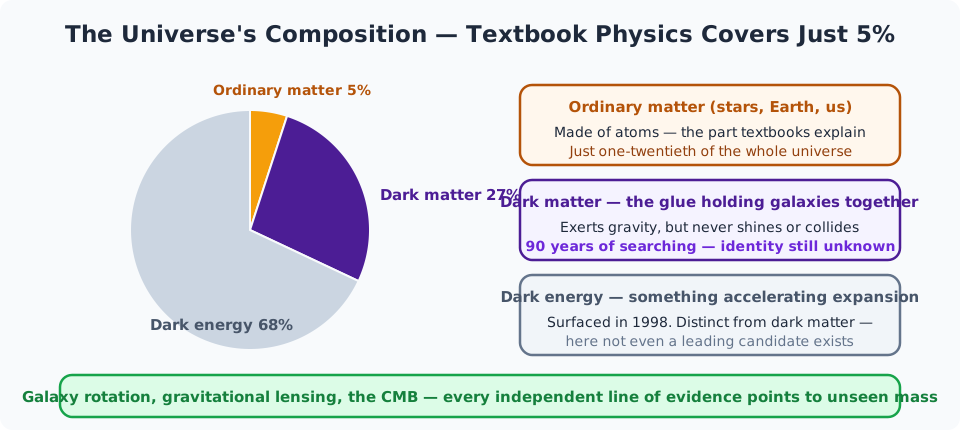
The atoms you learn about in school — the “ordinary matter” that builds stars, the Earth, and our own bodies — amount to a mere 5 percent of the universe’s total energy. Of the remaining 95 percent, about 27 percent is the unidentified “dark matter,” and about 68 percent the even more mysterious “dark energy.” In other words, textbook physics explains only one-twentieth of the universe. And dark matter stars in one of experimental science’s rarest stalemates: “it must be there — and 90 years of searching has not found it.” Let’s sort out what is known and what is not.
The Galaxies Spin “Too Fast”
The story of dark matter began with a nagging sense that “the numbers don’t add up.”
In 1933, the Swiss-born astronomer Fritz Zwicky, observing a cluster of galaxies, noticed something odd: the individual galaxies were moving too fast. The gravity of the visible stars could not possibly hold onto galaxies at those speeds — the cluster should long since have flown apart. Zwicky proposed that vast amounts of unseen matter were gravitationally tethering the galaxies, and named it “dark matter.” At the time, the proposal was mostly ignored.
The tide turned in the 1970s with the observations of the American astronomer Vera Rubin. Measuring the rotation of individual galaxies precisely, she nailed down a decisive fact: stars at a galaxy’s outer edge orbit far faster than the visible matter’s calculations allow. In the solar system, the outer planets orbit ever more slowly; in galaxies, rotation speed refuses to fall no matter how far out you go. This “flat rotation curve” was confirmed across many galaxies, and the only viable explanation was that several times the visible mass exists unseen, wrapped around each galaxy as a colossal spherical halo.
The Evidence Snowballs; the Identity Stays Dark
As observation technology advanced, the circumstantial evidence snowballed.
- Gravitational lensing: huge masses bend light’s path. Measuring mass distributions from the distorted images of background galaxies shows visible matter falls far short
- The cosmic microwave background: precision measurement of the ripples in the Big Bang’s afterglow lets you back-calculate the universe’s composition. This is where the modern standard figures come from: about 5% ordinary matter, 27% dark matter, 68% dark energy
- Galaxy formation: simulations show that without dark matter’s gravitational scaffolding, galaxies and clusters could not have grown this far in the time since the Big Bang
The piece rated the “smoking gun” is the observation of the Bullet Cluster, two galaxy clusters caught mid-collision. In the crash, the gas (the main component of ordinary matter) slammed together, slowed, and was left stranded in the middle. Yet the center of mass measured by gravitational lensing sat not with the gas but with the material that had passed straight through and moved on. Something of enormous mass that sails through a collision untouched. Evidence rarely speaks this plainly.
So “something is there” is nailed down by multiple independent lines of evidence. The problem: that something is none of the particles in particle physics’ Standard Model. It emits no light, carries no charge, almost never collides with ordinary matter — yet exerts gravity. Current physics owns no such particle.
Striking Out, 1,000 Meters Underground
The long-time leading candidate was “an unknown particle that is heavy and interacts with other matter only extremely rarely” (collectively, WIMPs). If the universe brims with these particles, the Earth is being pierced by countless dark matter particles every second — and if one very occasionally strikes an ordinary atomic nucleus, we could catch it.
The world bet on this script. To escape cosmic-ray noise, the detectors sit in mines and mountain tunnels a kilometer underground (Japan’s Kamioka mine hosts one). Tanks of liquid xenon are watched for years, waiting for the faint flash of a dark matter particle knocking a nucleus. Each generation of these experiments has raised sensitivity by orders of magnitude.
The result so far: every swing a miss. Attempts to manufacture dark matter particles in accelerators have caught no decisive signal either. The higher the sensitivity climbs, the more conveniently hidden any WIMP would have to be — so attention has shifted in recent years to other candidates (an ultralight particle called the axion; primordial black holes). “Evidence piled mountain-high in the cosmos, and not one catch in the laboratory.” That asymmetry is dark matter’s current address.
The Next Suspects — Axions and Primordial Black Holes
With the WIMP whiffing, new suspects have surfaced on the investigation board.
The first is the axion, an ultralight hypothetical particle. It was proposed in the 1970s for reasons unrelated to dark matter — to fix a separate theoretical snag in particle physics — but its resume turns out to fit dark matter’s job posting exactly: “light, abundant, and barely interacting.” Purpose-built experiments in several countries now stalk the instant an axion converts to a faint glimmer of light inside a strong magnetic field.
The second is primordial black holes. If small black holes born from density ripples just after the Big Bang survive in bulk, they could play dark matter’s role without hypothesizing any new particle. This old idea returned to the spotlight after 2015, when gravitational-wave observatories began catching black hole mergers one after another. But constraints from various observations increasingly say “primordial black holes alone cannot cover the whole 27%” — so they are being probed less as the ringleader than as an accomplice.
That the field cannot even narrow the candidates tells you where the problem stands. Mass estimates differ by dozens of orders of magnitude between candidates, and the search methods differ just as wildly. The dark matter investigation is staking out every alley at once, with no description of the suspect’s face or build.
The Rebellion: Maybe Gravity’s Law Itself Is Different
In fairness, a fundamentally different possibility deserves mention: “perhaps there is no invisible matter — perhaps the law of gravity itself needs modification at galactic scales.”
This modified-gravity theory, proposed in 1983 (known as MOND), explains galactic rotation curves astonishingly well with no dark matter at all — for some individual galaxies it even fits better than the dark matter model. But for observations like the Bullet Cluster, where mass and ordinary matter sit in different places, and for the precision data of the cosmic microwave background, the standard dark matter model holds the advantage, and the mainstream remains the “unknown matter” hypothesis.
Still, I think this rivalry displays science in good health. “Hypothesize invisible matter” and “modify the law” are both orthodox moves with historical precedent: Neptune was discovered by hypothesizing invisible matter, while Mercury’s orbital anomaly was resolved by modifying the law (general relativity). Which ending awaits dark matter, nobody yet knows.
How Is It Different from Dark Energy?
The Names Are Similar — Are Dark Matter and Dark Energy Different Things?
Entirely different — their jobs are, if anything, opposites. Dark matter is the “glue,” pulling matter together by gravity and holding galaxies intact. Dark energy is the “repulsion,” accelerating the universe’s expansion — its existence surfaced in the 1998 supernova observations (a discovery that won the Nobel Prize). What they share is only the mystery and the branding “dark.” The riddle of dark energy, 68% of the cosmos, runs even deeper than dark matter’s — there, not even a leading candidate has been narrowed down.
Is Dark Matter Passing Through My Body?
If the leading models are right, yes. Because dark matter barely interacts with ordinary matter, it is believed that vast quantities of it are streaming through your body and the whole Earth at this very moment. It is harmless (that is what “non-interacting” means). It sounds ghostly, but the neutrino — a real particle that “mostly passes through” — is already confirmed to pierce your body by the trillions each second, so physics finds nothing outlandish here. (Neutrinos themselves, by the way, are too light to be dark matter’s main ingredient.)
Related Unsolved Problems and Puzzles
See the fellow cosmic-scale mystery “the three-body problem”; the question of where the aliens are, “the Fermi paradox”; and the classic of why the night sky is dark, “Olbers’ paradox.”



Summary
This article covered “dark matter.”
It makes up 27% of the universe, holds the galaxies together, and stands on multiple independent lines of evidence — yet in 90 years it has never once been caught directly. A valley this deep between “evidence of existence” and “evidence of identity” is among the rarest sights in the history of science.
And here is the part worth holding onto: that valley is the flip side of the fact that “our textbooks are a commentary on 5 percent of the universe.” Ninety-five percent remains blank paper. For anyone about to study physics, has there ever been better news?
To return to the full list of unsolved problems, follow the link below.
Thank you for reading. We hope to see you in the next article.

Also popular with readers
📚 Series: Unsolved Problems in Math & Science (14/16)