Thank you for visiting this site. This article covers the mystery of “odd perfect numbers” — sometimes called “mathematics’ oldest unsolved problem.”
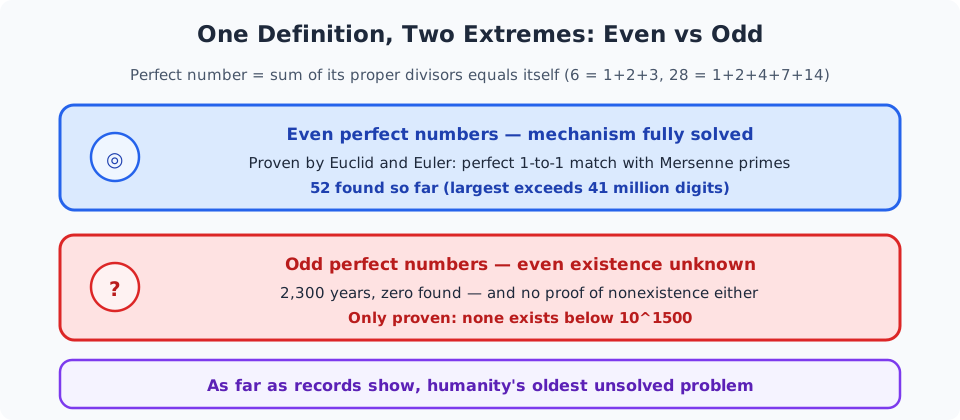
Take the number 6. Its divisors other than itself are 1, 2, and 3 — and 1+2+3 = 6. It lands exactly back on itself. Same with 28: 1+2+4+7+14 = 28. The ancient Greeks named such numbers “perfect numbers” and held them sacred. And yet, of the perfect numbers found to date, all 52 are even. Does an odd perfect number exist? No one has answered this question in over 2,000 years — making it, as far as records show, the oldest unsolved problem in existence.
Why 6 and 28 Were Called “Perfect”
A perfect number is a number whose proper divisors (all divisors except itself) sum exactly to the number itself. In ascending order: 6, 28, 496, 8128. These four were known already in ancient Greece.
The ancients saw mystery in this equilibrium. Numbers whose divisor-sum falls short (10 gives 1+2+5 = 8, a shortfall) are called “deficient”; those that overshoot (12 gives 1+2+3+4+6 = 16, an excess) are “abundant.” Only the numbers balancing “with neither lack nor excess” are perfect. The later Christian world went as far as interpretations like “God created the world in 6 days because 6 is perfect” and “the Moon’s cycle is 28 days because 28 is perfect.” Theology aside, it seems natural that numbers appearing so rarely along the number line were held apart as special.
The Pythagorean school also revered the perfect numbers’ cousins, the “amicable numbers.” The pair 220 and 284 stand in a relationship where each one’s divisor-sum equals the other: 220’s divisors sum to 284, and 284’s to 220. This sensibility — viewing numbers as emblems of character and relationship — is what nurtured the humble computation of divisor-sums into a research subject spanning two millennia.
Perfect numbers really are astonishingly scarce. Four exist below 10,000; finding the fifth (33,550,336) took over a thousand years. Today’s known total: 52 in all. And as noted at the outset, every last one of the 52 is even.
Euclid and Euler Solved the Even Side Completely
For even perfect numbers, the mystery is essentially solved — by a relay race 2,000 years long.
The first runner was Euclid, around 300 BC. In the Elements he proved: “if 2^p − 1 is prime, then that prime multiplied by 2^(p−1) is a perfect number.” For example, 2² − 1 = 3 is prime, so 3×2 = 6 is perfect; 2³ − 1 = 7 is prime, so 7×4 = 28 is perfect; and so on.
Primes of the form “2^p − 1” are called Mersenne primes, after the 17th-century friar Mersenne. Then the second runner, Euler, proved the converse in the 18th century: every even perfect number must take Euclid’s form. Even perfect numbers and Mersenne primes stand in perfect one-to-one correspondence.
Thanks to that correspondence, the hunt for even perfect numbers became the hunt for Mersenne primes. Today’s search is run by GIMPS, a distributed computing project linking volunteers’ computers worldwide, and the largest known Mersenne prime is a monster of more than 41 million digits. Each new Mersenne prime extends the perfect-number list by one. The figure 52 is the current score of this two-man relay.
Inside the Worldwide “Prime Hunter” Scene
The present-day Mersenne hunt is a genuinely exhilarating world. GIMPS, launched in 1996, works by having volunteers around the globe donate their home computers’ idle time to hunt giant primes, and it has monopolized the records for a quarter century. Anyone can join free, and discoverers get their names on new Mersenne primes.
Prize money entered the picture too. The Electronic Frontier Foundation set bounties at digit milestones, and $100,000 was actually paid for the first prime past 10 million digits (the next milestone, 100 million digits, still carries $150,000). The most recent, 52nd Mersenne prime was found by an individual who rented fleets of cloud GPUs — marking the shift from the age of the home PC to the age of the cloud.
The search for perfect numbers has traveled from ancient Greek mysticism, through a friar’s conjectural list, to a competition marshaling the world’s computing power. That a 2,300-year-old puzzle is still an active stadium is, I think, this problem’s proudest boast.
The Odd Side: 2,000 Years of Not Even Knowing If One Exists
In contrast to the elegant theory on the even side, the odd side is astonishingly blank.
To the question “does an odd perfect number exist?” the current answer is: “none has ever been found, and no proof of nonexistence exists either.” Counting from Euclid, 2,300 years — neither yes nor no. Descartes and Euler both worked on it; Euler narrowed the conditions (“if one exists it must take a specific form”), but a resolution stayed far out of reach.
The modern search advances by computationally raising the lower bound. It is now proven that no odd perfect number exists below 10^1500. The universe holds roughly 10^80 atoms; the searched territory dwarfs that beyond comparison. Moreover, dozens of harsh conditions have accumulated — if one exists it “must have many prime factors,” “must contain a prime factor of a specific form,” and so on — and the territory where an odd perfect number could hide shrinks year by year.
Most mathematicians conjecture “none exists.” But however tightly the conditions corner it, proving nonexistence is believed to require an independent, new idea. Shrinking a suspect’s possible hideouts never proves the suspect is nowhere. Here again is the same gulf as in Goldbach verification: between finite search and infinite proof.
The Luxury of 2,300 Years of “Uselessness”
Measured by utility, perfect-number research scores about zero. Unlike the primes used in cryptography, perfect numbers themselves have no industrial application in sight. Even so, I cherish this problem as the unsolved genre’s “emblem of purity.”
One reason: it demonstrates the lifespan of mathematics. The theorem Euclid proved remains exactly correct 2,300 years later, working today as the foundation of GIMPS’s search programs. Scientific theories get rewritten within decades; proven mathematics never ages. The history of perfect numbers is a living exhibit of that fact.
The other reason: it embodies, as the oldest specimen, the genre’s shared paradox that “the simpler the question, the tougher the fight.” A game of adding divisors that any schoolchild can play has stayed unsolved through the whole of human history — longer than Collatz, longer than Riemann. No problem offers a cheaper ticket to the bottomlessness of the world of numbers.
How Tightly Cornered Is the Odd Perfect Number?
If It “Almost Certainly Doesn’t Exist,” Why Not Just Declare It?
Mathematics cannot do that — and this very field supplies the cautionary tale. The old “list of exponents making Mersenne numbers prime” relied on Mersenne’s own conjecture, and later verification found the list contained both omissions and errors. “Almost certain” by intuition or authority has been overturned again and again before computers and proofs. The possibility of a single odd perfect number lurking beyond 10^1500 does not vanish until proven away. If anything, the tension between the feeling “surely no such thing exists” and the logic “we cannot say so” is the true pleasure of following this problem.
Are There Infinitely Many Mersenne Primes?
Also unsolved. The world of perfect numbers thus carries two open problems at once: “are even perfect numbers (= Mersenne primes) infinite?” and “does even one odd perfect number exist?” Most mathematicians expect infinitely many Mersenne primes — empirical laws predicting their growth rate have even been proposed — but there is no proof. As with the twin primes, “everyone believes it, no one can prove it” is the standard scenery here too.
Related Unsolved Problems and Puzzles
See “the Goldbach conjecture,” which shares the gulf between finite search and infinite proof; “the twin prime conjecture,” on the infinitude of primes; and “Galileo’s paradox,” a brush with the strangeness of numerical infinity.

Summary
This article covered the mystery of “odd perfect numbers.”
The even side: completely illuminated by Euclid and Euler’s 2,000-year relay. The odd side: hideouts narrowed past 10^1500, and still not even existence is known. Twin questions born of the same definition, split into light and darkness this extreme — a rare sight even within mathematics.
Add up 6’s divisors and return to 6. On the extension of that small game waits humanity’s oldest unsolved problem. Few places put the doorway of mathematics and its farthest frontier this close together.
To return to the full list of unsolved problems, follow the link below.
Thank you for reading. We hope to see you in the next article.
Also popular with readers
📚 Series: Unsolved Problems in Math & Science (5/16)