Thank you for visiting this site. This article covers “the twin prime conjecture” — the prime-number problem behind the greatest mathematical drama of recent years.
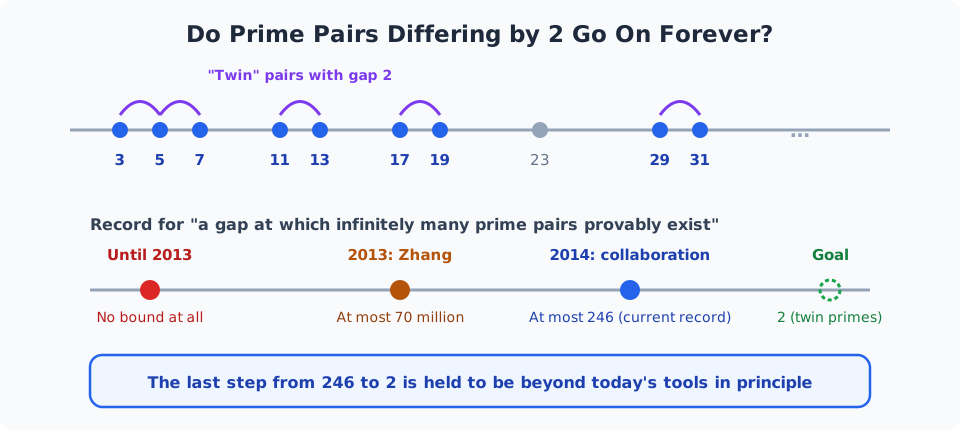
3 and 5, 5 and 7, 11 and 13, 17 and 19. Prime pairs differing by exactly 2 are called twin primes. Primes thin out as numbers grow, yet twins keep turning up even beyond the quintillions. So: are there infinitely many twin primes, or do they stop somewhere? Everyone believes they are infinite; no one can prove it. That deadlock was shattered in 2013 by a nearly unknown 58-year-old mathematician, working entirely alone. This article tells that story too, start to finish.
Primes Are Infinite — but Twins?
First, the foundation. That the primes themselves are infinite was proven by Euclid 2,300 years ago — held to be one of the most beautiful proofs in the history of mathematics, and the textbook example of proof by contradiction.
Yet the moment you restrict to “prime pairs differing by 2,” the conversation jumps to the frontier of modern mathematics. The conjecture was first put into print in its general form by the French mathematician de Polignac in 1849. The claim:
There exist infinitely many pairs of primes whose difference is 2.
Numerical experiments back the conjecture strongly. Twin primes keep being found deep into the world of large numbers — the largest known twin primes weigh in at about 390,000 digits. Still, that is no proof of “infinitely many.” As with the Goldbach conjecture, however many you find, logic cannot exclude the possibility that they run dry beyond.
The Sum of Reciprocals Reveals How “Thin” Twins Are
A beautiful classical result tells the story of the twins’ difficulty.
Add up the reciprocals of all the primes (1/2 + 1/3 + 1/5 + …) and the sum diverges to infinity. Euler’s discovery means the primes are “not just infinite, but distributed fairly densely.”
Then in 1919, the Norwegian mathematician Brun proved something shocking: the sum of the reciprocals of the twin primes converges to a finite value. That value is called “Brun’s constant,” estimated at about 1.902.
The meaning: twin primes — even if infinite — are scattered far more thinly and sparsely than the primes at large. The twin prime conjecture is thus not a claim that “something dense is infinite” but that “something extremely thin nevertheless never runs out” — and that thinness is precisely the wall blocking a proof. Incidentally, the “sieve method” Brun developed for this proof became a main weapon of subsequent prime research. Unsolvable problems breeding tools: the classic contribution of the genre.
2013: The Bombshell from an Unknown
The long stalemate was broken by someone who was not even a tenured professor.
Yitang Zhang is a mathematician who, unable to find a research post after his doctorate, drifted through jobs as a bookkeeper and in fast food. He eventually secured a lecturer position at the University of New Hampshire, but reached his late fifties with a research record close to invisible.
In April 2013, the paper he submitted to mathematics’ most prestigious journal stunned its editors. The claim: “There exist infinitely many prime pairs whose difference is at most some fixed value below 70 million.”
70 million versus 2 may look like a chasm. But the meaning of the result lies in this: for the first time in history, a finite bound on prime-pair gaps was proven. Until then, for every difference, “whether infinitely many such pairs exist” was unknown; now, “for at least some difference, infinitely many exist” was settled. A leap from zero to one. The journal rushed the paper through review at unprecedented speed, and the unknown 58-year-old became mathematics’ hero overnight.
What followed was even more dramatic. Mathematicians worldwide launched a bound-shrinking race as an online collaboration, the young James Maynard added a new method, and in under a year 70 million shrank to 246. That record — 246 — stands today. Shrink that number to 2, and the twin prime conjecture is solved.
How Far Away “244 More” Really Is
So is 246-to-2 just a matter of time? Unfortunately, no one thinks so.
The current methods are known to carry a theoretical limit: even assuming the proof of a powerful conjecture (the Elliott–Halberstam conjecture), the present line of attack can reach only 6. The final step to 2 is beyond existing tools in principle. The expert consensus is that solving the twin prime conjecture will require an entirely new idea — one that out-shocks Zhang’s shock.
The shape is a dead ringer for this series’ Goldbach conjecture. There: “three primes achieved, two primes a sheer wall.” Here: “reached 246, and 2 is the wall.” The final step before the finish line is longer than the entire journey so far. Set the two problems side by side and you feel it: in the world of unsolved problems, this absurd geometry is simply the norm.
The Formula That Predicts the Count Already Exists
Strangely, the world of twin primes already possesses a prophecy that calls their count. In 1923, England’s Hardy and Littlewood published the conjecture that the number of twin pairs up to x is approximated by “about 1.32 × x ÷ (log x squared).” A logarithm, roughly speaking, is a quantity that grows slowly, in proportion to the number of digits — so the prophecy says twins thin out steadily, but at a lawful pace, forever.
The formula’s marksmanship is superb: the twin counts computers actually tally and the predicted values continue to agree with high precision. The twin-prime world thus sits in a bizarre state: “the prediction of how many keeps coming true, while the crucial proof that they are infinite is missing.” Like a weather forecast that verifies daily while no one can prove the sun will rise tomorrow. It sits uncomfortably — deliciously so.
By contrast, that prime gaps can open arbitrarily wide is easy to prove. Take 101 factorial and add each of 2 through 101: those 100 consecutive numbers each have an obvious divisor, hence all are composite. So prime-free “deserts” can be built as long as you like. Amid deserts that can stretch without limit, do the paired oases alone continue forever? The exquisite knife-edge of the twin prime conjecture shows clearly in that contrast.
The Twin Primes That Exposed a Computer’s Flaw
Twin primes hold a rare distinction earned outside mathematics.
In 1994, the American mathematician Thomas Nicely was computing reciprocals of masses of twin primes to pin down Brun’s constant to high precision. But the results from his brand-new PC disagreed with theory. Hunting down the cause, he discovered the problem was not his code but a design flaw lurking in the division circuitry of Intel’s newest CPU.
This became the notorious Pentium FDIV bug affair. Intel initially balked, but mounting criticism forced a full recall at enormous cost. A computation of twin primes — the archetype of pure-math dilettantism — exposed a quality defect in the world’s PCs. “Useless mathematics” baring its fangs in the least expected place: one of my favorite anecdotes.
From Cousin Primes to Spectator’s Guides
I Heard There Are Also “Cousin Primes” and “Sexy Primes”
There are. Pairs differing by 4 are “cousin primes”; pairs differing by 6 are “sexy primes” (from the Latin sex = six — mathematicians in a puckish mood). De Polignac’s original conjecture is the general form — “for every even difference, infinitely many prime pairs with that difference exist” — and the twins are merely its star representative. What the post-Zhang results guarantee is only “infinitely many pairs at some difference of 246 or less” — whether that difference is 2 or 100 remains unidentified. Today’s theory sits at exactly that fascinating, maddening waypoint.
If Primes Are Infinite, Aren’t Infinite Twins Obvious?
Intuition says so; mathematics says no. In fact, it is easy to prove that “prime triplets with gaps of 2” (p, p+2, p+4 all prime) exist exactly once: 3, 5, 7 (one of the three must always be divisible by 3). Even with infinite primes, a specific pattern can terminate finitely. Whether the twins are infinite is therefore a genuine problem demanding proof.
Can a Layperson Follow the Latest Progress?
Zhang’s story has become a staple of mathematical nonfiction, with documentary films made of it. And the shrinking race from 70 million to 246 was run as the online collaboration known as the “Polymath Project,” whose progress remains public. Even without following the technical interior, watching the record shrink is enjoyable the way sports are. It is also a fine vantage on mathematics transforming from a solitary, closed-room craft into a networked team sport.
Related Unsolved Problems and Puzzles
See the boss of prime distribution, “the Riemann hypothesis”; the fellow “final step” problem, “the Goldbach conjecture”; and for intuition-rattling counting and probability, “the birthday paradox.”


Summary
This article covered “the twin prime conjecture.”
Progress stood at zero for over 160 years, jumped to 70 million on one blow from an unknown 58-year-old, shrank to 246 in an online team battle — and the final 244 remains a sheer wall. I think this story contains everything that makes the unsolved-problems genre magnetic: no one knows who will solve it, no one knows when it will move — but when it moves, it moves all at once.
Next time the word “primes” crosses a mathematics headline, it may be the twin-prime record moving again. Keep the current position — 246 — in mind, and you will feel the weight of that news.
To return to the full list of unsolved problems, follow the link below.
Thank you for reading. We hope to see you in the next article.

Also popular with readers
📚 Series: Unsolved Problems in Math & Science (4/16)