Thank you for visiting this site. This article covers one of the oldest unsolved problems in mathematics: “the Goldbach conjecture.”
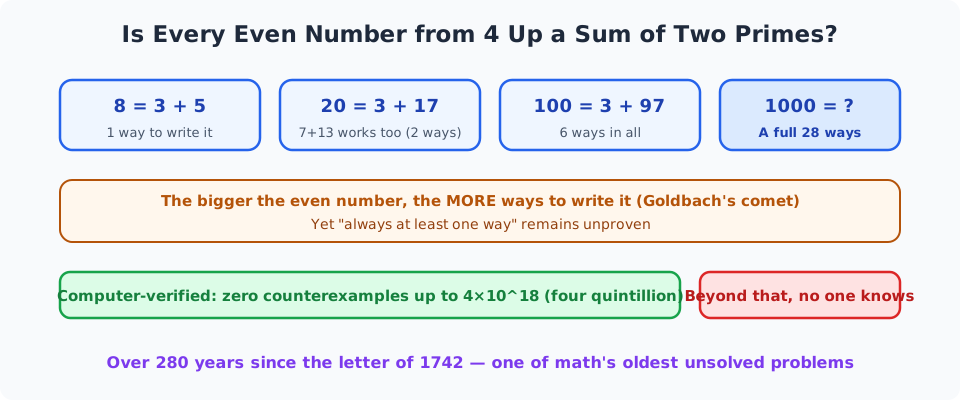
8 is 3+5. 20 is 3+17, or 7+13. 100 is 3+97. In this fashion, every even number from 4 upward can be written as “two primes added together.” Pick a few even numbers and try it yourself — you will always find a pair. But can we declare that a pair will always be found, for “every even number”? This question — explainable to a schoolchild, checkable as a game — has repelled the world’s mathematicians since 1742, for more than 280 years.
It Began with Two Mathematicians’ Correspondence in 1742
It started in June 1742, with a letter from the Prussian mathematician Christian Goldbach to the greatest mathematician of the age, Leonhard Euler. In the letter’s margin, Goldbach passed along an observation about numbers. Euler tidied it up and, in his reply, restated it in its modern form:
Every even number greater than or equal to 4 can be expressed as the sum of two primes.
Euler wrote back to the effect that “I regard this as a completely certain theorem, although I cannot prove it.” A problem that made Euler raise the white flag went on amassing white flags ever after. It was folded into the eighth of Hilbert’s 23 problems of 1900 (together with the Riemann hypothesis), and even the all-out war of 20th-century mathematics failed to settle it.
Goldbach himself, incidentally, was more of an enthusiast than a titan — a mathematician with no great theorem to his name. Yet the marginal observation of that man endures as a problem that has repelled Euler and every great mind since. In mathematics, posing a good question can itself be a great work — this is the exhibit A.
It is among the most senior of mathematics’ unsolved problems, and its statement is arguably the most accessible of them all. That “anyone can play” appearance would later attract an incident of its own, as we will see.
Checked to Four Quintillion, Zero Counterexamples
In the computer age, the conjecture came under brute-force assault. To date, every even number up to 4×10^18 (four quintillion) has been confirmed expressible as a sum of two primes. Counterexamples: zero.
And not merely “expressible.” As even numbers grow, the number of ways to write them as two primes tends to increase and increase. 100 can be written 6 ways; 1,000 has 28 ways. Graph the count of representations and a pattern spreads out like a comet’s tail — the famous “Goldbach’s comet.” With bigger evens ever richer in representations, a suddenly unwritable even number seems wildly implausible; probabilistic estimates rate the conjecture “almost certainly true.”
The comet’s spread is emphatic: by the hundred-thousand class, an even number has hundreds of representations. For the conjecture to fail, an even number whose hundreds of candidate pairs all perish without exception would have to lurk somewhere beyond four quintillion. That overwhelming margin is why most mathematicians never doubt the conjecture. And yet “a wide margin” and “zero exceptions” are different claims — such is mathematics’ code.
Still, mathematics refuses to say “proven.” The logical possibility that the very next even number after 4×10^18 breaks the pattern is not zero. As discussed in this site’s survivorship bias article, between piled-up observations and proof lies a gulf that no quantity of observations can fill. As a teaching tool for the depth of that gulf, this conjecture is my favorite.
”Close” Results Abound
The 280-year campaign has not been wasted. Short of a full proof, the “close calls” have stacked up. The landmark results:
- Three primes: done. The claim that “every odd number from 7 up is a sum of three primes” is called the “weak Goldbach conjecture,” and in 2013 the Peruvian-born mathematician Harald Helfgott announced its proof — the greatest advance in the problem’s 280-year history
- A prime plus an “almost-prime”: done. In 1973, China’s Chen Jingrun proved that “every sufficiently large even number is the sum of a prime and a number that is either prime or a product of two primes” (Chen’s theorem). Achieved under persecution during the Cultural Revolution, the proof is a national legend in China
- Large numbers: nearly done. In 1937, Vinogradov proved every sufficiently large odd number is a sum of three primes, opening the road to Helfgott
So the current state reads: “three primes — achieved. Two-and-a-bit — reached. The final ‘two’ — an unclimbed wall.” The goal in plain sight with the last step a sheer cliff: among unsolved problems, few shapes are more tantalizing.
The Million-Dollar Prize and “Uncle Petros”
In 2000, prize money landed on the conjecture from an unexpected direction. The publisher Faber and Faber announced it would pay one million dollars to anyone proving the conjecture within two years — as a promotion for the novel “Uncle Petros and Goldbach’s Conjecture,” the story of a mathematician who sacrifices his life to the problem.
Predictably, perhaps, no proof appeared within the deadline and the money went unclaimed. But the campaign left an epilogue: a torrent of “proof-like objects” poured in from around the world. Precisely because anyone can understand the statement, the difficulty of the proof looks deceptively small too. The Goldbach conjecture stands as a symbol of the gap between how mathematics looks and what it is.
Try decomposing a few small even numbers yourself and prime pairs turn up almost disappointingly fast. That felt gap — “so easy to find, yet impossible to guarantee” — comes through vividly when you work by hand, and I enjoy it as a weekend brain-teaser.
How Did the Verification Reach Four Quintillion?
Four quintillion sounds mind-numbing, but the verification rests on an efficient tactic: for each even number n, search for its “partner” starting from the smallest primes. Try 3 first and test whether n−3 is prime; failing that, 5, then 7, then 11. In practice, nearly every even number finds its partner within the first handful of primes.
The verification projects’ tallies preserve a delightful fact: every even number up to 4×10^18 decomposed using a smaller prime no bigger than 9,781. Across the furthest corners of a four-quintillion world, the partner-hunt stays absurdly light. This “findability” is itself powerful circumstantial evidence for the conjecture.
That it still is not a proof comes down to findability being only an “average tendency.” However strong the tendency, it cannot exclude one lone exception. The same shape appears in the Collatz conjecture article: the gulf between “almost certain” and “certain” is the main battlefield of the whole unsolved-problems genre.
Odd Numbers, and the Limits of Verification
What About Odd Numbers?
An odd number cannot always be two primes. Split an odd number into two summands and one must be even, so only odd numbers of the form “prime + 2” qualify (11, for instance, cannot be written so). Hence the weaker conjecture for odds — “a sum of three primes” — which was proven in 2013. The two are master and servant: prove the two-prime version for evens, and the three-prime version for odds follows instantly as “the even case plus the prime 3.”
Why Can’t Computers Just Check Everything?
Because there are infinitely many even numbers. However far the computation runs, it can only say “true as far as we checked” — covering all of infinity requires proof by logic. Notably, the proof of the weak Goldbach conjecture used a combined arm: “prove it theoretically for all odd numbers above a huge threshold, and verify everything below by computer.” A fine case of exhaustive verification functioning as part of a proof — a fascinating episode for thinking about the relationship between computers and mathematics.
Which Is Harder — This or the Riemann Hypothesis?
Even experts split on the comparison, but one relationship is often cited: “solve the Riemann hypothesis, and the understanding of primes advances at the root, delivering powerful tools toward Goldbach.” Indeed, early proofs of the weak Goldbach conjecture were conditional on the generalized Riemann hypothesis. The prime-number mysteries are not independent riddles but something like a clan, with the Riemann hypothesis as its patriarch.
Related Unsolved Problems and Puzzles
See the patriarch of the prime clan, “the Riemann hypothesis”; the fellow pursuit of prime pairs, “the twin prime conjecture”; and “Hempel’s ravens,” on why piled-up observations never amount to proof.

Summary
This article covered “the Goldbach conjecture.”
A marginal jotting in a letter became a 280-year problem, and four quintillion pieces of evidence still leave it labeled “unsolved.” That stubbornness, I think, is the backbone of mathematics itself. In a daily life where guesswork and assertion blur together, it is a fine antidote that at least one world exists where no amount of evidence substitutes for proof.
An unsolved problem you can join with nothing but a calculator is a precious thing. As a child’s first doorway into mathematics too, I think Goldbach is the finest material there is.
To return to the full list of unsolved problems, follow the link below.
Thank you for reading. We hope to see you in the next article.
Also popular with readers
📚 Series: Unsolved Problems in Math & Science (3/16)