Thank you for visiting this site. This article covers the famous maxims illuminating the border between science and science fiction: “Clarke’s three laws.”
What would happen if you showed a smartphone to someone from a century ago? A palm-sized slab that, at a touch, lets you speak with anyone on Earth and summon all human knowledge. They would surely call it magic. The three statements containing this insight — “advanced science becomes indistinguishable from magic” — are the legacy of science fiction writer Arthur C. Clarke: “Clarke’s three laws.” The celebrated third law remains one of the most quoted aphorisms in any discussion of technology. Few laws provoke deeper thought about the possibilities of science and the limits of human imagination.
What Are Clarke’s Three Laws?
Clarke’s three laws are three maxims about the potential of science and technology, formulated by the British science fiction writer Arthur C. Clarke — author of the classic 2001: A Space Odyssey and an early, prescient proposer of the communications satellite.
The three laws:
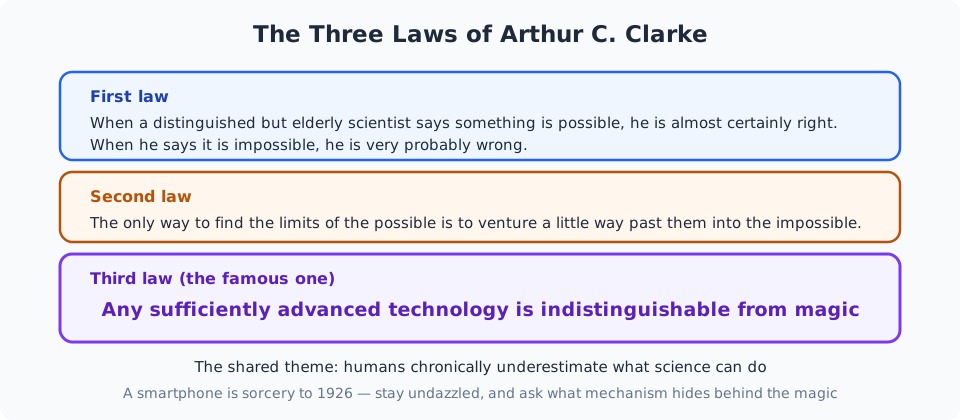
First law: “When a distinguished but elderly scientist states that something is possible, he is almost certainly right. When he states that something is impossible, he is very probably wrong.”
Second law: “The only way of discovering the limits of the possible is to venture a little way past them into the impossible.”
Third law: “Any sufficiently advanced technology is indistinguishable from magic.”
All three warn of the same thing: human imagination systematically underestimates what science can do. The third law towers above the rest in fame — for most people, Clarke’s law means this one. A charming footnote: Clarke originally published only the first law; the second and the famous third were added later. He capped the list at three with the joke that “if three laws were good enough for Newton, they are good enough for me.”
Doubt the Authority Who Says “Impossible”
The first law is a stinging warning: when a scientific authority declares something impossible, that is exactly when to be skeptical.
Why doubt the eminent scientist’s “impossible”? Clarke’s insight: the deeper an expert has mastered a field, the more tightly its “common sense” binds them. Decades of experience harden a framework of “this works, that doesn’t” — and possibilities outside the framework get reflexively dismissed as “impossible.” Yet the history of science is a parade of authoritatively pronounced impossibilities coming true. Heavier-than-air flight, spaceflight, harnessing the atom — all were declared flatly out of the question by front-rank experts of their day. All happened.
Meanwhile, Clarke notes, when an expert says something is possible, they are usually right — because judging something possible requires actually seeing a path to it. “It can be done” rests on evidence; “it can’t be done” may only mirror the limits of the speaker’s imagination. This asymmetry makes the first law a quiet encouragement for anyone whose new idea has just been dismissed out of hand. The great unsolved problems covered on this site were also once “obviously unsolvable” — until a new idea broke through. An authoritative “impossible” is often an invitation to try.
The Future That Looks Like Magic
And the most famous, most poetic of the three is the third law: “any sufficiently advanced technology is indistinguishable from magic.”
The sentence deepens the longer you consider it. Perhaps what we call “magic” is simply “technology too advanced for us to understand.” As in the opening: to a person from 1926, a smartphone is pure sorcery. Airplanes, microwave ovens, television — to anyone ignorant of their workings, they read as supernatural power. Once technology sufficiently exceeds our understanding, it becomes indistinguishable from magic.
The law implies two things. First, future technology may exceed our present imagination entirely — inside what we now dismiss as “magic, impossible” may sleep the commonplace of the next century. Second, and paradoxically, we should be careful around things that look like magic. Even today, faced with an awesome technology whose workings we cannot see, people either believe uncritically or fear irrationally. As generative AI and other hard-to-intuit technologies spread, the calm stance — “however magical it looks, there is always a mechanism behind it” — matters more than ever. Keeping the eye that distinguishes magic from machinery: that is the question this law puts to our era.
A Truth Only a Science Fiction Writer Could See
Clarke’s three laws carry intellectual weight beyond an aphorism precisely because their author was a science fiction writer. This is worth dwelling on.
Scientists are experts in “what can be realized now.” A great SF writer’s job is imagining “what has not been realized yet but might be.” Clarke conceived the communications satellite when it was fantasy, and lived to watch it become infrastructure. Understanding the frontier of science while boldly imagining beyond it — holding both viewpoints is what let him see the truth that “humans chronically underestimate what science can do.”
Delightfully, the genre of science fiction itself embodies Clarke’s laws. The warp drives, artificial intelligences, and space elevators of SF look like “magical nonsense” today. Yet history shows that many dreams SF drew first went on to inspire scientists and become real technology. As Sturgeon’s law defended the genre — “90% of SF is crud, but 90% of everything is crud” — SF, for all its wildness, is a serious laboratory for extending human imagination into the future. Clarke’s three laws are, I think, the most beautiful expression of that intellectual power.
Questions About Clarke’s Three Laws
Why Does the First Law Specify an ‘Elderly’ Scientist?
A sharp observation of Clarke’s. Young researchers, not yet steeped in a field’s common sense, stay relatively open to bold ideas. Veteran authorities, having internalized the field’s framework over decades, more readily dismiss out-of-frame possibilities as “impossible.” This is not an insult to senior scientists. It names a universal trap of human cognition: “the deeper the expertise, the tighter the grip of that expertise’s assumptions.” The theme connects to this site’s Peter principle and Dunning-Kruger articles — the tangled relationship between mastery and mental flexibility.
Doesn’t the Third Law Mean Anything Can Be Excused as ‘Magic-Level Tech’?
An essential caution. The third law says “genuinely advanced technology looks like magic” — it does not say “whatever looks like magic is genuine technology.” Confusing the two is dangerous. Real-world scams exploit the converse, passing off empty tricks as “technology too advanced to explain.” Those who know the third law should therefore be the first to ask whether a verifiable mechanism truly stands behind the wonder. Refuse to be dazzled by the mystique; interrogate the substance. That is the key to using this law well.
What Present-Day Technology Qualifies as ‘Magic-Like’?
Plenty. Generative AI — producing prose and images like a person, by mechanisms most users cannot intuit — is received as exactly modern magic. Instant global communication, gene editing, machines driven by brain signals — all were fantasy a short while ago. The delicious part: after enough daily use, these too become “ordinary” and stop looking magical — just as telephones and television once did. Clarke’s third law points at “the frontier technology understanding hasn’t caught up with,” and that frontier migrates with each generation. The technology that feels like magic to you today will be air to the next generation.
Related Laws and Biases
See “Sturgeon’s law” (also born from SF), the “Dunning-Kruger effect” (expertise and its blind spots), and “dark matter” (the frontier mystery of current science).
Summary
This article covered “Clarke’s three laws.”
The three statements Arthur C. Clarke left behind illuminate a single truth from different angles: humans habitually underestimate what science can do. Doubt the authority’s “impossible.” Step a little past the possible. And know that “sufficiently advanced technology is indistinguishable from magic.” These are insights available only to someone who knew both the frontier of science and the reach of imagination.
The third law rings loudest today, surrounded as we are by “magic-like technologies” from generative AI onward. Neither dazzled by the unknown nor dismissive of its potential — keep asking what mechanism stands behind everything that looks like magic. That is the intellectual posture Clarke’s words quietly teach. Next time you hear “that’s impossible,” remember the old science fiction writer.
To return to the full list of laws, follow the link below.
Thank you for reading. We hope to see you in the next article.
Also popular with readers
📚 Series: Famous & Fascinating Laws (21/25)