Thank you for visiting this site. This article covers a rule of thumb tailor-made for the fake news era: “Brandolini’s law.”
Online, obviously false information and rumors spread in an instant. Yet try to explain carefully why they are false, and the work is endless — and people don’t even believe you. Sound familiar? Brandolini’s law names this lopsided exhaustion: “the amount of energy needed to refute bullshit is an order of magnitude bigger than that needed to produce it.” It is also called “the bullshit asymmetry principle.” Why do lies profit while truth doesn’t pay? This article lays out the machinery.
What Is Brandolini’s Law?
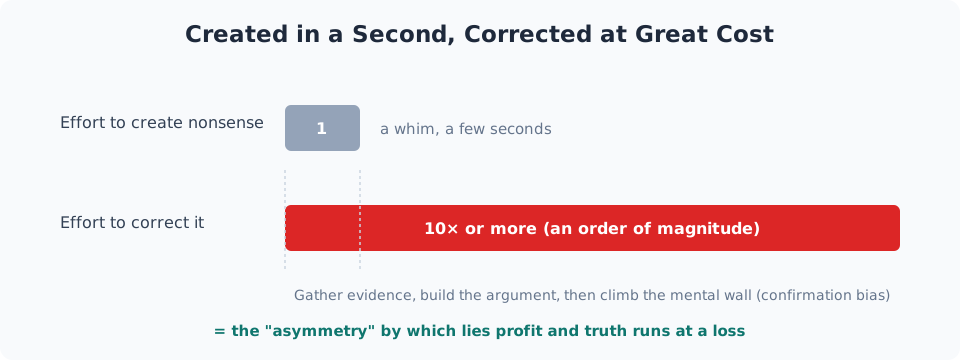
Brandolini’s law is the rule of thumb that “the effort required to refute nonsense is an order of magnitude larger than the effort required to produce it.” “An order of magnitude” means, roughly, ten times the work or more.
The law is attributed to the Italian software engineer Alberto Brandolini, who formulated it in 2013 — reportedly while watching a television debate full of baseless claims, struck by the thought that “saying something careless takes a second; correcting it point by point takes forever.”
Once stated, everyone recognizes it. Muttering a groundless rumor takes seconds. Demonstrating that it is wrong requires finding proper sources, constructing the argument, and persuading the listener — a multi-stage grind. This overwhelming gap — “cheap to make, brutal to correct” — is the law’s core.
Why Is the Correcting Side Always Shortchanged?
Why is the asymmetry so extreme? Several clear reasons.
First, nonsense carries no burden of truth. Lies need not match the facts or marshal any evidence — they can be invented on a whim, tuned for the ear, shaped for convenience. The correction, by contrast, must rest on verified facts, present evidence, and hold logically. The workloads never stood a chance of balancing.
Second, nonsense can be engineered to entertain. Stories that shock, enrage, or frighten spread on their own power. A thrilling lie travels faster and farther than a sober correction. By the time the correction arrives, the rumor has finished its world tour.
Third, a story once believed resists correction. As in the site’s article on confirmation bias, people favor information that supports what they already accepted and resist information that negates it. Present the perfect debunk and the response is still “well, even so…” You can spend many times the creation cost and go entirely unrewarded — a recipe for burnout on the correcting side.
Fourth — the nastiest wrinkle — the correction itself can spread the rumor. Writing “X is false” requires restating X, delivering the rumor to people who had never heard it. Worse, over time memory drops the “…is false” part and keeps the X. The act of correcting hands the enemy ammunition. By this point, the deck’s tilt against the corrector is fully visible.
This Does NOT Mean Debunking Is Impossible
One misreading to head off: Brandolini’s law does not say “nonsense cannot be refuted.” It says “refutation costs many times the creation.” Confuse the two and the law degrades into an excuse — “it’s hopeless, so why bother.”
The right move is to price in the asymmetry from the start. Knowing that debunking is inherently laborious, you stop wondering “why is this taking so long?” and stop quitting midway. The cost is structural — not a verdict on your effort.
Then allocate your limited energy deliberately. You are not obligated to duel every rumor to exhaustion. Engage carefully with the high-impact ones; let trivia go; refuse to leap at thrilling headlines; breathe once before sharing. The cheapest way to reduce correction labor is not to spread the nonsense in the first place.
Zoom out to society and the asymmetry darkens. The producers of nonsense publish endlessly at trivial cost, while the correctors — journalists, experts, fact-checkers — must chase each item at ten times the price. Left alone, this producer-favored structure trends toward a world where “confident lies outcover careful truth.” Each person declining to amplify falsehood is what lightens the correctors’ load at the scale of society. This is bigger than personal etiquette — it is one of the information age’s central problems.
A Posture for the Fake News Era
Brandolini’s law earned its spotlight because ours is the age of instant global distribution. On social media, sloppy claims and malicious rumors ship with one tap. The cost of producing nonsense has fallen effectively to zero.
And now generative AI mass-produces plausible fake text and images cheaply. The production cost keeps falling while the per-item verification cost stays stubbornly high. The asymmetry is set to widen further.
Hence the personal posture matters. The more thrilling the information, the less you should swallow it — pause before sharing. Check the source; let an hour pass before judging. My own habit: when a piece of news astonishes me, that is exactly when I brake — “this may be a Brandolini moment.” If correction costs ten times creation, then the single most effective countermeasure is not believing and spreading cheaply in the first place.
Common Questions About Brandolini’s Law
Why Do Rumors Spread Faster Than Truth?
Because rumors are built without factual constraints, optimized for thrill. Stories that shock or outrage carry their own propulsion. Between accurate-but-dry and false-but-electric, the electric one gets the shares. Lies can also be fitted to the audience’s wishes — “wouldn’t it be delicious if this were true” — hooking emotion directly. Rumors compete on transmissibility, not truth — that is their entire advantage, and why corrections forever run behind.
If Correcting Is Futile, What Should I Do?
“Futile” is the wrong conclusion. The law says “refutation is expensive,” not “refutation is impossible.” The key is choosing where to spend. Respond thoroughly to high-impact falsehoods; don’t chase the small fry. And above all, don’t become a distribution node yourself — the most cost-effective countermeasure in existence. Every person who declines to amplify saves the corrector ten units of labor downstream. The practical lesson is not to fight everything but to allocate wisely.
How Does Confirmation Bias Fit In?
Deeply. Confirmation bias — the tendency to collect congenial information and dodge the rest — is the main engine of the corrector’s despair, the “they won’t accept it even when shown.” Once a person believes a rumor, they attend to supporting material and mute corrections. Facts alone don’t win the retraction. Refutation is heavy labor because there are two walls: the wall of evidence, and the wall of the mind. See both walls, and the law comes into three-dimensional focus.
Related Laws and Biases
See “confirmation bias” (collecting only what you want to believe), “Poe’s law” (parody indistinguishable from sincerity), and “Godwin’s law” (the derailment patterns of online argument).
Summary
This article covered “Brandolini’s law.”
Refuting nonsense costs an order of magnitude more than producing it. Rumors are built free of factual constraints, thrilling, in seconds; correcting them means gathering evidence, building the argument, and then scaling the wall of the believer’s mind. This asymmetry — “cheap to make, brutal to correct” — is exactly why lying profits and truth runs at a loss.
But the law is not a declaration that debunking is pointless. Know the cost in advance, choose your battles — and above all, don’t cheaply believe and forward. In an era where generative AI makes lies cheaper by the month, the habit of pausing one breath before thrilling information is real self-defense. Brandolini’s law makes a fine compass for swimming the information sea.
To return to the full list of laws, follow the link below.
Thank you for reading. We hope to see you in the next article.

Also popular with readers
📚 Series: Famous & Fascinating Laws (19/25)