Thank you for visiting this site. This article covers the prophecy that built the modern digital world: “Moore’s law.”
Smartphones grow thinner and faster every year; the computer that once filled a room now rests in a palm. This exponential progress was called half a century in advance by a single sentence: “the density of components on a semiconductor chip doubles roughly every two years.” Born from one engineer’s magazine article, the rule became the roadmap for the entire computer industry. The delicious twist: it was never a law of nature like gravity — it was a target the industry chose to chase.
What Is Moore’s Law?
Moore’s law is the rule of thumb that “the number of components (transistors) that fit on a single semiconductor chip doubles at a steady interval” — the interval now conventionally stated as about two years.
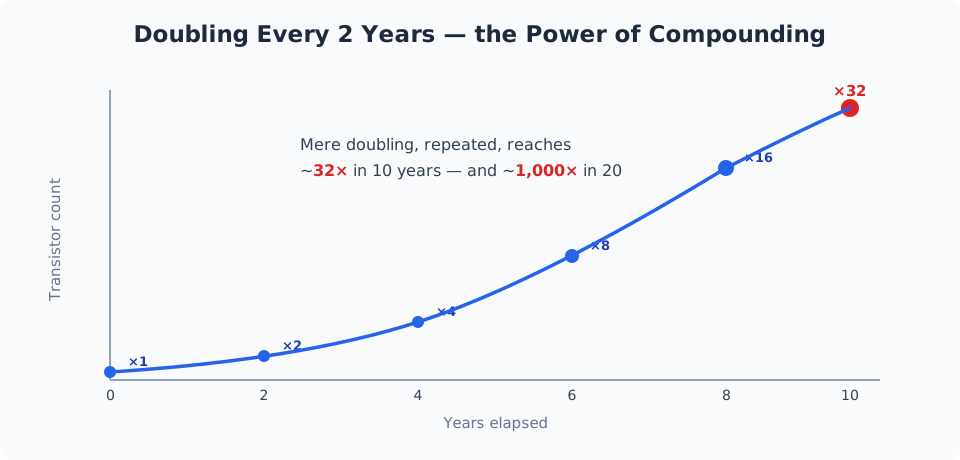
A transistor is an electrical switch — the most basic building block of a computer. Doubling their count means, roughly, that a chip of the same size delivers twice the performance, while the same performance costs half as much. “Double every two years” sounds modest until it compounds: in 10 years, about 32×; in 20 years, about 1,000×. The power of doubling — the exponential function — became, literally, the speed of technological progress.
The dramatic evolution of computing we have lived through owes itself to this stacking of doublings. Moore’s law is a rare case of one engineer’s estimate becoming an industry’s shared common sense.
A Prophecy That Began as One Article
The law’s author is Gordon Moore, the engineer who would co-found Intel. It began with a single article in a trade magazine in 1965.
Integrated circuits — chips combining many components — were newborn. Looking at just a few years of data, Moore noticed the component count doubling roughly every year, and boldly extrapolated: “at this rate, the doubling will continue for at least the next decade.” The original pace was the aggressive “double every year.”
The forecast was later tuned to reality: around 1975, Moore himself revised the pace to “double every two years.” The often-quoted “18 months” version, by the way, is not Moore’s phrasing — it is attributed to an Intel colleague who combined component growth with speed gains to estimate performance doubling every ~18 months. That multiple numbers circulate reflects the truth: this is not an equation but a rule of thumb resting on observation.
Why Was Exponential Progress Possible?
Why did the doubling continue so long? The key was miniaturization — making the components ever smaller.
Shrink a transistor and more of them fit on the same chip area. Better still, smaller components mean electricity travels shorter distances (faster) and consumes less power. Miniaturization was a magical direction that delivered “more, faster, cooler, cheaper” all at once — and engineers marched down that single road for decades.
One important angle: pushing miniaturization demands staggering R&D spending and colossal investment in new fabrication equipment. Companies kept paying because of the shared dread that “whoever falls off Moore’s law loses the race.” The law held, in large part, because the whole industry believed in it and chased it. The next section digs into this “self-fulfilling prophecy” character.
Not a Law — a Deadline
Despite the name, Moore’s “law” is utterly different in kind from the law of gravitation. Gravity works whether or not anyone believes in it; Moore’s law stops the moment people stop trying.
The semiconductor industry in fact used the law as a shared schedule. “Components double in two years” became a collective target date, and materials suppliers, equipment makers, and design houses all synchronized their development to hit it. Moore’s law was thus simultaneously a prophecy and a deadline everyone agreed to meet. A prediction, widely believed, thereby causing the predicted future — a superb real-world example of the self-fulfilling prophecy.
There is a curious symmetry with Parkinson’s law, covered on this site. Parkinson says work expands to fill the time allowed; Moore’s law shows an industry expanding its technology, at full sprint, to meet the deadline it set for itself. Human will converting a rule of thumb into physical reality — to me, the most fascinating thing about Moore’s law.
Is Moore’s Law Ending?
The live debate of recent years: “has Moore’s law finally hit its limit?” Experts genuinely disagree.
The case for the end rests on physics. Miniaturization cannot continue forever: when components approach the width of a few atoms, further shrinking becomes brutally difficult, and problems like current leakage and uncontrollable heat grow severe. That the old pace of doubling has become hard to sustain is acknowledged by most in the field.
The counter-view holds that “progress continues in different forms.” Stacking components vertically, combining multiple chips, specializing designs per workload — performance keeps improving through such means today. Even if Moore’s law in its original sense (shrinking transistors) has slowed, the broader version — “the computation you can buy per dollar keeps growing” — arguably still lives. No one can declare a winner, but a fair summary: the fifty-year original pace has reached a bend in the road.
Common Misconceptions About Moore’s Law
Is Moore’s Law a Law of Physics?
No — perhaps the single most common misconception. Moore’s law is an empirical observation and a forecast, not a physically proven law of nature. It stops if humanity stops investing, and slows when physics pushes back. The word “law” suggests something as absolute as gravity, but the reality is closer to “a promise the industry kept for half a century.” Grasp that distinction and the “end of Moore’s law” debate snaps into focus.
Is This Why Phones and PCs Keep Getting Faster?
Very much so. Our devices became more capable and cheaper year after year because the chips at their hearts evolved along Moore’s curve. More computation for the same money is what made high-resolution screens, video editing, and lately the heavy lifting of generative AI possible on everyday machines. Had Moore’s law stalled early, much of modern digital convenience simply would not exist.
Does It Still Matter to Daily Life?
Enormously. The recent explosion of generative AI became possible only because semiconductors made vast computation cheap. Clarke’s third law — “sufficiently advanced technology is indistinguishable from magic” — was covered on this site; the computational muscle underwriting that “magic” is Moore’s law’s accumulated compounding. Whether the pace continues will shape how smart and how cheap AI becomes — a question wired directly into everyday life.
Related Laws
See “Parkinson’s law” (the mirror-image self-fulfilling deadline), “Clarke’s three laws” (the possibilities of technology), and “Benford’s law” (the hidden regularities of growing numbers).

Summary
This article covered “Moore’s law.”
Chip density doubles about every two years. That short sentence served as the computer industry’s roadmap for fifty years, steering the dramatic evolution of every device we own. And it was never nature’s decree — it was a target made real because an entire industry believed in it and chased it. Among all the famous rules of thumb, none is more dramatic proof that prophecies can build futures.
Physical limits have appeared, and whether the old pace can hold is disputed. Yet the larger current — ever more computation per dollar — remains the foundation of the AI era. Next time you pick up your phone, remember the half-century of compounding effort pressed inside it. The ordinary convenience will feel, for a moment, extraordinary.
To return to the full list of laws, follow the link below.
Thank you for reading. We hope to see you in the next article.

Also popular with readers
📚 Series: Famous & Fascinating Laws (22/25)