Thank you for visiting this site. This article covers one of the oldest and most famous rules of thumb about money: “Gresham’s law.”
You have probably encountered the phrase “bad money drives out good.” It is the motto of Gresham’s law: when debased money circulates, good money disappears from the world. At first glance it runs backwards — surely the good survives and the bad gets weeded out? But learn the mechanism and it becomes obvious: if people simply act in their own interest, this outcome is guaranteed. This article covers the logic, and the law’s surprisingly wide reach.
What Is Gresham’s Law?
Gresham’s law is the rule of thumb that “when two kinds of money with the same face value but different intrinsic value circulate together, the valuable ‘good money’ gets hoarded and vanishes, leaving only the ‘bad money’ in circulation.” The compressed motto: “bad money drives out good.”
Good money here means coins rich in gold or silver — high intrinsic value. Bad money means coins with the metal skimped or degraded. Old coins were themselves precious metal, so two coins of the same denomination could differ sharply in what they were worth melted down.
The crucial setup: the two kinds of coin are decreed by law to be “the same face value” and circulate together. At the shop, either coin spends as one unit. Under that condition, how do people behave? Follow the psychology in the next section.
Why Does the Good Money Disappear?
The logic is astonishingly simple — nothing beyond the universal urge not to lose out.
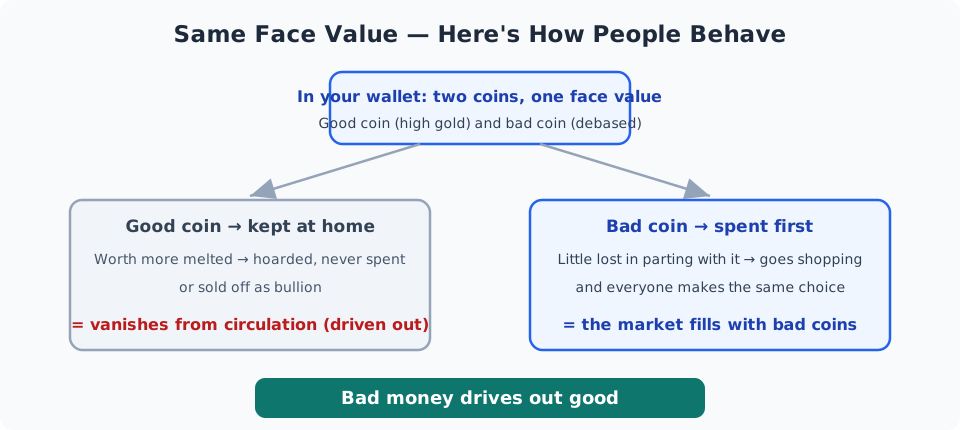
Your wallet holds one high-gold good coin and one debased bad coin, same face value. Either spends identically. Which do you spend, and which do you keep? Obviously: spend the low-value coin first, keep the high-value coin. Nobody hands over a coin worth more melted than spent.
Now let everyone in society reason the same way. Good coins vanish one by one into drawers and strongboxes (or the smelter), and the marketplace fills with bad coins. The good money is “driven out” of circulation. Nobody acted maliciously — yet the pile-up of individually rational choices produces the perverse social outcome of good money disappearing. Like the “tragedy of the commons” covered on this site, it is a textbook case of individual cleverness summing to collective loss.
The Name, and the Real Discoverer
The law bears the name of Thomas Gresham, the 16th-century English financier who advised Queen Elizabeth I on the realm’s debased currency.
Honesty requires noting that Gresham did not discover the phenomenon. The insight is much older: the astronomer Copernicus stated it clearly, and medieval scholars before him. The label “Gresham’s law” spread because a 19th-century economist attached his name — making this another case, like Benford’s law, of a law named for someone other than its first discoverer.
Still, Gresham genuinely wrestled with the coinage problem in practice. Knowing the story behind the name gives the law a satisfying third dimension.
A Law with Conditions Attached
Using Gresham’s law correctly requires knowing the conditions under which it holds — an often-overlooked and essential point.
The law operates only when good and bad money are legally forced to trade at the same face value. Because the two must be accepted as equal, people spend the lesser and hoard the greater.
But if people may freely value each coin on its merits — good money dear, bad money cheap — the story reverses. Nobody surrenders valuable money at a discount. In that regime, everyone prefers to transact in trustworthy money, the debased stuff is shunned, and things can run toward “good money driving out bad.” Gresham’s law, in other words, is a rule of thumb with a precondition: fixed face values. It is not a universal key — a caveat worth remembering with every law of this kind.
”Bad Drives Out Good” Beyond Money
Intriguingly, the law extends as a metaphor to arenas far from coinage. The trigger condition: “good and bad sit on the same shelf at the same price — and buyers can’t tell them apart.”
Consider a market where quality is hard to judge. If buyers cannot distinguish fine goods from shoddy ones and both sell at one price, the seller who invests in quality loses money. So cut-corner products survive while quality goods exit the market — precisely Gresham’s structure. It connects to the famous “market for lemons” dynamic in used cars: where quality is invisible, prices sink toward the junk.
The same lens fits organizations and information. In a workplace where careless work draws the same pay and praise as careful work, the careful workers eventually stop bothering. In a feed where sensational falsehood spreads as easily as careful reporting, quality publishing gets buried. These metaphorical applications are looser than the monetary original — “similar structure,” not identical mechanics. But the lesson travels well: where good things are not correctly distinguished and rewarded, bad things take over.
Common Questions About Gresham’s Law
Does It Apply to Modern Cash and Digital Money?
To modern currency itself, barely. Today’s bills and coins have essentially zero intrinsic value — every unit is identical. With no good coins or bad coins, there is nothing to drive out. Gresham’s law lived as a literal phenomenon in the era when money was made of gold and silver and each coin’s melt value differed. But wherever the structure reappears — “same treatment, different quality, hard to distinguish” — the law still earns its keep as metaphor.
How Does It Differ from the Tragedy of the Commons?
Both share the skeleton: individually rational behavior producing a collectively bad outcome. The difference is what gets ruined. Gresham’s law is about quality vanishing from circulation — a story of sorting and selection. The tragedy of the commons is about a shared resource being consumed to exhaustion — a story of depletion. Different lenses, same chassis: “each person acts wisely, and society loses.” Learned as a pair, they explain a remarkable amount of the world.
How Do You Stop Good Money from Being Driven Out?
Historically, by eliminating the good-bad gap itself — recalling debased coinage and re-minting a unified currency. Translated to the metaphorical arena, the countermeasure becomes: make sure good and bad receive visibly different treatment. Build systems where quality is legible at a glance; make sure careful work is actually rewarded. If bad wins because treatment is equal, then differentiated treatment is how good survives. That is the practical wisdom this old law hands us.
Related Laws
See the “tragedy of the commons” (individual rationality, collective ruin), “Benford’s law” (hidden regularities in numbers, and another misattributed name), and “Hanlon’s razor” (generosity toward human error).

Summary
This article covered “Gresham’s law.”
The seemingly paradoxical “bad money drives out good” flows from the most ordinary psychology in existence: keep what’s valuable, spend what isn’t. With not one villain present, everyone’s rational choices accumulate until good money has vanished from the world — a beautiful example of aggregated human behavior defying intuition.
Remember, though: this is a law conditional on fixed face values — allow differentiated treatment and the good can win instead. That “know the conditions before using the tool” discipline applies to every rule of thumb. And once you see the same structure in markets with illegible quality and workplaces where diligence goes unrewarded, this five-century-old law becomes a working instrument for reading modern life. How do we build systems where good things are correctly recognized? That question holds the law’s deepest lesson.
To return to the full list of laws, follow the link below.
Thank you for reading. We hope to see you in the next article.

Also popular with readers
📚 Series: Famous & Fascinating Laws (23/25)