Thank you for visiting this site. This article covers the law that skewers the trap of managing by numbers: “Goodhart’s law.”
Test scores, sales quotas, corporate KPIs — we measure the goodness of things with numbers (metrics). Yet the moment a number is hoisted up as a target and chased, an ironic thing happens: the number improves while the thing that actually mattered gets left behind. Goodhart’s law names this: “when a measure becomes a target, it ceases to be a good measure.” Numbers are useful tools — misused, they send people sprinting in exactly the wrong direction. This article examines the machinery and the remedy.
What Is Goodhart’s Law?
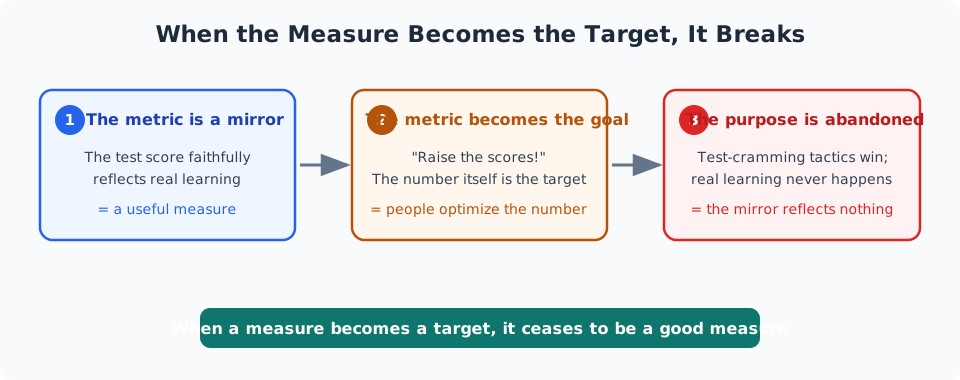
Goodhart’s law is the rule of thumb that “when a measure is set as a target, it stops functioning as a good measure.” The familiar formulation: “when a measure becomes a target, it ceases to be a good measure.”
It began with an observation by the British economist Charles Goodhart in the 1970s about monetary policy. The idea later escaped economics entirely and is now understood to apply to every context where numbers are used to steer people — organizations, education, all of it. The crisp modern phrasing is credited to a later scholar’s restatement.
The heart of the claim: a number starts life as a faithful “mirror” of some reality. But the moment that number is declared “the goal to hit,” people begin optimizing the number’s appearance — and the mirror stops reflecting reality. The tool quietly swaps places with the purpose. Catching that swap in the act is what makes this law so sharp.
Chase the Number, Abandon the Purpose
Why does targeting a metric break it? The reason is simple: people take the shortest path to raising the number they are judged by.
Consider test scores. A score is supposed to be a mirror of how much has been learned. But once the score itself becomes the goal, students and teachers alike drift toward “tactics purely for scoring” — memorizing patterns for likely questions, forgotten the day after the exam. The score rises while actual learning — the original purpose — is left behind. At that point, the score no longer mirrors ability at all.
The same happens everywhere. Manage “customer response speed” as a number and responses get faster — while each conversation gets sloppier and the satisfaction you actually wanted falls. A metric, chased directly, drifts away from the thing it was supposed to measure. Numbers change their nature the instant they become targets.
The crucial point: this is not usually cheating. Mostly, people are working sincerely to raise the number they were given. But when “raising the number” and “achieving the purpose” have come apart, sincere effort itself veers off-purpose. No malice is required; the distortion is born the moment the metric becomes the target. Blaming individuals fixes nothing — the defect is in how the number is used, not in the people. This connects deeply to the worker ant rule’s lesson that problems live in structures, not persons.
The Famous Soviet Nail Factory
Discussions of Goodhart’s law reliably reach for one famous parable: the Soviet nail factory. Whether it literally happened is debated, but it captures the law’s essence perfectly.
A nail factory is evaluated by “number of nails produced.” To hit the quota, the factory begins mass-producing tiny, uselessly thin nails. The count is achieved; not one useful nail exists.
The evaluators switch the metric to “total weight of nails.” Now the opposite happens: the factory produces a handful of comically enormous, heavy nails nobody could ever use. By count or by weight, the actual purpose — make useful nails — is achieved nowhere. Target a metric, and people will satisfy the metric while cheerfully betraying the purpose. No story teaches the law’s menace more clearly.
The same pattern surrounds us today. Pressure a hospital hard on “patient waiting times,” and workarounds appear — check patients in instantly so the recorded wait is zero, then have them wait for the actual examination. Evaluate a call center on “average handling time,” and complex problems get cut short unresolved. The quota is met on paper while the service it stood for is degraded. The nail factory, endlessly reincarnated.
How to Live with Numbers
Should we abandon management by numbers, then? No. Goodhart’s law says not “don’t use numbers” but “mind how you use them.” A few working principles:
First, never forget that the metric is a stand-in for the real purpose. The score is not the learning — only its shadow. Don’t celebrate the number rising; keep re-asking whether the purpose behind it is being achieved.
Second, never evaluate on a single number. One metric as the sole target invites the shortest-path exploit. Combine several metrics, and look at unquantified quality too. For the nails: check count, and weight, and “can anyone actually use these?”
Third, use numbers as hints about reality, not as cudgels. When I track something numerically, I try to attend not to “making this number go up” but to “what this number is telling me about the world.” A number is a tool, never the goal. Holding that line is precisely what determines whether Goodhart’s trap closes on you.
Common Questions About Goodhart’s Law
So Is Setting Numerical Goals a Mistake?
No — numerical goals are effective. The failure mode is making a number the sole, absolute goal. Numbers excel at tracking progress and surfacing problems. Danger arrives when raising the number becomes the purpose and the original aim fades from memory. Post the number if you like — but keep asking, “what was this number originally trying to measure?” Used as a tool with that question attached, numbers remain powerful allies.
What Are Some Everyday Examples?
Everywhere you look. Chase only the scale reading in a diet, and you’ll sacrifice health — the actual goal — to move the number. Make “likes” the goal, and you post what performs instead of what you meant to say. Declare “zero overtime” as the sole target, and work migrates home, achieving the number on paper only. In every case, the drift from purpose begins at the moment the metric becomes the target. Once you know the pattern, you find the law operating in astonishing places.
Is This Related to the ‘Cobra Effect’?
A close cousin. The cobra effect names well-intended interventions that produce the opposite result — from the tale of a bounty on cobras that inspired people to breed cobras for the bounty. It shares Goodhart’s skeleton: targeting the metric (“cobra corpses delivered”) betrayed the purpose (fewer cobras). Set a number as the target, and humans will find the loophole that satisfies the number. Two names, two angles, one deep fact about people and incentives.
Related Laws
See “Parkinson’s law” (work swelling to fill its container), “Gresham’s law” (the bad driving out the good), and the “Peter principle” (rising to one’s level of incompetence).


Summary
This article covered “Goodhart’s law.”
When a measure becomes a target, it stops being a good measure. Scores, quotas, KPIs — the instant we chase them, we optimize their appearance and abandon what they were supposed to measure. The Soviet nail factory — thin nails for the count, giant nails for the weight — paints the irony indelibly.
What matters is remembering that every number is only the shadow of a real purpose. Evaluate on more than one number; keep asking whether the purpose behind the number is actually served; use metrics as hints, not cudgels. Handled rightly, numbers are powerful allies; enthroned as goals, they lead whole organizations astray. Goodhart’s law is the essential vaccination against being ruled by your own dashboard.
To return to the full list of laws, follow the link below.
Thank you for reading. We hope to see you in the next article.

Also popular with readers
📚 Series: Famous & Fascinating Laws (8/25)