Thank you for visiting this site. This article covers the famous rule about effort and talent: “the 10,000-hour rule.”
“Practice anything for 10,000 hours, and you’ll reach world class.” This appealing message spread worldwide through a bestselling book, embraced as proof that anyone can become a master through effort. But the rule contains a serious distortion of the research behind it — and the researcher himself protested loudly at how it spread. This article goes back to the original study to sort out what the rule actually meant. Clear the misunderstanding, and the real levers of improvement come into view.
What Is the 10,000-Hour Rule?
The 10,000-hour rule is the claim that “reaching world-class mastery in a field requires roughly 10,000 hours of practice.” Ten thousand hours is a staggering quantity — about 10 years at 3 hours a day, over 5 years even at 5 hours daily.
The rule was made famous by a 2008 bestseller, which presented celebrated musicians and entrepreneurs as cases whose success rested on extraordinary volumes of unglamorous groundwork, carrying the message that “hours invested, more than talent, make the master.”
The message inspired millions. “Even without inborn gifts, accumulated effort can carry you to the top” is a deeply hopeful idea. But in the process of compressing the research into this catchy form, several crucial nuances of the original work fell away. Let’s look at what the study actually found.
What the Original Research Showed
The rule’s foundation is a 1993 study by psychologist Anders Ericsson and colleagues, who examined violin students at a music academy, comparing accumulated lifetime practice hours against performance level.
The results were clear. The best group had accumulated an average of roughly 10,000 practice hours by age 20; the less accomplished groups had accumulated thousands fewer. Differences in skill mapped cleanly onto differences in accumulated practice. That “top tier ≈ 10,000 hours” figure is what later escaped into the wild as “the 10,000-hour rule.”
Stopped there, you might conclude “so hours are everything after all.” But what Ericsson wanted to emphasize was never the raw hours. The point he spent his career defending was something else entirely — the quality of the practice.
The Missing Core: Deliberate Practice
Ericsson’s central concept was “deliberate practice.” For him, masters are made not by the quantity of practice but by its quality.
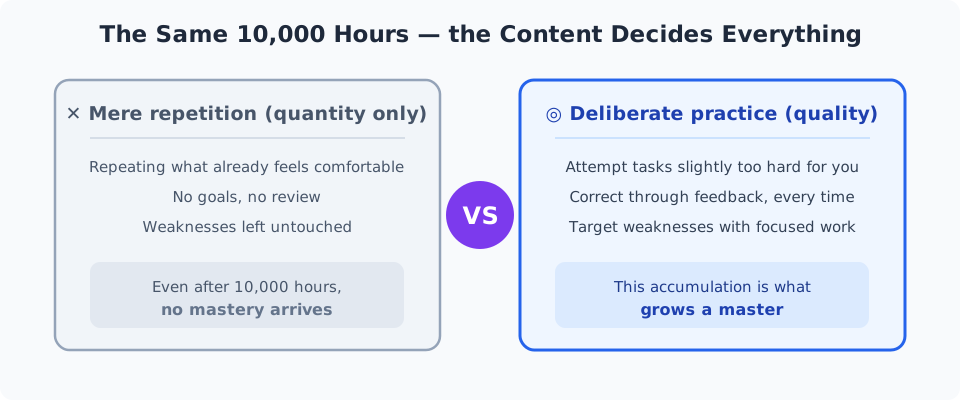
Deliberate practice is not mindless repetition. It means setting explicit goals, targeting your specific weaknesses, attempting tasks slightly beyond your current ability, and folding the feedback into corrections — effortful, concentration-heavy, often unpleasant work.
The distinction is decisive. Ten thousand hours of autopilot repetition produces no master. The guitarist of twenty years who noodles through favorite songs nightly does not automatically approach professional level — precisely because of this difference. In Ericsson’s terms, what counts is not “having spent 10,000 hours there” but “how much of that time was deliberate practice.” By pushing the number “10,000” to the front, the bestseller washed out the actual thesis: quality is the essence. That was the misreading Ericsson regretted most.
10,000 Is Not a Magic Number
The second big misunderstanding: treating “10,000 hours” as a pass mark for mastery. This too conflicts with the original research.
First, 10,000 was an average. The top group’s practice hours averaged out around there — it was never a threshold where “above = master, below = amateur.” In reality, some reach elite levels with fewer hours, and others plateau far beyond 10,000. Reading an average as a mandatory quota was the overreach.
Second, the required amount varies hugely by field. In domains with crisp rules (chess, instrumental music), practice explains a great deal of skill. In messy domains where luck and circumstance loom large, practice explains much less. “A uniform 10,000 hours for every field” was always a blunt simplification — meta-analyses report that practice’s contribution to performance differs substantially across domains. Don’t be seduced by the tidy number: the quantity varies by person and by field.
The Rule’s Real Value
After this pile of corrections you might dismiss the rule entirely. I would not. Understood correctly, a deeply encouraging core remains.
That core: “much of top-level skill is explained not by inborn talent but by accumulated effort aimed in the right direction.” This is exactly what Ericsson’s research showed. Masters are not born in a day; they are grown at the far end of enormous quantities of deliberate practice. For anyone tempted to give up on themselves over “talent,” that is solid hope.
The key is to obsess over the content of practice, not the count of hours. When I set out to learn something, I take this rule not as “log 10,000 hours” but as the discipline: “don’t merely continue — target the weaknesses and stack up high-quality practice.” It connects deeply to the Dunning-Kruger article’s point that accurately seeing your own inadequacy is the gateway to improvement. Don’t take comfort in the total on the clock; ask how dense you can make this one hour. That is the rule’s best lesson.
Common Questions About the 10,000-Hour Rule
So Will 10,000 Hours Make Anyone Elite?
Unfortunately, no such guarantee exists. As we saw, the same 10,000 hours produce wildly different results depending on whether they were deliberate practice, and the required amount varies by person and field. “Ten thousand hours suffices” is not what the research says. What is true: those at the highest levels got there through staggering amounts of well-aimed effort. Hours alone are not sufficient — but no master exists without enormous quality practice either. Holding both halves is the accurate understanding.
Why Did the Researcher Object to His Own Rule?
Because the most important part of his research — practice quality — was dropped, while the number was amplified. For Ericsson, what produces masters is the substance of deliberate practice, not elapsed time. Watching that reduced to “just put in the hours” alarmed him enough to rebut it in his own book. As with the Mehrabian rule, the lesson generalizes: catchy numbers detach from context and roam free.
So What Should I Actually Focus On When Practicing?
Import the elements of deliberate practice into your own training: set explicit goals; pick tasks slightly too hard for your current self; review every session, however clumsily; and target your weak points for concentrated work. Not comfortable repetition within your existing range, but careful engagement with tasks just beyond it. That is the documented fast lane. Counting total hours for reassurance yields far less than asking, every session: how dense can I make this one?
Related Laws and Biases
See the “Dunning-Kruger effect” (blindness to one’s own inadequacy), the “Mehrabian rule” (another famously misquoted number), and the “Peter principle” (rising to one’s level of incompetence).

Summary
This article covered “the 10,000-hour rule.”
The famous message — “practice 10,000 hours and reach the top” — has encouraged millions. But beneath it, the original research’s key nuances had been stripped away. What Ericsson actually taught: the quality of deliberate practice matters more than elapsed time; 10,000 was an average, not a threshold; and the required amount varies by field and person.
Yet the rule’s core survives as real hope: most top-level skill is grown through correctly aimed, accumulated effort. The point is never to chase the number but to obsess over the content of the practice. How deliberately, how densely, can you spend today’s single hour? Freed from the spell of its famous number, this rule becomes genuinely useful equipment.
To return to the full list of laws, follow the link below.
Thank you for reading. We hope to see you in the next article.

Also popular with readers
📚 Series: Famous & Fascinating Laws (7/25)