Thank you for visiting this site. This article covers the summit of modern cipher mysteries: “Kryptos.”
At CIA headquarters, in the courtyard, a copper sculpture has stood since 1990. Its rippling plate carries some 1,800 letters concealing four encrypted passages. Over the years, three have been solved. But the last — a mere 97 characters known as “K4” — has defeated everyone on Earth for 35 years. And the setting: the very citadel of espionage, where thousands of professional codebreakers report to work. Why can’t it be broken? Here is the full portrait of this magnificently spiteful puzzle.
What Is Kryptos?
Kryptos is a cipher sculpture created by artist Jim Sanborn and installed in the courtyard of the CIA’s new headquarters building in 1990. The name is Greek for “hidden.” Letters are pierced through an S-curved copper screen, edge to edge.
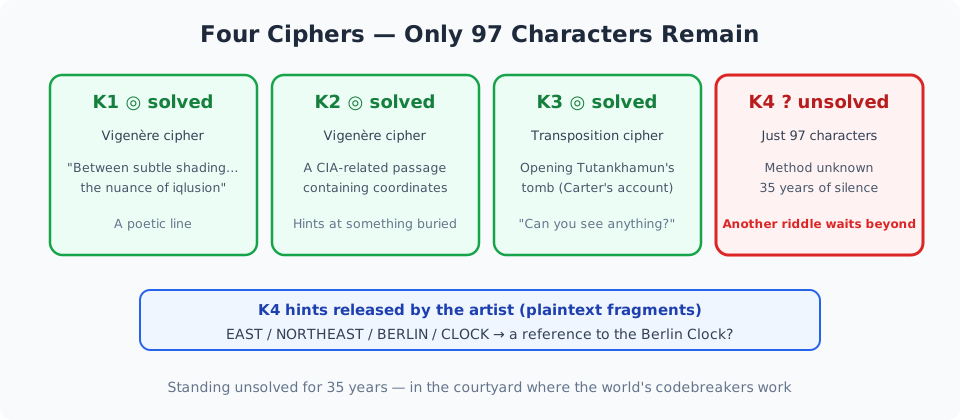
Sanborn was no cryptographer, so he took tutoring in classical ciphers from a retiring chairman of the CIA’s cryptographic committee. Over months he learned the techniques and composed the ciphertexts by hand on paper. The sculpture is, in effect, a challenge sanctioned by the intelligence community itself. Its encrypted text divides into four parts: K1, K2, K3, and K4.
The delightful premise: the work was designed from the start on the assumption it would eventually be solved. Its theme is “the gathering and concealment of information” — a secret, erected as sculpture, in a spy agency’s garden. Sanborn is said to have sealed the full solution in an envelope entrusted to the CIA director of the day. An artwork, and simultaneously a pure contest of wits with no prize money. From the day after installation, CIA staff reportedly spent lunch breaks squinting at the copper.
The Three Solved Passages
The first break came quietly. It later emerged that a small NSA team had privately solved K1 through K3 in the early 1990s. Publicly, a CIA analyst achieved the same in 1998, and a civilian computer scientist independently in 1999.
The methods were all applications of classical cryptography. K1 and K2 are variants of the Vigenère cipher (keyword-shifted alphabets); K3 is a transposition cipher (letters reordered).
Curiously, the decrypted texts contain deliberate-looking misspellings — “illusion” rendered strangely, among others — too systematic to be accidents, and long suspected to be clues to further riddles. The sculpture’s surroundings hold devices beyond the text as well: copper plates bearing Morse code, a lodestone magnetized to derange compasses. Per Sanborn, everything in the installation is part of the puzzle. Reading the letters is not the end of it.
The solved contents are rather poetic. K1: “Between subtle shading and the absence of light lies the nuance of iqlusion.” K2: a passage touching the CIA that includes latitude-longitude coordinates of something buried. K3: a rendering of archaeologist Howard Carter’s account of opening Tutankhamun’s tomb, ending on the moment of peering in — “Can you see anything?” A showman’s touch.
Which leaves the final 97 characters: K4.
Why Can’t the Last 97 Characters Be Broken?
The reason K4 resists is simple: the text is too short, and it uses a subtler method than K1–K3. Short ciphertexts starve analysts of statistical footholds; brute-force approaches generate endless “plausible” readings with no way to pick the true one.
Watching the stalemate, Sanborn himself began an unprecedented drip of hints — fragments of K4’s plaintext. Revealed so far: characters 64–69 read “BERLIN,” 70–74 read “CLOCK,” character 26 onward reads “NORTHEAST,” preceded by “EAST.” The Berlin-plus-clock pairing suggests a reference to the famous Berlin Clock (the Mengenlehreuhr) — yet even so, no solution has followed.
And according to Sanborn, solving K4 still won’t end it: the four passages together form one further riddle. Thirty-five years on, mailing lists of thousands of challengers have accumulated mountains of attempts, and the copper stays silent. Recently the aging Sanborn drew headlines with plans to auction the solution itself — even the custody of the secret has become part of the story.
Something Buried on the Grounds, and the 16-Year Correction
The solved sections hold unfinished business of their own. Chief among them: the coordinates in K2, which point to a spot on the CIA grounds not far from the sculpture. The text teases: “It’s buried out there somewhere. Who knows the exact location?” Whether anything is actually buried, or has ever been dug for, has no official answer — presumably another gear in the machine.
Then, in 2006, a small earthquake: Sanborn revealed that the accepted reading of K2’s ending was wrong. The final phrase decoders had trusted for 16 years was a near-miss misreading caused by a dropped letter in the original encipherment; the true text ends in a phrase meaning “layer two.” The correction shook the community, since it bears on assumptions for attacking K4. Even the “solved” parts shift in the artist’s hands. That is how deep this well goes.
The work is engineered down to these extra-textual devices — copper, coordinates, magnetized stone, Morse. All components of a single puzzle, of which K4’s 97 characters may be only the final lock. This is why challengers call Kryptos not a cipher puzzle but “a treasure-hunt-shaped total artwork.”
The Irony of Being Unsolvable at Spy Headquarters
Kryptos’s magnetism is not only cryptographic. The irony of the setting elevates it.
Consider: the sculpture stands on the campus of the world’s premier intelligence agency. Professionals of cryptanalysis and signals intelligence walk past it every morning. And 97 characters have defeated the institution’s collective power — at least publicly — for 35 years. The professional exposers of secrets, unable to expose the secret in their own garden. Irony rarely comes this well-made.
The second attraction: the guaranteed existence of an answer. Unlike the Beale ciphers — forever shadowed by “maybe there’s nothing inside” — Kryptos has a living author and an archived solution. It resists not because it is fake but because it is genuinely hard. That soundness is what lets enthusiasts worldwide commit safely and completely. I am one of the people looking forward to the headline “K4 SOLVED” someday.
Questions About Kryptos
Can Ordinary People Take a Shot at It?
Absolutely. You cannot enter the CIA grounds, but the complete ciphertext is public and available online. Armed with K4’s 97 characters and the published hints, amateurs worldwide chip away daily; the enthusiast community actively cross-checks proposals. What’s required is not expensive equipment but persistence and imagination. Learn classical cryptography as you go, and the possibility of a world first is open to anyone. No prize money — but solving it writes your name permanently into the history of cryptography.
If the Artist Dies, Is the Answer Lost?
That worry has become a live issue. Sanborn, born in 1945, has long been concerned about the fate of K4’s secret after his death. The solution’s custodians are few, and the custody arrangements are not fully public. The reported plan to transfer the solution by auction reads as one answer to this “survival of the riddle” problem. Will the buyer publish it, or keep the silence? The inheritance of a mystery itself — a problem with no precedent in the history of ciphers — is unfolding in real time.
Hasn’t Anyone Claimed to Have Solved It?
Claims arrive constantly; not one has survived verification. K4 is short enough that with forced assumptions you can manufacture “plausible English.” But any true solution must place BERLIN, CLOCK, EAST, and NORTHEAST at exactly the revealed positions — and that filter has shredded every loose proposal so far. Flip it around: when a solution appears in which those words click into place, that will be the real one.
Related Mysteries
See the fellow cipher mysteries “the Zodiac ciphers” and “the Beale ciphers,” and the 600-year champion of unreadability, “the Voynich manuscript.”
Summary
This article covered “Kryptos.”
The cipher sculpture in the CIA courtyard: three of four passages solved, with the final 97 characters — K4 — unsolved for 35 years. Even the artist’s drip-fed hints — “BERLIN,” “CLOCK” — have not opened it, and beyond K4 waits yet another riddle. Count in the irony of standing unbroken at the headquarters of professional codebreaking, and you have one of the best-constructed mysteries of the modern age.
Unlike the Beale ciphers, Kryptos certainly has an answer. The challenge is honest, and the day of resolution must eventually come — through human insight, through AI, or through the strange inheritance of the artist’s secret. The whole puzzle-loving world is waiting for the moment those 97 characters finally speak.
To return to the full list of mysteries, follow the link below.
Thank you for reading. We hope to see you in the next article.
Also popular with readers
📚 Series: World Mysteries (10/21)