Thank you for visiting this site. This article covers archaeology’s unfinished homework: “Linear A.”
Some 3,500 years ago, the Minoan civilization flourishing on Crete left its own script pressed into clay tablets — the Linear A of our title. The script has a near-identical younger sibling, “Linear B,” which was brilliantly deciphered in 1952, one of the great triumphs in the history of archaeology. The elder sibling, however, remains unreadable more than seventy years later. Strangest of all: the sounds of the signs can be partly reconstructed — yet the meaning stays completely dark. A dead-end quite unlike a cipher’s. Let’s explore this odd predicament through the history of decipherment.
What Is Linear A?
Linear A is a writing system used mainly on Crete from around 1800 BC to 1450 BC — the script of the Minoans, Europe’s earliest high civilization (the people of the palace of Knossos, of Minotaur-and-labyrinth fame). About 1,400 inscribed objects survive: clay tablets, vessels, ritual implements.
The name is plain bookkeeping: Arthur Evans, excavating Knossos in the early 1900s, labeled the scripts he found “Linear A” and “Linear B” in order of age. Both look like sequences of simple line-built signs. Most Linear A documents carry numerals and commodity signs, and are believed to be accounting records — warehouse inventories and transactions. In a fine irony, these tablets survive because the fires that destroyed the palaces baked the sun-dried clay hard as pottery. The flames that ended the civilization became the kiln that delivered its writing to the future.
So the contents are probably “so many sheep, so many jars of oil” — workaday records, not books of mysteries. And still we cannot read them. That gap is what sharpens Linear A’s enigma.
Not everything is ledger-keeping, though. Stone ritual vessels and offerings carry recurring fixed phrases known as the “libation formula,” believed to be religious wording. The same phrasing appears at sanctuaries across the region, making it precious comparative material. Crete also holds an even older, picture-like script (Cretan hieroglyphic) — likewise undeciphered. The Minoans left behind a triple stack of unreadable writing; no civilization has tormented decipherers more thoroughly.
The Triumph of Linear B
To tell Linear A’s story, you first need the drama of Linear B’s decipherment — one of archaeology’s finest scenes.
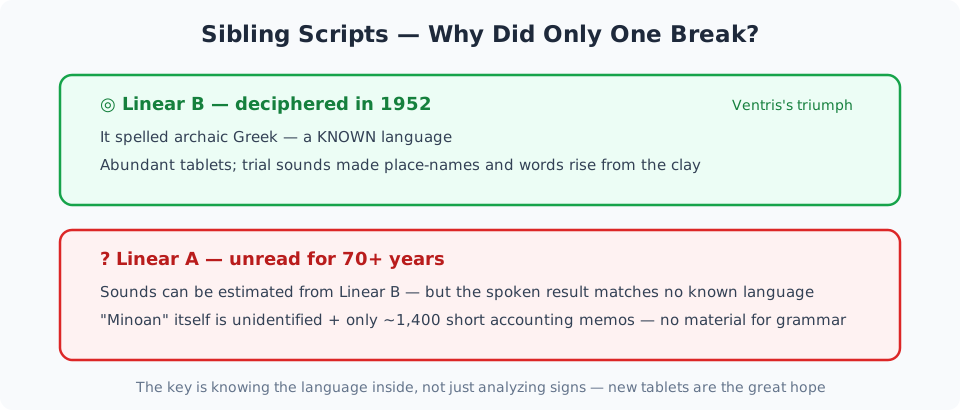
Linear B is a descendant script, built from Linear A’s signs. Long assumed to hide “the mysterious Minoan tongue,” it fell in 1952 to Michael Ventris, a British architect with a gift for languages, building on the meticulous groundwork of the scholar Alice Kober. The answer stunned everyone: Linear B spelled a very archaic form of Greek. Mainland Mycenaeans, having taken control of Crete, had borrowed the Minoan script to write their own Greek.
The decisive factor was identifying the underlying language. Assign trial sounds to the signs, read aloud — and Greek place-names and words rose from the clay. The moment the script connected to a known language, the puzzle avalanched open. The enduring lesson: success depends not only on analyzing the script, but on knowing the language inside it. And that lesson is precisely the wall standing before Linear A.
Why Won’t Linear A Break?
If Linear B fell, its sign-sharing sibling should follow. Indeed, researchers can apply Linear B’s sound values to Linear A’s signs and reconstruct approximate pronunciations. So far so good. Then comes the wall.
The resulting sound sequences match no known language. Linear A spells the Minoans’ own tongue — so-called “Minoan” — and that language itself is an unknown. Not Greek; no demonstrated kinship with any classified family. Linear A’s problem is thus not cryptanalysis but “reconstructing an unknown foreign language, with no dictionary and no grammar, from nothing but short memos.”
The evidence shortage compounds it. Fourteen hundred objects sounds like plenty, but most are brief accounting notes; the total sign count is tiny, and without long texts, the raw material for inferring grammar simply is not there. The contrast is stark: deciphered Linear B had thousands of tablets from Crete and the mainland palaces both, plus the foothold of place-names. Linear A lacks both. The sounds are within reach; the bridge to meaning never lands. That stalemate is now seven decades old.
What Has Been Learned Anyway
Short of full decipherment, the field is not standing still. Partial breakthroughs keep accumulating.
Exploiting the accounting format, researchers have pinned down the numeral system, units, and many commodity signs. A word believed to mean “total” has been identified. Words recurring across multiple sites yield candidates for place-names and divine names. Document structure — what gets written, in what order — is increasingly mapped, so the office routine of Minoan clerks has a visible outline even while unreadable.
On the language’s affiliation, hypotheses under study include Semitic, Anatolian, and a language isolate belonging to no known family. Recent work brings statistical and AI methods to bear, but the root wall — too little text — cannot be climbed by computation alone. The great hope remains new tablets. Excavation on Crete continues, and a single long document could transform everything.
Behind the Decipherment: Kober’s Grids and Ventris’s Gamble
To appreciate Linear A’s difficulty, look one level deeper at how Linear B was actually solved. It is one of the great dramas in the history of decipherment.
The vanguard was the American classicist Alice Kober. Refusing to presuppose any language, she observed only the behavior of the signs — and discovered “triplets”: the same word appearing with varying endings. This proved the language was inflected, like Latin’s amo/amas/amat. She organized sign relationships into grid tables — and then, in 1950, died of illness at 43, her work unfinished.
Her inheritance passed to the architect Michael Ventris. He extended Kober’s grids and risked a bold hypothesis: a cluster of frequent words might be Cretan place-names. Assigning trial sounds, out came “ko-no-so” — Knossos. Words tumbled forth in chains, and the language that emerged, confounding almost everyone, was archaic Greek. Ventris announced the result over BBC radio in 1952 and astonished the world. He, too, died young — four years later, at 34, in a car crash.
The drama teaches the conditions for success: abundant material, the foothold of place-names, and the luck of a known language inside. Linear A lacks all three. Hence today’s realistic program: accumulate Kober-style presupposition-free observation, and wait for new clay.
Questions About Linear A
Is the Phaistos Disc Related?
The Phaistos Disc is a clay disc found at the palace of Phaistos on Crete, stamped with signs in a spiral — a Cretan artifact of the same era as Linear A. But its signs belong to neither Linear script; it is an isolated writing system with almost no parallels. With just this single document, decipherment is considered even more hopeless than Linear A’s — it has become the byword for “the text that can never be read.” There is even a running dispute over whether it is genuine. One island, multiple unreadable scripts: Crete is called the treasury of undeciphered writing for good reason.
What Would It Take to Crack It?
Three royal roads. First, new material — especially long texts or a bilingual (a Rosetta Stone). Second, identifying Minoan’s family: find a related language and the door could swing open as it did for Linear B. Third, advances in statistical and AI analysis, which grow yearly better at squeezing structure from scarce text. History offers encouragement: Egyptian hieroglyphs and Linear B were both declared unreadable before they were read. “Undeciphered” is not a proof of “impossible.”
Can an Amateur Take a Shot?
The challenge is open to anyone. The Linear A corpus is organized and published; sign lists and transcriptions are accessible. In honesty, though, a wide gulf separates “a plausible-feeling reading” from scholarly acceptance — Linear A has attracted many claimed decipherments, none of which survived scrutiny. And yet Ventris himself was no professional academic: outsider talent has moved this exact field before. For someone willing to learn deeply and work patiently, few dreams are finer.
Related Mysteries
See the fellow undeciphered “Voynich manuscript,” the ancient-technology mystery of “the Antikythera mechanism,” and the unopened “Beale ciphers.”
Summary
This article covered “Linear A.”
Its near-twin Linear B fell in 1952 to the luck of Greek inside and the insight of Ventris. Linear A, though its signs can be sounded out, spells the unidentified “Minoan” language, in a corpus of short accounting memos — and the bridge to meaning has refused to land for seventy years.
Still, the outworks keep falling: numerals, commodity signs, probable place-names. What remains is one long clay tablet, waiting somewhere in the Cretan earth. The day the voices of that island’s daily life first become audible after 3,500 years could arrive without warning. The hieroglyphs and Linear B both met exactly such an impossible day.
To return to the full list of mysteries, follow the link below.
Thank you for reading. We hope to see you in the next article.

Also popular with readers
📚 Series: World Mysteries (8/21)