
Thank you for visiting this site. This article covers the cosmos’s “one-time phone call”: “the Wow! signal.”
Summer, 1977. A radio telescope running a search for extraterrestrial civilizations caught 72 seconds of anomalously intense radio emission. Days later, an astronomer reviewing the printout circled the string of readings in red ink and wrote one word in the margin: “Wow!” The signal sat precisely at the special frequency where alien civilizations had been predicted to transmit. And then — nothing. Dozens of observations of the same patch of sky never found it again. What was it? This is the story of one night’s riddle, engraved deep in the history of SETI.
What Is the Wow! Signal?
The Wow! signal is an unexplained, intense, narrowband radio signal received on August 15, 1977, by Ohio State University’s “Big Ear” radio telescope, then running one of the world’s earliest sustained SETI programs.
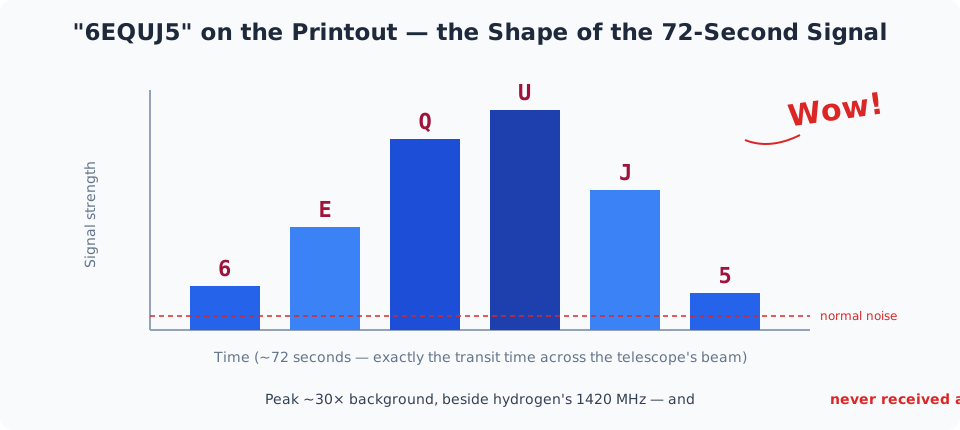
The “discovery” happened days after reception. Jerry Ehman, an astronomer volunteering on the analysis, was scanning the computer printout when an impossible sequence stopped his eye. The paper encoded signal intensity in alphanumerics; ordinary noise printed as scattered 1s and 2s. But there stood “6EQUJ5” — a sharply peaked signal rising to about 30 times the background noise. The electrified Ehman circled the column in red and wrote the word that became the signal’s name.
Two properties make the signal special. First, its energy was concentrated in an extremely narrow frequency band — natural sources glow broadly across the spectrum, while narrowband emission is the signature of artificial transmitters. Second, the frequency sat right beside 1420 MHz — the emission line of hydrogen, the most abundant element in the universe. SETI’s founders had predicted this exact frequency as the “universal channel” any radio-literate civilization would know — the leading candidate for deliberate interstellar transmission.
The Signal “Behaved” Like the Real Thing
What elevates the Wow! signal is its obedience. Its 72-second duration matched, precisely, the number predicted by the telescope’s own geometry.
Big Ear was a fixed telescope, sweeping the sky by way of the Earth’s rotation. A genuine signal from a fixed point in the sky should therefore take exactly 72 seconds to cross the field of view, tracing a rising-then-falling curve of intensity. The Wow! signal did exactly that. The natural conclusion: this was no terrestrial interference or radar leak, but emission from a fixed point on the celestial sphere — localized toward the constellation Sagittarius.
One wrinkle, though. Big Ear observed each sky position twice, minutes apart, through two feed horns — and the signal appeared in only one of them. A genuinely continuous transmission should show in both. So the signal existed during one 72-second window and was gone minutes later. An intermittent transmitter, or a fleeting coincidence? The mystery was already deepening on day one.
The “Again” That Never Came
In science, a single observation decides nothing; reproduction is everything. And the Wow! signal’s five decades have been a history of failed reproduction.
Ehman’s team re-observed the region immediately and repeatedly: nothing. Later campaigns with far more sensitive instruments — including major radio telescope arrays — hunted it again and again. The signal has never been received a second time.
Candidate explanations have been worked through. Terrestrial radio reflected off space debris sounds plausible until you hit the wall: the band around 1420 MHz is internationally protected — transmission there is banned precisely to keep radio astronomy clean. A strong artificial signal there would itself be a regulatory anomaly, and the celestial-fixed-point behavior fits poorly besides. A 2017 claim that a comet’s hydrogen cloud was the source made headlines and was broadly rejected — the comet in question was not at that position at that time. More recently, researchers mining archival data for similar-but-weaker events have proposed that the signal could be a rare natural flare of an interstellar hydrogen cloud (a maser-like brightening). Promising — and still unverified. The honest current state: “a natural explanation is possible but unconfirmed, and the extraterrestrial possibility cannot be excluded.” Suspended, exactly there.
”Wow!” in the History of SETI
To grasp the signal’s meaning, you need the context of SETI — the search for extraterrestrial intelligence. The Wow! signal is not an isolated curio but the climax of a long story.
It begins in 1959, when two physicists published the historic paper “Searching for Interstellar Communications,” proposing: “look near hydrogen’s frequency, 1420 MHz.” The most abundant element’s emission line is known to any civilization that has discovered radio astronomy — so a civilization transmitting deliberately would choose this “cosmic common channel.” The next year, 1960, the first true search — Project Ozma — pointed a dish at two nearby stars on exactly this logic.
The search then went global. In 1974, humanity transmitted in the other direction: the Arecibo message, a pictorial radio broadcast of human knowledge, sent toward a star cluster (arrival time: tens of thousands of years — a magnificent message in a bottle). Big Ear’s long watch belonged to this same lineage.
Which means that on that night in 1977, Big Ear was watching the frequency theory predicted, by the method theory prescribed — and received a signal shaped exactly as theory said it would be. The Wow! signal was the one moment SETI’s entire logic appeared to strike home perfectly. Hence the depth of the disappointment when it never returned — and the question “what was that?” that has not faded in half a century.
What the Signal Teaches
The Wow! signal resonates deeply with the Fermi paradox covered on this site — “if aliens exist, why haven’t we met them?”
If the signal truly was another civilization, then ironically it teaches that “they are not necessarily broadcasting continuously.” Like a lighthouse beam that happened to sweep across Earth for 72 seconds, no amount of listening guarantees a reunion. And if it was natural — then we have discovered an unknown astrophysical phenomenon. A mystery that pays off scientifically whichever way it falls: a rare thing.
What I love most is Ehman’s own bearing. The discoverer himself maintained, for decades: “we should not claim it as evidence of aliens — but it has never been explained either.” Neither leaping nor dismissing; filing the unknown, properly labeled, as unknown. The coexistence of the exclamation “Wow!” and a scientist’s restraint — the ideal relationship with a mystery, compressed into one episode.
Questions About the Wow! Signal
So Could It Really Have Been Aliens?
The possibility remains — and cannot be proven. That is the precise answer. The signal’s features (narrowband, at the hydrogen line, fixed on the celestial sphere) tick the boxes SETI predicted for an artificial transmission. But with a single, unrepeated event, science can never certify it as evidence of extraterrestrial civilization. The natural explanations lack a clincher too. Verdict: suspended. And that suspension is the honest conclusion — both “it must be aliens” and “obviously just noise” overrun the evidence.
Can’t Modern Technology Pinpoint the Source?
Attempts continue. Recent projects have short-listed sun-like stars in the signal’s direction and observed them intensively; others mine old Arecibo data for faint analogues. But Big Ear’s beam covered a fairly wide patch of sky, and pinning the source to a single point is inherently difficult. The real decider would be re-detection. The world’s SETI networks still keep an ear turned toward Sagittarius.
What Happened to the Big Ear Telescope?
An unworthy ending. After decades of observation, Big Ear was demolished in 1998 — the site went to a golf course expansion. For the instrument that ran one of history’s longest SETI watches and left us the Wow! signal, a painfully abrupt exit. But its mission lives on in today’s great telescopes and in privately funded SETI programs at scale. If a “second Wow!” is ever caught, the modern protocol swings telescopes worldwide onto it within minutes. The preparations for not missing the next 72 seconds are well underway.
Related Mysteries
See the space-and-sky mysteries: “the Fermi paradox,” “the Tunguska event,” and “ball lightning.”



Summary
This article covered “the Wow! signal.”
In the summer of 1977, a radio telescope caught 72 seconds of intense signal — beside the hydrogen frequency where alien civilizations were predicted to broadcast, behaving exactly like a genuine source fixed on the sky — and it never came again. The comet theory fell; the natural-flare theory is under test; the extraterrestrial possibility can be neither proven nor dismissed. What remains is the red ink on the printout: “Wow!”
Science can call a one-time, unreproduced event neither white nor black. And so this signal teaches the discipline of properly storing an “unknown.” Tonight, again, the world’s telescopes are listening toward Sagittarius. When the next 72 seconds come, humanity does not intend to miss them.
To return to the full list of mysteries, follow the link below.
Thank you for reading. We hope to see you in the next article.

Also popular with readers
📚 Series: World Mysteries (19/21)