Thank you for visiting. This article is the fifth installment (the final one) in a series explaining the original texts of Canaanite (Ugaritic) mythology.
At last, I explain this series’ greatest highlight, “the connection of the Bible and Canaanite mythology.” With the discovery of the Ugaritic clay tablets in the 20th century, we have become able to reread the Old Testament in the very midst of the world that gave birth to it. The God of the Bible, the Bible’s monster, the Bible’s expressions — many of them resonate astonishingly deeply with Canaanite mythology.
For an overview map of the original texts of Canaanite mythology as a whole, please see this summary article.
Why Are Canaan and the Bible Deeply Connected?
In the first place, the people of ancient Israel lived in this very land of Canaan. The Hebrew they spoke is, linguistically, one of the Canaanite-family languages (the Bible itself has a passage calling Hebrew “the language of Canaan”).
That is, Israel’s faith grew up in the very midst of Canaan’s culture, language, and mythology. The Old Testament, on one hand fiercely rejecting Canaanite polytheism, on the other hand also richly inherits its words and expressions. Let me first put the main points of contact of the two into a diagram.
The God’s Name “El” — Canaan’s Supreme God and the God of the Bible
The most fundamental connection is the name “El.” As seen in Article 4, El was the name of Canaan’s supreme god. And the same “El” is also the word meaning “god” in Hebrew.
“Elohim,” which points to God in the Old Testament, is a derived form of this “El.” Further, in the Bible appear many names of God containing “El,” such as El Elyon (God Most High), El Shaddai (God Almighty), and El Olam (the Everlasting God).
Many of the features the Canaanite El had — the aged figure with a white beard, the mercy, presiding over the heavenly council seated on a throne — are inherited in the description of the God of the Bible too. It is thought that Israel integrated and reinterpreted the figure of Canaan’s supreme god El into their own one God, Yahweh.
”The Rider of the Clouds” — Baal and Yahweh
Next, the connection with the storm god Baal. In Article 1, I introduced “the rider of the clouds” as a title of Baal. In fact, this expression is used, just so, for Yahweh in the Bible.
Psalm 68 praises God as “the one who rides the clouds (the wasteland),” and Deuteronomy 33 likewise depicts God riding the heavens and rushing to aid. Thundering, making rain fall, driving the clouds — such an image of the storm god was originally attributed to Baal in Canaan. Israel, as if declaring “the true god who controls rain and storm is not Baal but our Yahweh,” sang the whole majesty of Baal as belonging to Yahweh.
The Battle over the Sea — Yam and Leviathan
The climax of Article 1 was the scene in which Baal struck down the sea god Yam (the chaotic sea). This theme of “god subduing the raging sea” also flows strongly into the Bible.
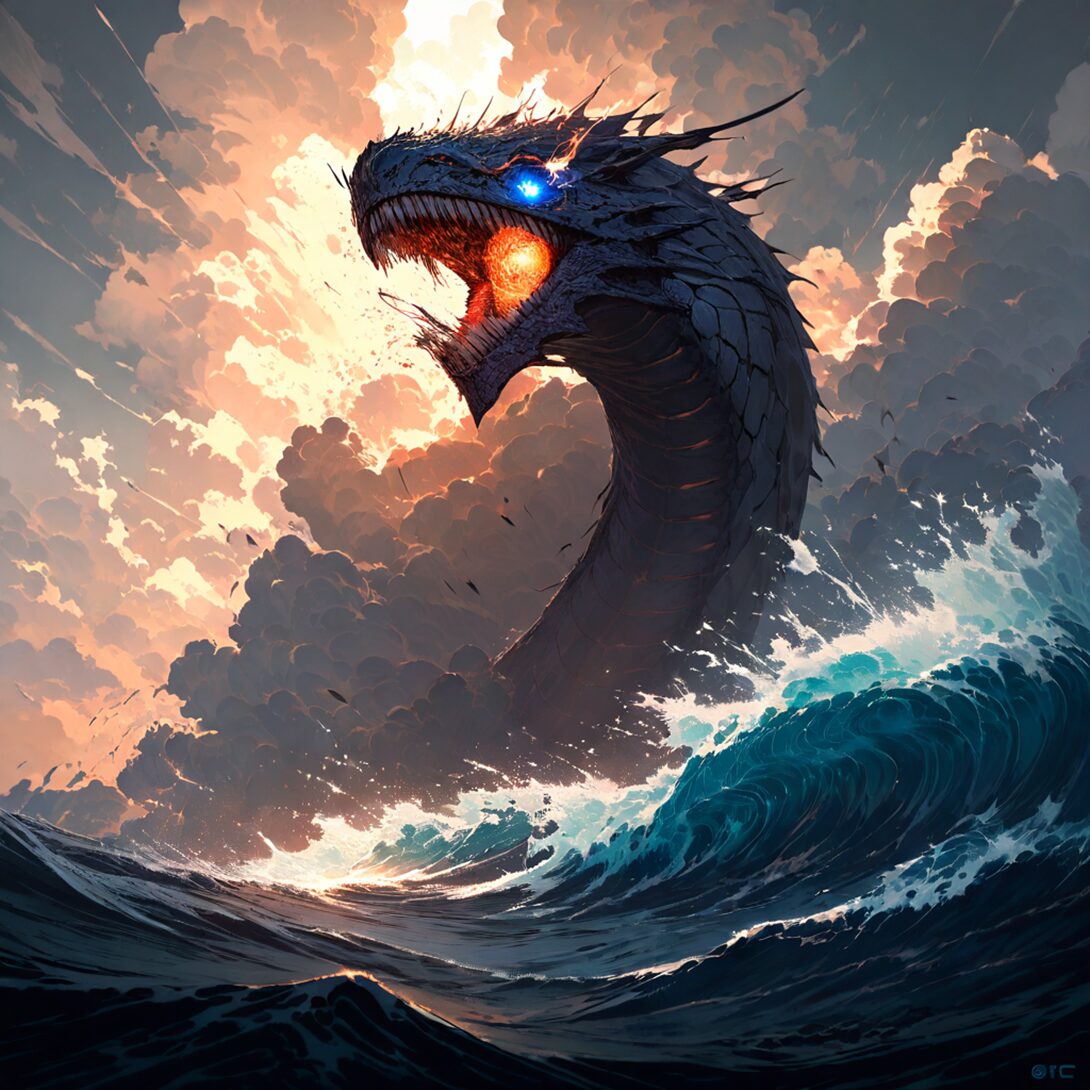
In the Old Testament, the figure of Yahweh splitting the sea and smashing the dragon (Rahab) is sung repeatedly (Psalm 74, Isaiah 51, etc.). Even more vivid is the monster Leviathan. Do you remember the seven-headed serpent Lotan that Baal and Anat defeated in Article 1? Isaiah 27 says God will punish “Leviathan the fleeing serpent, Leviathan the twisting serpent,” but this expression overlaps almost word for word with the description of Ugarit’s Lotan. That Psalm 74 sings “you crushed the heads of Leviathan” in the plural also recalls the memory of the seven-headed Lotan. The god who defeats the monster of the chaotic sea — the Bible shares that grand image with Canaan.
Swallowing Death — the Death God Mot and the Bible
The death god Mot, seen in Articles 1 and 4, was a being with a bottomless mouth that swallows all living things. This image of “death = the swallower” flows into the Bible too.
In the Old Testament, the world of the dead “Sheol” is often depicted as opening a great mouth and swallowing people (Isaiah 5, Proverbs 1, etc.). Even more vivid is a passage of Isaiah 25. There, God declares that he will “swallow up death (Mot) forever.” God, conversely, swallowing up death itself, which has swallowed everything — knowing Canaan’s death god Mot, one sees how powerful a declaration of reversal these biblical words are. It is the declaration that the true lord who rules death is not the death god Mot but Yahweh.
The “Council of the Gods” and the Bible
The “council of the gods” seen in Article 4 — the structure in which the supreme god deliberates, leading the heavenly gods — is also inherited by the Bible.
Psalm 82 sings, “God (Elohim) stands in the council of the gods, and judges in the midst of the gods,” depicting the very heavenly council. In 1 Kings 22, the prophet Micaiah sees in a vision the Lord surrounded by the host of heaven, and at the opening of the Book of Job, the “sons of God” gather before the Lord. Deuteronomy 32 also has a reading conveyed by old manuscripts (the Dead Sea Scrolls, the Septuagint) that the Most High allotted the nations “according to the number of the sons of God.”
The Bible, while sharing this image of the “heavenly council” with Canaan, decisively remade it. The ones who gather at the council are not equal gods, but were repositioned into angels and the heavenly host serving the one God. The polytheistic assembly changed form into the monotheistic heavenly court — that transformation can be seen here.
The Confrontation with Baal — the Battle of the Prophets
Of course, the Bible and Canaanite mythology are not only in a relationship of inheritance. The Old Testament fiercely rejects, of all the Canaanite gods, Baal worship, as the greatest enemy.
Its peak is the confrontation of the prophet Elijah and the prophets of Baal in 1 Kings 18. On Mount Carmel, Elijah challenges the 450 prophets of Baal. It is a contest of which god will bring fire down from heaven. The prophets of Baal desperately danced and cried from morning to evening, calling on Baal even to the point of cutting their own bodies, but Baal at last remained silent, with no response at all. Meanwhile, when Elijah prayed, Yahweh sent down fire from heaven.
Here is contained a trenchant irony. The storm god Baal, who should command thunder and fire, cannot raise a single fire. The true god who gives rain and harvest is not Baal but Yahweh — the prophet Hosea too appealed that grain, wine, and rain are gifts not of Baal but of Yahweh. In time the name “Baal” became a byword for a false god. The chief of demons that appears in the New Testament, “Beelzebul (Beelzebub),” also derives originally from the name of Canaan’s “Baal.”
Inherited Words and Expressions
The discovery of Ugarit greatly advanced biblical scholarship itself. Because the Ugaritic language was a very close relative of Hebrew, the difficult words of the Bible and the expressions of old poetry, whose meaning had been unknown until then, were unraveled one after another.
For example, the technique of “parallelism (repeating the same content twice with changed words)”, characteristic of Hebrew poetry, was exactly the same as that of Ugaritic poetry. That the wise king Danel (Dan’el), seen in Article 3, appears in the Book of Ezekiel as an ancient righteous man alongside Noah and Job is also one example. Also, the name of one of Canaan’s twin gods, “Shalim,” is said to remain in the name of the holy city “Jerusalem.” The words and myths of Canaan leave traces in every corner of the Bible.
Canaanite Mythology Illuminates the Bible
Finally, let me summarize the relationship of the two. What matters is that this is by no means a story of the Bible “plagiarizing Canaanite mythology.”
Rather, Israel’s faith was born and grew up from the soil of Canaan. In doing so, Israel freely used the words, images, and story-types of Canaan, while remaking them from the root, from polytheism to faith in the one God. Baal’s majesty was made Yahweh’s, the council of the gods became the court of angels, and the monster of the chaotic sea was relegated to one of the one God’s creatures.
The Ugaritic clay tablets returned the other living voice of Canaan to a world in which only “one voice,” the Bible, had long remained. Knowing Canaanite mythology is nothing other than understanding the Old Testament even more deeply, within the age in which it truly lived.
The original texts of the Old Testament itself are explained in detail in the following series. Reading them alongside makes the resonance of the two appear even more vividly.
How Strong Are the Characters? — the Strongest Ranking
The monster Leviathan (Canaan’s serpent Lotan) dealt with in this article is also introduced in order of strength in the “Mythology, Religion, and Legend Strongest Ranking.” Please enjoy both its figure in the original texts and its “strength.”
To Learn More
Conclusion
In this article, I explained in detail the deep connection of Canaanite mythology and the Old Testament, following the original texts. How was it?
The god’s name El, Baal’s title “the rider of the clouds,” the monster Leviathan and the serpent Lotan, the heavenly council, and the confrontation of Elijah and Baal. I think you have felt that the Old Testament built its faith in the one God within the world of Canaan, wrestling with its words.
With this, all five articles of the Canaanite mythology (Ugaritic) original-texts series are complete. From the myth of the storm god Baal that was buried in sand, to the epics of kings, and the background of the Bible, I hope you have savored the “other ancient world.”
I also explain the original texts of other mythologies and religions. For the full list, please see the Summary of the World’s Mythology and Religion Original Texts.
Reading it alongside the original texts of the Old Testament and Judaism lets you enjoy the connection even more deeply.
I hope you’ll read the next article too.
Also popular with readers
📚 Series: The Original Texts of Canaanite (Ugaritic) Mythology (6/6)