Thank you for visiting. This article is the second installment in a series explaining the original texts of Egyptian mythology.
This time, we look in detail at Egyptian mythology’s most important and popular story, the “Osiris myth.” Depicting “death and rebirth” and “the battle of good and evil,” it may be called the heart of Egyptian mythology.
For an overview map of Egyptian mythology’s original texts as a whole, please see this summary article.
This story remains only fragmentarily in the original texts, and what conveys it in the most coherent form is the work of the later Greek writer “Plutarch,” On Isis and Osiris. Here I explain it following that tradition.
The broad flow of the story is as follows.
Osiris’s Good Reign
The protagonists of the story are the four gods, children of the earth god Geb and the sky goddess Nut: the eldest “Osiris,” his sister and wife “Isis,” the younger brother “Seth,” and the sister who becomes Seth’s wife, “Nephthys.”
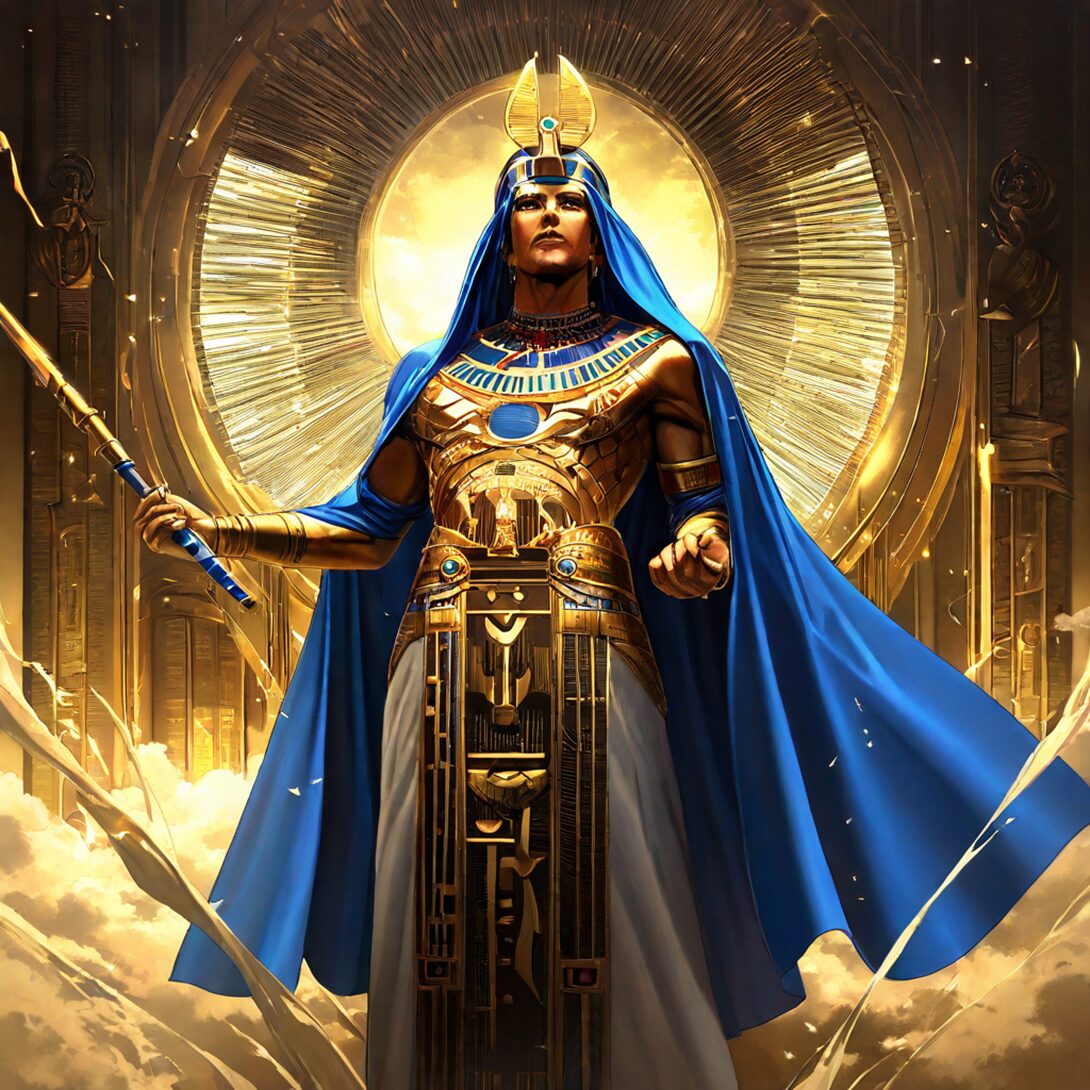
Osiris was the good king who first ruled Egypt. To people who had until then lived in barbarism, he taught agriculture, law, and how to revere the gods, leading Egypt to a rich, civilized nation. His wife Isis too supported the king with wisdom and magic and was deeply loved by the people.
Seth’s Betrayal and the Death of Osiris
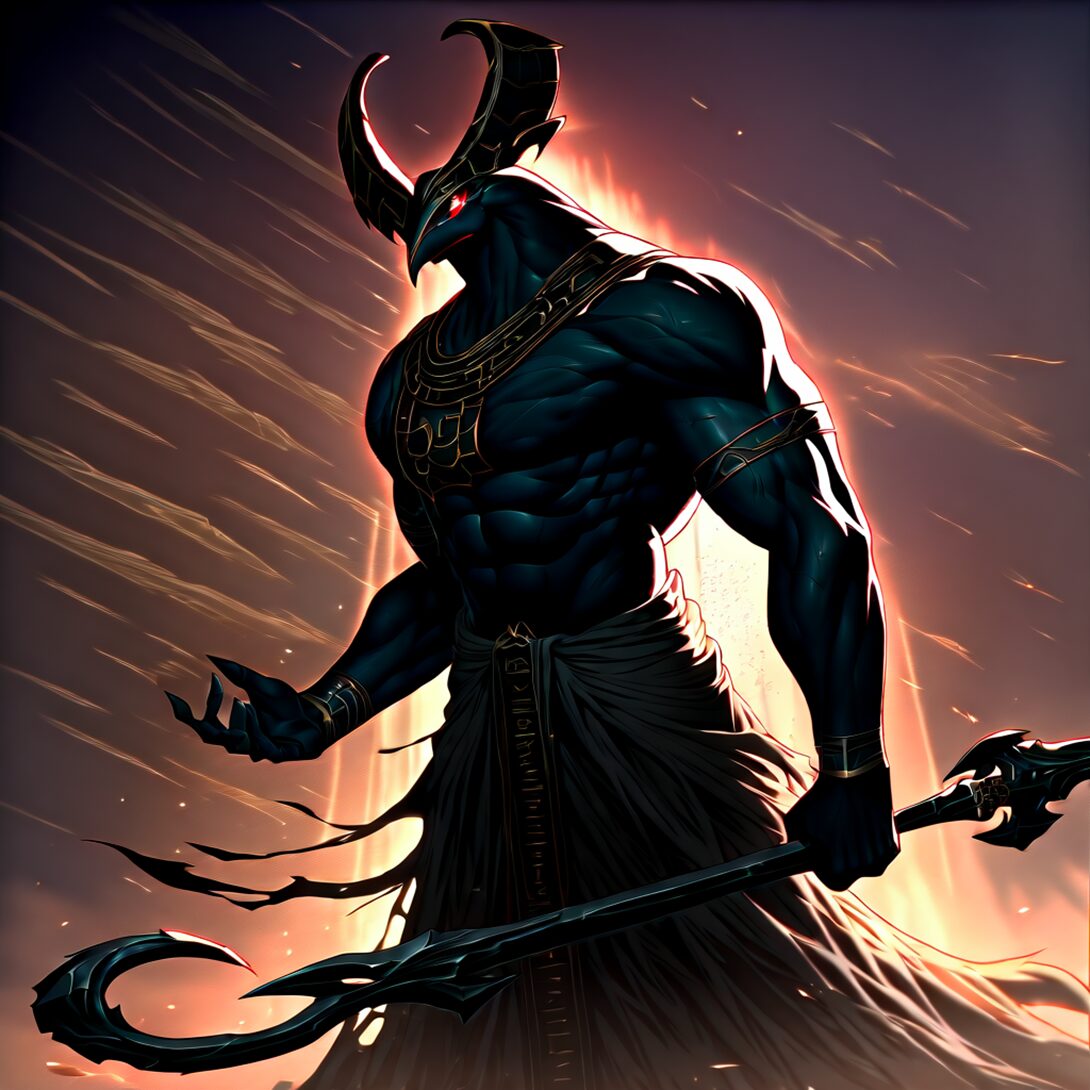
But the younger brother “Seth” fiercely envies his elder brother Osiris’s prosperity and popularity. Seth, who governs chaos and violence, devised a terrible scheme to seize the throne.
Seth held a grand banquet and secretly prepared a “beautiful box (coffin)” fitting Osiris’s body exactly. And he proposed as entertainment, “I will give this to whoever fits perfectly in this box.”
After the invited guests tried it one after another, the moment Osiris lay down in the box, Seth and his companions all at once shut the lid, nailed it, sealed it with molten lead, and set the box adrift on the Nile. Thus Osiris was killed, and Seth seized the throne of Egypt.
Isis’s Search and the Dismemberment of the Body
The wife “Isis,” grieving her husband’s death, cut her hair, donned mourning clothes, and set out on a long journey to find the cast-away coffin.
The coffin went down the Nile and out to sea, washing ashore in a far foreign land, “Byblos” (present-day Lebanon). There a tree enveloped the coffin and grew large, and that splendid tree was cut down and made into a pillar of the great hall of the king’s palace. Arriving at Byblos, Isis served the queen with her identity hidden and became the prince’s nurse. Eventually revealing her identity, Isis was given the pillar containing the coffin, and at last brought her husband’s body back to Egypt.
But Seth, learning of it, was enraged. Seizing back Osiris’s body, Seth cut the body into 14 pieces and scattered them across all of Egypt — so he could never be revived.
Even so, Isis did not give up. With the help of her sister Nephthys, she went around the marshes in a papyrus boat and patiently gathered the pieces of her husband’s body, scattered all over Egypt, one by one. However, only the phallus was eaten by a fish of the Nile and not found. So Isis, it is told, formed that part by magic to make up for it. At the places where each part of Osiris’s body was said to have been found, sacred sites enshrining Osiris were later built.
The foremost of these sacred sites is “Abydos,” believed to be where Osiris’s head (or his body itself) was buried. Taken to be Osiris’s tomb, it became Egypt’s foremost pilgrimage site, and every year a rite reenacting the death and resurrection of Osiris (the Osiris festival, a mystery play) was grandly held. People are said to have all wished to be buried at Abydos, or at least to have a stele erected there. A fine example of myth deeply rooted in actual faith and land.
The Resurrection of Osiris and the Birth of Horus
The gathered body, Isis wrapped in bandages and restored to its original form. This is taken as the origin of the “mummy,” and it is told that the god Anubis, who governs mummification, helped.
And Isis, using powerful magic, temporarily revived Osiris. During this time, Isis conceived a child with Osiris. But Osiris could no longer remain in the world of the living. He became the “king of the underworld (the land of the dead),” the being who judges the dead and governs rebirth.
This became the root of the Egyptian view of life and death. The belief that “like Osiris, a person can be revived after death and gain eternal life” leads on to the later Book of the Dead (Article 3).
The Infant Horus and Isis’s Magic
Isis, escaping Seth’s eyes, hid in the marshes of the Nile Delta (Chemmis) and secretly bore and raised her son “Horus” — to avenge his father and recover the stolen throne.
This figure of “the mother Isis, all alone, protecting and raising her infant in a dangerous wilderness” strongly captured the hearts of the Egyptian people and became the subject of many amulets and protective spells. Especially famous is the story in which the infant Horus is stung by a scorpion and falls near death. Hearing the grieving Isis’s plea, the sun god Ra halts the course of the heavens and sends the wisdom god Thoth to grant an antidote spell, and Horus is saved. The “Horus stelae (cippi),” beginning with the “Metternich Stela” that carves this tale, were believed to protect from poison and illness if one drank the water poured over them. A precious original text showing that myth was directly linked to people’s daily prayers (medical magic).
The Battle of Horus and Seth, and the Succession
The grown Horus challenges his uncle Seth in a battle over the kingship. For this latter part, separate from Plutarch, an original text of Egypt itself remains: the “Contendings of Horus and Seth” recorded in the Chester Beatty Papyrus of the New Kingdom (c. 12th century BC). This is a story depicting the trial and confrontation of the gods, sometimes with comic touches, and the following draws on this original text. The contest, it is told, was a long one of as much as 80 years, including not only contests of strength but trials in the court of the gods.
In the court of the gods, it would not easily be decided. Many gods supported Horus as the legitimate heir, but the sun god Ra showed an attitude leaning toward Seth, saying “Horus is still too young,” and the debate dragged on. Losing patience, the two waged several direct contests.
- A diving contest as hippopotami: the two gods change into hippos and contest who can stay submerged longer. There is a scene in which the mother Isis, trying to harpoon Seth, accidentally wounds her son Horus and hastily pulls the harpoon out.
- Horus’s eyes gouged out: in the struggle, Seth gouges out both of Horus’s eyes and buries them. But the goddess Hathor heals Horus’s eyes with gazelle milk.
- The lettuce stratagem: Seth tries to shame Horus and show he is unfit to be king, but by Isis’s wisdom, conversely Seth’s side ends up shamed, and the scheme fails.
- The stone-boat race: Seth builds a boat of real stone and sinks; Horus disguises a wooden boat as stone and wins.
The two contended fiercely many times, and the eye of Horus, wounded here and later healed, is called the “Wedjat eye (Eye of Horus)” and was widely used in Egypt as an amulet, a symbol of recovery, protection, and wholeness.
In the end, the one who settled it was Osiris himself, now king of the underworld. By Osiris writing to the court, “If justice is not done, I, who govern the dead, will deliver retribution,” the gods at last acknowledged Horus’s kingship.
In the end, the court of the gods acknowledged the kingship to the legitimate heir Horus and drove off the chaotic Seth. Thus Horus became the rightful king of Egypt.
From this ending, in Egypt it came to be thought that “the living pharaoh is the incarnation of Horus, and the dead pharaoh becomes Osiris.” The Osiris myth was not a mere story but a supremely important myth that supported the very legitimacy of the pharaoh’s kingship.
How Strong Are the Characters Here? — The Power Ranking
The gods and heroes appearing in this article are also introduced in strength order in the “Mythology, Religion & Legend Power Ranking.” Enjoy their exploits in the original text alongside their “strength.”
To Learn More
Conclusion
In this article, I explained the heart of Egyptian mythology, the “Osiris myth,” in detail. How was it?
The good king Osiris is killed by Seth, revived by Isis’s love and magic to become king of the underworld, and his son Horus avenges his father and inherits the kingship — this story concentrates the Egyptian values of “death and rebirth,” “the battle of good and evil (order and chaos),” and “legitimate kingship.”
In the next article (Article 3), I will explain the “Book of the Dead” and the afterlife, which depict how the dead are judged in the underworld where Osiris became king.
I hope you’ll read the next article too.
Also popular with readers
📚 Series: The Original Texts of Egyptian Mythology (3/5)