Thank you for visiting. This article is the seventh installment (the finale) in a series explaining the original texts of Hindu mythology.
In this finale, I take up the other great epic, alongside the Mahabharata, the “Ramayana.” The ideal prince Rama rescues his abducted wife — a clear, single-threaded hero tale in which good prevails over evil. I trace it following the structure of the original text’s seven books (kandas).
For an overview map of Hindu mythology’s original texts as a whole, please see this summary article.
What Kind of Original Text Is the Ramayana?
| Item | Content |
|---|---|
| Meaning | ”The path Rama walked (the story of Rama)“ |
| Author | The poet Valmiki (taken to be “the first poet”) |
| Structure | 7 books (kandas), about 24,000 verses |
| Hero | Prince Rama (the 7th avatar of the preserver god Vishnu) |
The Ramayana is an epic with Prince “Rama” of the kingdom of Kosala as its hero, attributed to the poet “Valmiki.” He is praised as “the first poet (Adi Kavi),” and the Ramayana is positioned at the starting point of Indian literature.
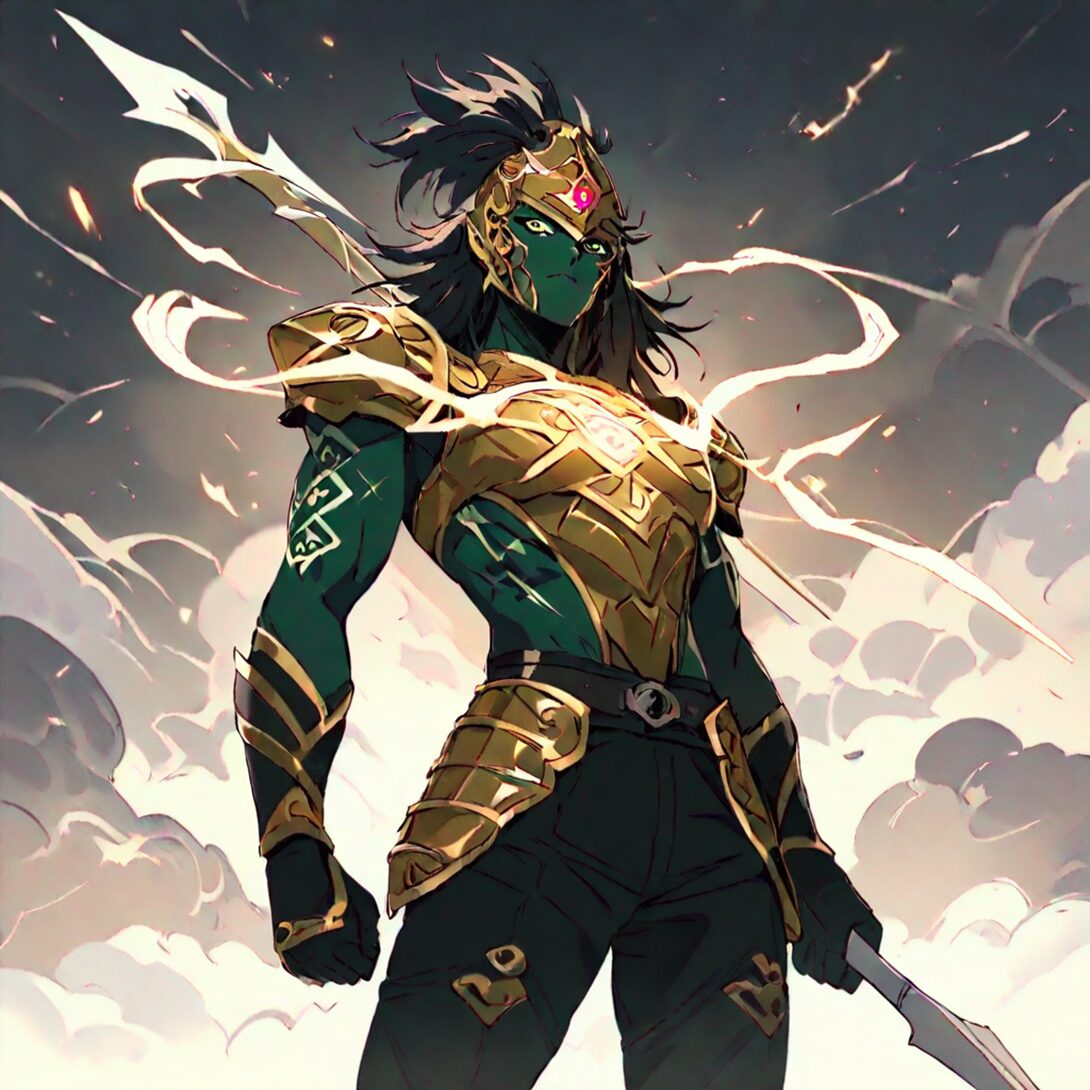
Whereas the Mahabharata is a complex ensemble drama, the Ramayana is a clear morality tale of “the ideal king Rama rescuing his abducted wife.” Rama as “the ideal human and ideal king,” his wife Sita as “the ideal woman,” and his brother Lakshmana as “the ideal sibling” have been taken as models for the way of life of the Indian people, and have boasted immense popularity.
The story is composed of the following seven books (kandas). In this article, I explain following this book structure.
Book 1: Bala Kanda (the Book of Childhood) — Birth and Marriage
The story begins in the capital of the kingdom of Kosala, Ayodhya. The aged King Dasharatha had no heir and at last gained four princes through ritual. The eldest is “Rama,” and the half-brothers Bharata and Lakshmana.
In fact this birth had a heavenly background. The rakshasa king Ravana, having gained through asceticism the boon of “being killed by neither god nor demon,” was threatening the world. Receiving the gods’ plea, the preserver god Vishnu deliberately was born on earth as the human prince Rama to defeat Ravana — this is Rama’s true identity (Vishnu’s 7th avatar; see Article 4).
The grown Rama, accompanied by the sage Vishvamitra, shows his valor early, defeating rakshasas who hinder asceticism. And in the neighboring kingdom of Mithila, by easily stringing and breaking the giant bow of the god Shiva, which no one could lift, Rama took the princess “Sita” as his wife. Sita is a virtuous and beautiful woman, said to have been born from the earth.
Book 2: Ayodhya Kanda — the Exile
The story turns dark in this Book 2.
The aged King Dasharatha decides to make the virtuous Rama the next king (the heir-apparent). The whole country rejoiced. But just before, tragedy strikes.
The king’s secondary wife “Kaikeyi,” egged on by her wicked maid “Manthara,” brought up “two wishes” she had once been granted by the king. What she demanded was the all-too-merciless: “Make my son Bharata king, and exile Rama abroad for 14 years.”
A king’s word cannot be unsaid. Sensing his father the king’s painful position, Rama showed no attachment whatsoever to the throne and, to keep his father’s promise (the weight of his word), willingly accepted a life of exile in the forest. His wife Sita and his faithful brother Lakshmana also followed Rama into the forest.
In the grief of losing his son, King Dasharatha soon passed away. The brother Bharata, who returned home not knowing the circumstances, was enraged at his mother Kaikeyi’s plot and begged the forest-bound Rama to take the throne. But Rama firmly declined, keeping his father’s word. So Bharata placed Rama’s “sandals” on the throne and ruled the country as Rama’s regent. This figure of brothers yielding the throne to each other is one reason the Ramayana is taken as an “ideal story.”
Book 3: Aranya Kanda (the Forest Book) — Sita’s Abduction
Amid the peaceful life in the forest, an event that changes fate occurs.
One day, “Shurpanakha,” the sister of the rakshasa king “Ravana,” visits the forest, falls in love at first sight with Rama, and makes advances. When she raged at being rejected, the brother Lakshmana cut off her nose and ears.
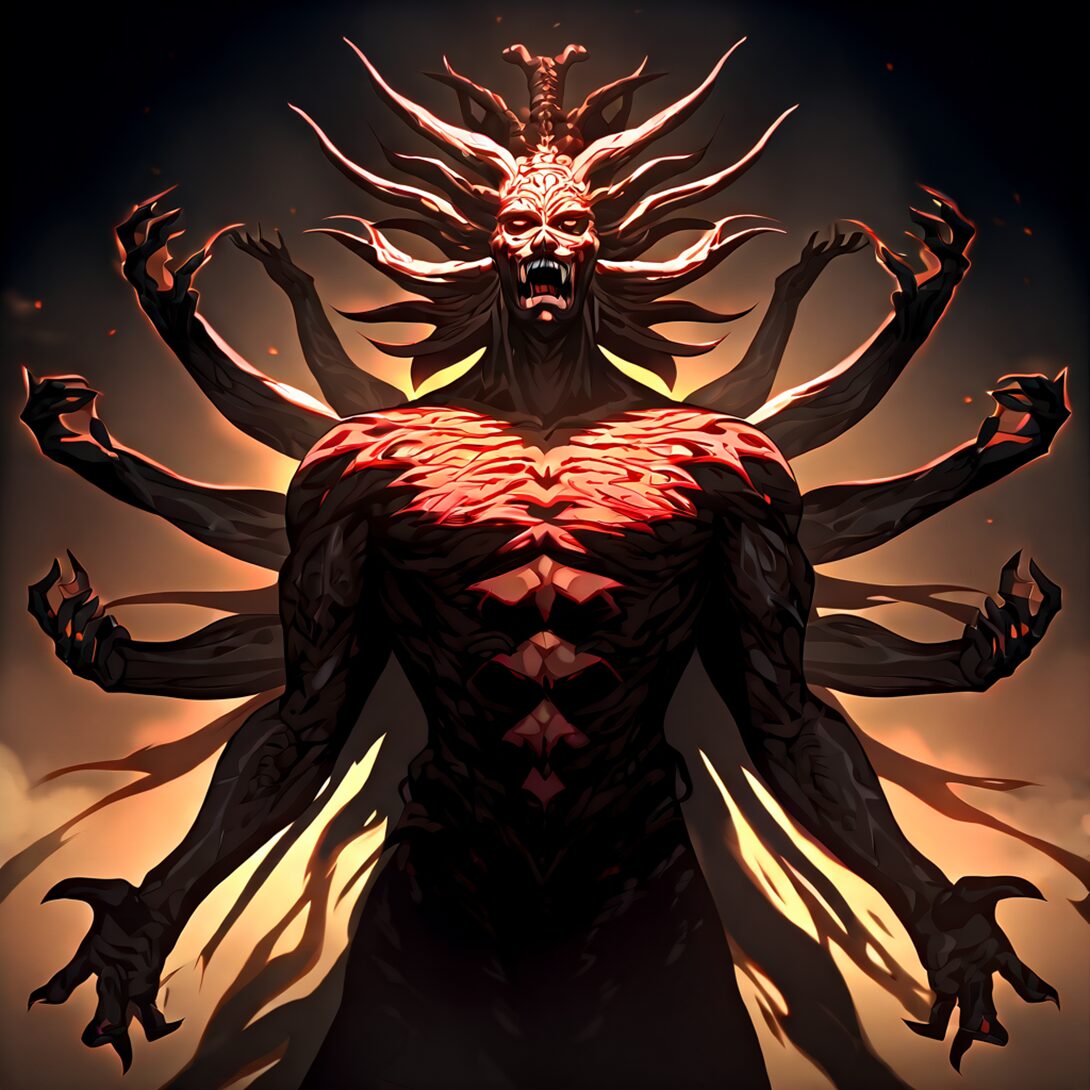
Out of revenge for his humiliated sister and lust for Sita’s beauty, the mighty demon king Ravana, with ten heads and twenty arms, plots Sita’s abduction. He had his subordinate monster “Maricha” transform into a beautiful golden deer. Sita wants that deer, and Rama goes to catch it. Then, by a fake cry for help imitating Rama’s voice, the brother Lakshmana too was drawn away.
In that gap, Ravana abducted Sita and carried her off by flying chariot to the island of Lanka (taken to be present-day Sri Lanka). At this time, the sacred vulture “Jatayu” challenged Ravana, risking himself to save Sita, but had his wings cut and fell dead, telling the arriving Rama what had happened before breathing his last. His beloved wife taken, Rama sets out with his brother on a long journey to rescue Sita.
Book 4: Kishkindha Kanda (the Book of the Monkey Kingdom) — the Alliance
Searching for Sita, Rama forms a fateful alliance with the monkey kingdom on his journey.
Rama helps the monkey prince “Sugriva,” who had had his throne and wife taken by his brother, defeats his brother “Vali,” and seats Sugriva on the throne. In return, Sugriva promises to lend Rama the great monkey army.
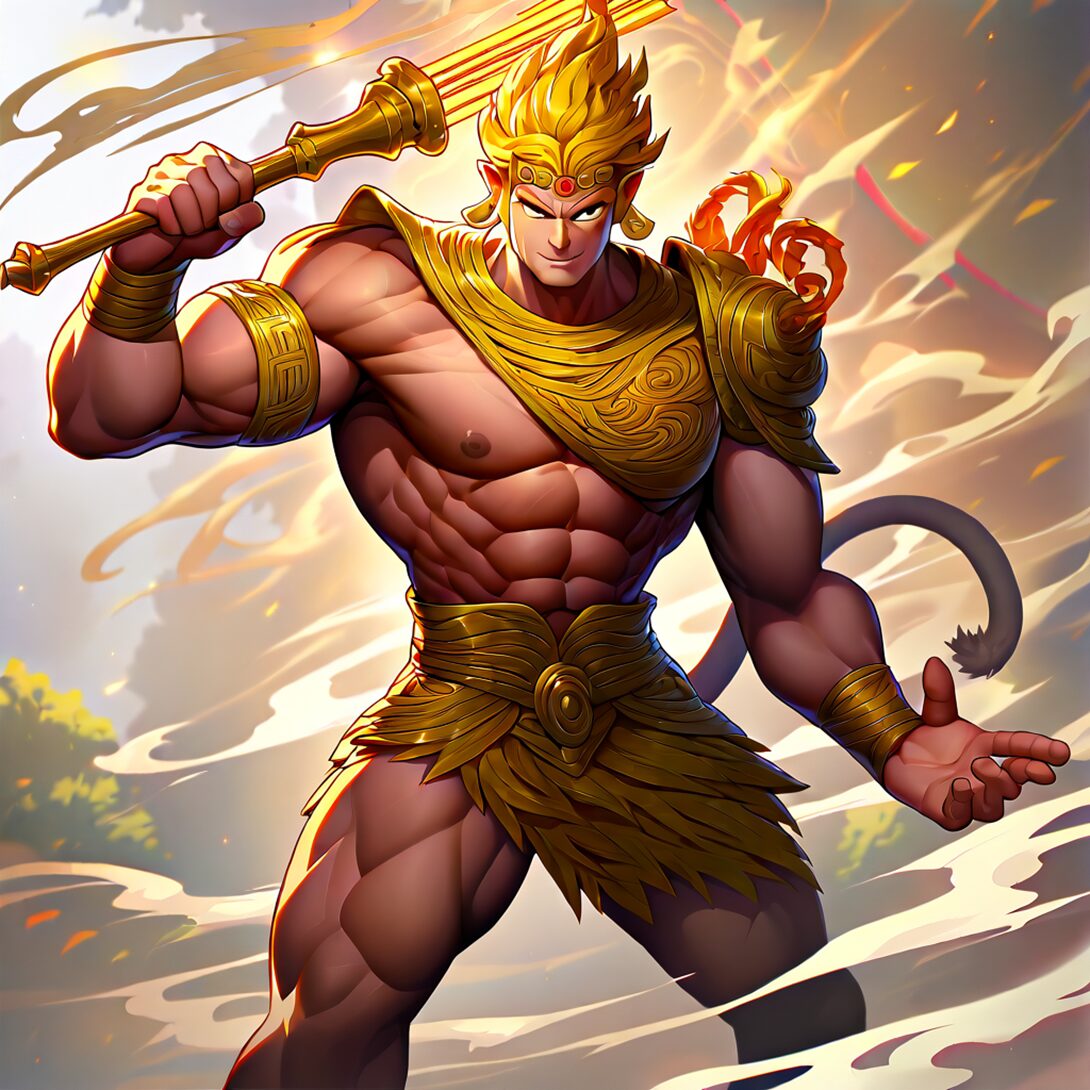
Among this monkey army, boasting immense popularity in the whole Ramayana, is the monkey hero “Hanuman.” He is the son of the wind god, with superhuman power to fly and freely grow and shrink his body, combined with absolute loyalty to Rama. The monkeys scattered in all directions to search for Sita’s whereabouts.
Book 5: Sundara Kanda (the Beautiful Book) — the Deeds of Hanuman
Book 5 is one of the most beloved books in the Ramayana, with Hanuman as the lead.
Gaining a clue that Sita is on the island of Lanka, Hanuman leaped across the vast sea in a single bound and infiltrated Lanka alone. And he found Sita, imprisoned in the garden of Ravana’s palace, resolutely continuing to refuse the demon king. Hanuman handed her Rama’s ring to tell her that rescue was near and to encourage her.
On his way back, Hanuman deliberately let himself be captured and was brought before Ravana. When, as punishment, his tail was set on fire, he used that fire to burn down the city of Lanka one after another and crossed the sea back at his leisure. By this delightful feat, Rama’s army gained a foothold for the counterattack.
Book 6: Yuddha Kanda (the Book of War) — the Decisive Battle and the Defeat of Ravana
Having pinpointed Sita’s location, Rama leads the great monkey army to attack the island of Lanka. To cross the sea, the monkeys piled giant stones into the sea to build a bridge (this “Rama’s Bridge” is told tied to a real topographical feature).
At this time, “Vibhishana,” Ravana’s brother who, though his brother, had admonished his evil deeds, was exiled, and joined Rama’s side, contributes greatly by telling Rama the weaknesses of the rakshasa army. The battle on Lanka was extremely fierce.
- Kumbhakarna: Ravana’s brother. With a mountainous giant body but, by a curse, spending most of the year asleep. Woken for the battle, he shows a rampage, swallowing monkeys one after another.
- Indrajit: Ravana’s son. A wielder of magic who even defeated the thunder god Indra; disappearing to shoot arrows, he drives Rama and Lakshmana into crisis again and again.
In the midst of the battle, the brother Lakshmana falls, gravely wounded. The one who saved him was Hanuman. He left the famous anecdote that, seeking the medicinal herb needed for treatment, he flew to the Himalayas, and seeing that he could not tell which was the herb, lifted and carried the whole mountain where the herb grew. With this herb (sanjivani), Lakshmana barely survived.
And finally Rama, with weapons granted by the gods, struck down the ten-headed demon king Ravana. Thus Sita is rescued.
But the story does not end in a simple happy ending. Because Sita’s fidelity was doubted, having been long in the demon king’s keeping, she undergoes the “trial of entering the fire (the judgment by the fire god Agni)” to prove her innocence. The flame did not harm Sita, and her purity was proven. Having completed the 14-year exile, Rama returns in triumph with Sita to his home, Ayodhya, and is enthroned as king amid the people’s joy. The peaceful, justice-filled age Rama ruled, “Rama Rajya (Rama’s rule),” is still a byword in India for “an ideal world.”
Book 7: Uttara Kanda (the Later Book) — the Aftermath
The final book, said to be a later addition, is a poignant aftermath depicting what becomes of Rama and Sita.
Though Rama carried out ideal rule, among the people the rumor again spread, “Was the fidelity of Sita, long in the demon king’s keeping, truly kept?” Unable to ignore the people’s voice as king, Rama, after bitter agony, sent away the pregnant Sita to the forest.
Taking refuge in the forest, Sita, by chance at the hermitage of the poet Valmiki (taken to be the author of the Ramayana), bore and raised twin boys, Lava and Kusha. Eventually the grown twins sang the Ramayana before Rama, not knowing he was their father, and parent and children reunited.
Rama tries to call Sita back, but she, asked repeatedly to prove her fidelity, prayed to the earth goddess who bore her, “If I am pure, O earth, receive me,” and returned into the opened earth. That a glorious morality tale closes at the last bearing deep sorrow is also the depth of the original text called the Ramayana.
The Ramayana Spreading Across Asia
The influence of the Ramayana does not stop at India. Centered on Southeast Asia, in various parts of Asia, each region’s own “Rama story” was nurtured, and it still lives on as dance, shadow play, painting, and ritual.
| Region | Development of the Ramayana |
|---|---|
| Thailand | The national epic the Ramakien. So deeply rooted that successive kings take the name “Rama” |
| Indonesia | The central subject of the shadow play (wayang) and dance dramas of Java and Bali |
| Cambodia | Handed down as the Reamker, also carved on the reliefs of the Angkor ruins |
| Japan | There is a theory that, through Buddhist tales and the like, the story of the monkey king Hanuman became one source of Sun Wukong in Journey to the West |
Among them, the monkey god “Hanuman,” who served Rama with loyalty, is still one of the most popular gods in India. Embodying great strength, loyalty, and selfless devotion, he is taken as the model of the ideal devotee (bhakta) and gathers immense faith as a guardian god who drives off difficulties. That a single story has been beloved in such diverse forms, across borders and ages, expresses well the vitality of the original text called the Ramayana.
How Strong Are the Characters Here? — The Power Ranking
The gods and heroes appearing in this article are also introduced in strength order in the “Mythology, Religion & Legend Power Ranking.” Enjoy their exploits in the original text alongside their “strength.”
To Learn More
Conclusion
In this article, I explained the great epic the “Ramayana” in detail, following its structure of seven books. How was it?
Birth and marriage (Book 1), exile (Book 2), Sita’s abduction (Book 3), the alliance with the monkeys (Book 4), the deeds of Hanuman (Book 5), the decisive battle and return (Book 6), and the aftermath (Book 7) — this story woven by the ideal king Rama, the loyal monkey Hanuman, and the demon king Ravana spread not only across India but throughout Southeast Asia, deeply influencing the cultures of each region.
With this, the seven-article series on Hindu mythology’s original texts is complete. From the oldest scripture the Vedas, through the profound Upanishadic philosophy, the rich myths of the Puranas, the avatars of Vishnu, to the two great epics and the Bhagavad Gita, I hope you have savored the vast world of Indian mythology.
For the big picture of Indian mythology’s original texts and the list of other myths and religions, please see the pages below.
I hope you’ll read the next article too.
Also popular with readers
📚 Series: The Original Texts of Hindu Mythology (8/8)