Thank you for visiting. This article is the sixth installment in a series explaining the original texts of Hindu mythology.
This time, I take up the scripture contained within last time’s Mahabharata, the “Bhagavad Gita.” Though part of the epic, it is, on its own, the most widely read scripture in Hinduism, a special piece that keeps influencing people around the world, beginning with Gandhi.
For an overview map of Hindu mythology’s original texts as a whole, please see this summary article.
What Is the Bhagavad Gita?
“Bhagavad Gita” means “the Song (Gita) of the Lord (Bhagavat).”
| Item | Content |
|---|---|
| Position | Part of the Mahabharata’s 6th book, the “Bhishma Parva” |
| Structure | 18 chapters, about 700 verses |
| Form | A dialogue between the warrior Arjuna and the charioteer Krishna |
| Theme | How to live, how to act, and how to turn toward the divine |
This dialogue is placed at the very eve of battle, just before the great war of Kurukshetra begins in the Mahabharata explained last time (Article 5). Seen against the whole epic it is but a small part, but because its content is so profound, it has long been treated as an independent scripture, with countless commentaries written and translations into many languages. For Hindus, it is a “book at one’s side” that may be called a daily guide.
The Setting — Arjuna Loses His Will to Fight
The Gita does not begin with descriptions of fierce combat. Quite the opposite.
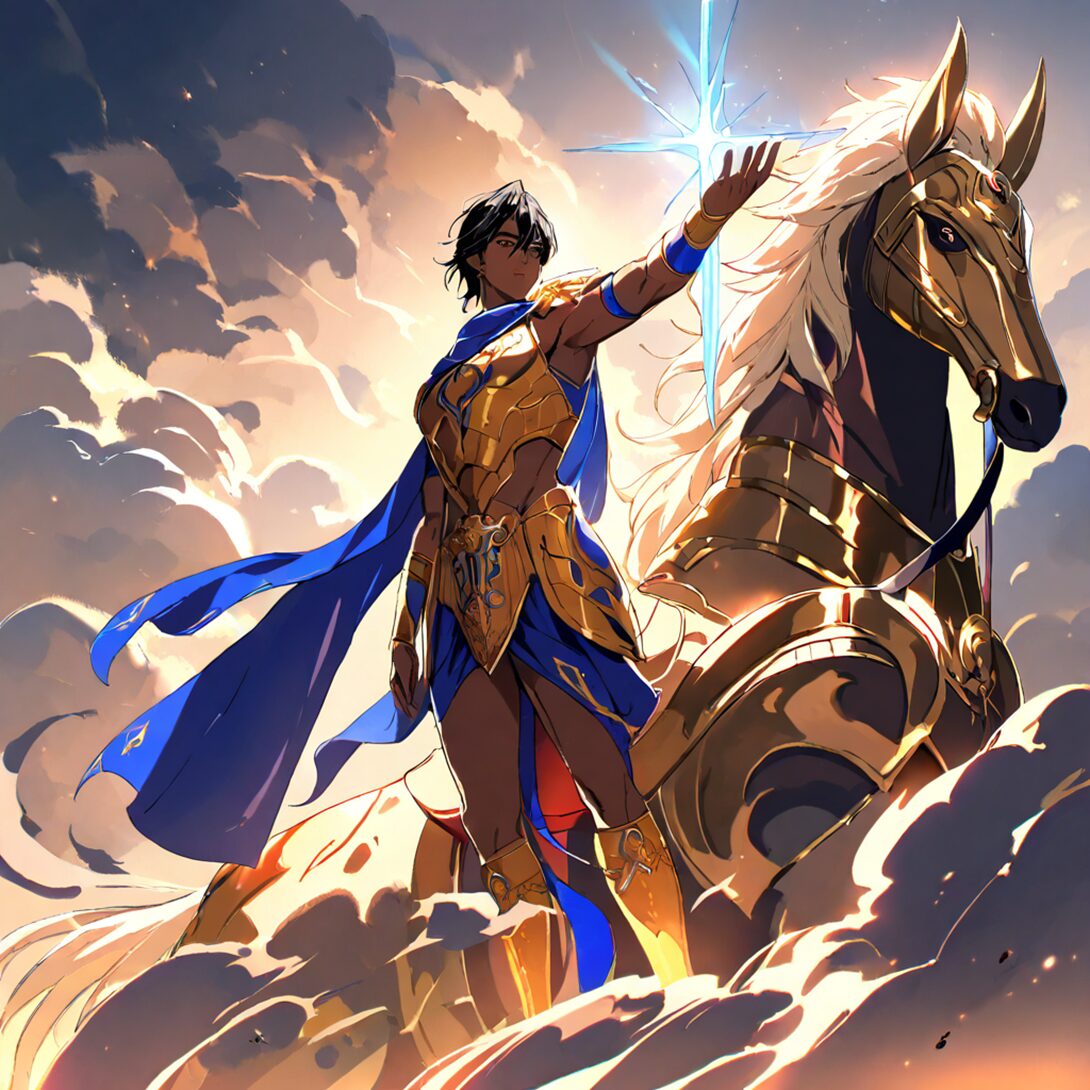
When the two armies faced off on the battlefield of Kurukshetra, the Pandava-side hero “Arjuna” asks his charioteer “Krishna” to advance the chariot between the two armies. And surveying the enemy ranks, Arjuna is stunned to realize that those arrayed there are only loved ones — his grandfather, teachers, cousins, and friends.
By killing these kinsmen, what happiness could I possibly gain? Even to gain the sovereignty of the whole world, I do not wish to kill them.
Saying this, Arjuna drops his bow and crumples down in the chariot. “Should I fight, or should I withdraw?” — he is crushed by the unanswerable anguish of fighting his own kin. From this anguish of Arjuna, Krishna’s teaching begins. The Gita depicts the universal moment when a person stands frozen at a crossroads of life.
Krishna’s Teaching — Three Paths (Yogas)
To the agonizing Arjuna, the charioteer Krishna — whose true identity is the avatar of the preserver god Vishnu — teaches a deep teaching. The teaching is wide-ranging, but it can be broadly organized into three “yogas (paths to the divine).” “Yoga” originally means “to join (with the divine).”
In addition, the path of meditation that controls the mind, “dhyana (raja) yoga,” is also taught. These are not mutually exclusive; one can reach the ultimate state from any path. Now let’s look at the heart of the teaching in order.
The Immortality of the Soul — Do Not Fear Death
Krishna first answers the “fear of death” at the root of Arjuna’s grief.
Even if the body perishes, the true self within it, “Atman (the soul),” is an eternal being that is neither born nor dies — this truth taught in the Upanishads (Article 2), Krishna tells in a vivid analogy.
As a person casts off old clothes and puts on new ones, so the soul casts off the old body and moves to a new one.
In other words, the death of the body is no more than changing clothes. The soul is not cut by weapons, not burned by fire, not wetted by water. So it is not right to grieve excessively over death, Krishna admonishes.
Karma Yoga — Act Without Clinging to Results
The most famous and central among the Gita’s teachings is “karma yoga (the path of action).”
Arjuna feared that “the act of fighting produces sin.” But Krishna teaches that abandoning action itself is the error. For as long as one lives, one cannot help doing something. The problem is not the action itself but the mind that clings to the “result” of the action.
What you should do is the action itself, never its result. Do not act with the result as your motive.
If one acts seeking success or reward, the mind is disturbed and bound by karma. But if one lets go of expectation of results and simply fulfills one’s own duty calmly, as an offering to the divine, that action no longer binds one — this is karma yoga.
Dharma — Fulfill One’s Own Duty
Connected to this is the teaching of “dharma (duty, one’s portion).” Krishna teaches that since Arjuna is a warrior (Kshatriya), fighting for justice is the very portion (svadharma) laid upon him.
To fulfill one’s own duty, even imperfectly, is nobler than performing another’s duty well. Carrying out, without selfishness, the role given to each within society leads to maintaining the world’s order (dharma).
Bhakti Yoga — Devotion to the Divine
And what the Gita ultimately holds highest is “bhakti yoga (the path of devotion).”
Krishna teaches that even without mastering difficult practice or knowledge, the one who simply loves the divine from the heart and entrusts all to the divine is saved. This is a path of salvation open to anyone regardless of class or ability, and it became the center of the people’s faith in later Hinduism. At the end of the Gita, Krishna says:
Abandon all (worries about) duties and entrust yourself to me alone. I will free you from all sins. Do not fear.
The Three Gunas — the Three Qualities Composing All Things
Krishna also teaches that everything in the world is composed of “three gunas (qualities).” The pure and clear “sattva,” the passionate and dynamic “rajas,” and the dark and dull “tamas.” A person’s character and deeds are also determined by the blend of these gunas, and it is taught that raising sattva to keep the mind pure aids liberation.
Vishvarupa — the Cosmic Form of the God
As the teaching advances, Arjuna wishes to see with his own eyes Krishna’s true identity — that he is the very god, the root of all things.
So Krishna grants Arjuna “a special eye for seeing the divine” and reveals his true form, the “Vishvarupa (cosmic form).”
It was an unimaginably awesome form, with countless mouths, countless eyes, countless arms, shining like a thousand suns, containing the whole cosmos within itself. All things are born from it and swallowed into it — life and death, all worlds, were within Krishna. When Arjuna trembled in awe, the god said:
I am Time (Kala), the destroyer of worlds.
All things are fated to perish in time eventually. Whether you fight or not, those before you are already determined by me (Time) — facing this overwhelming form of the god, Arjuna at last lets go of the doubts of his small ego.
The Ending — Cutting Through Doubt and Rising
Having received the god’s true form and the profound teaching, Arjuna is at last freed from his anguish. He says, “My doubt has vanished. I will act as you say,” firms his resolve to fulfill his duty as a warrior, and takes up his bow again.
What is important here is that the Gita’s conclusion is not the simple answer “fight.” It was a teaching about the way of living itself: “Without clinging to results, casting off selfishness, entrusting to the divine, fulfill what you should do.” The extreme stage of the battlefield is in fact depicted as the place for the universal question “how should a person act, and how should they live?”
The Structure Running Through the 18 Chapters — the Balance of the Three Paths
The Bhagavad Gita consists of 18 chapters, about 700 verses. Interestingly, its 18 chapters have been read in three groupings of six chapters each.
| Section | Chapters | Central path |
|---|---|---|
| First 6 | Chs. 1–6 | Centered on karma yoga (the path of action) |
| Middle 6 | Chs. 7–12 | Centered on bhakti yoga (the path of devotion) |
| Last 6 | Chs. 13–18 | Centered on jnana yoga (the path of knowledge) |
Worth noting is that the Gita does not make any single path “the correct answer.” The three paths — action, devotion, knowledge — are presented as different ascents to the goal, according to each person’s nature and circumstances. The path of action for those who act vigorously, the path of devotion for the kind-hearted, the path of knowledge for those who love contemplation. This generosity of preparing for every type of person their own path of salvation is exactly why the Gita has been so widely beloved, across class and standing.
Influence on Later Ages
The Gita’s teaching spread not only in India but across the world.
In modern India, the independence movement leader “Gandhi” took the Gita as his “guide for daily action” and made its teaching “fulfill your duty without clinging to results” the spiritual support of his practice of nonviolence.
Its thought was also introduced to the West and influenced many thinkers and scientists. The passage “I am Time, the destroyer of worlds” is known as the words the physicist Oppenheimer, who led the development of the atomic bomb, recalled when he witnessed the first nuclear test. A battlefield dialogue of only 700 verses is read on across times and cultures — that is the power of the original text called the Gita.
How Strong Are the Characters Here? — The Power Ranking
The gods and heroes appearing in this article are also introduced in strength order in the “Mythology, Religion & Legend Power Ranking.” Enjoy their exploits in the original text alongside their “strength.”
To Learn More
Conclusion
In this article, I explained the scripture “Bhagavad Gita” in detail, along with the heart of its teaching. How was it?
Taking the form of teaching to Arjuna, who lost his will to fight on the battlefield, the Gita was an original text teaching a guide to the way of living itself — the immortality of the soul, the karma yoga of not clinging to results, the fulfillment of one’s own duty (dharma), and devotion (bhakti) to the divine. Its teaching, “seek not the result, do what you should do,” resonates deeply in our hearts today too.
In the next article (Article 7, the finale), I will explain the other great epic, the story of the ideal king Rama, the “Ramayana,” following its structure of seven books.
I hope you’ll read the next article too.
Also popular with readers
📚 Series: The Original Texts of Hindu Mythology (7/8)