Thank you for visiting. This article is the fifth installment in a series explaining the original texts of Hindu mythology.
This time, I take up the world’s longest epic, the “Mahabharata.” It is one of India’s two great epics, depicting a terrible great war between cousins over a family’s throne.
For an overview map of Hindu mythology’s original texts as a whole, please see this summary article.
What Kind of Original Text Is the Mahabharata?
| Item | Content |
|---|---|
| Meaning | The great (story) of the Bharata clan |
| Author | The sage Vyasa (by tradition) |
| Structure | 18 books (parvas), about 100,000 verses |
| Scale | Several times Homer’s epics. Among the world’s longest epics |
| Theme | The great war among kin over the throne, and the question of dharma (the right path) |
The Mahabharata is a vast work in 18 books, attributed to the sage “Vyasa.” Its length reaches about 100,000 verses (200,000 lines), and it is known as one of the world’s longest epics.
The main thread of the story is the struggle between cousins over the throne of the Bharata clan, but woven into it are all manner of themes — myth, legend, philosophy, ethics, and practical wisdom. So it is an encyclopedic scripture, said even to be that “what is here may be elsewhere, but what is not here is nowhere.” The scripture the Bhagavad Gita, treated next time (Article 6), is also part of this epic.
The broad flow of the story is as follows.
Two Royal Houses — the Pandavas and the Kauravas
The center of the story is the conflict of two cousin clans, born to the distinguished Kuru royal house of the Bharata clan. Its origin lay in the elder brother, who should have inherited the throne, being blind from birth.
So instead of the blind elder brother “Dhritarashtra,” the younger brother “Pandu” became king. But because Pandu died early, the matter of the throne grew tangled in the generation of both their children.
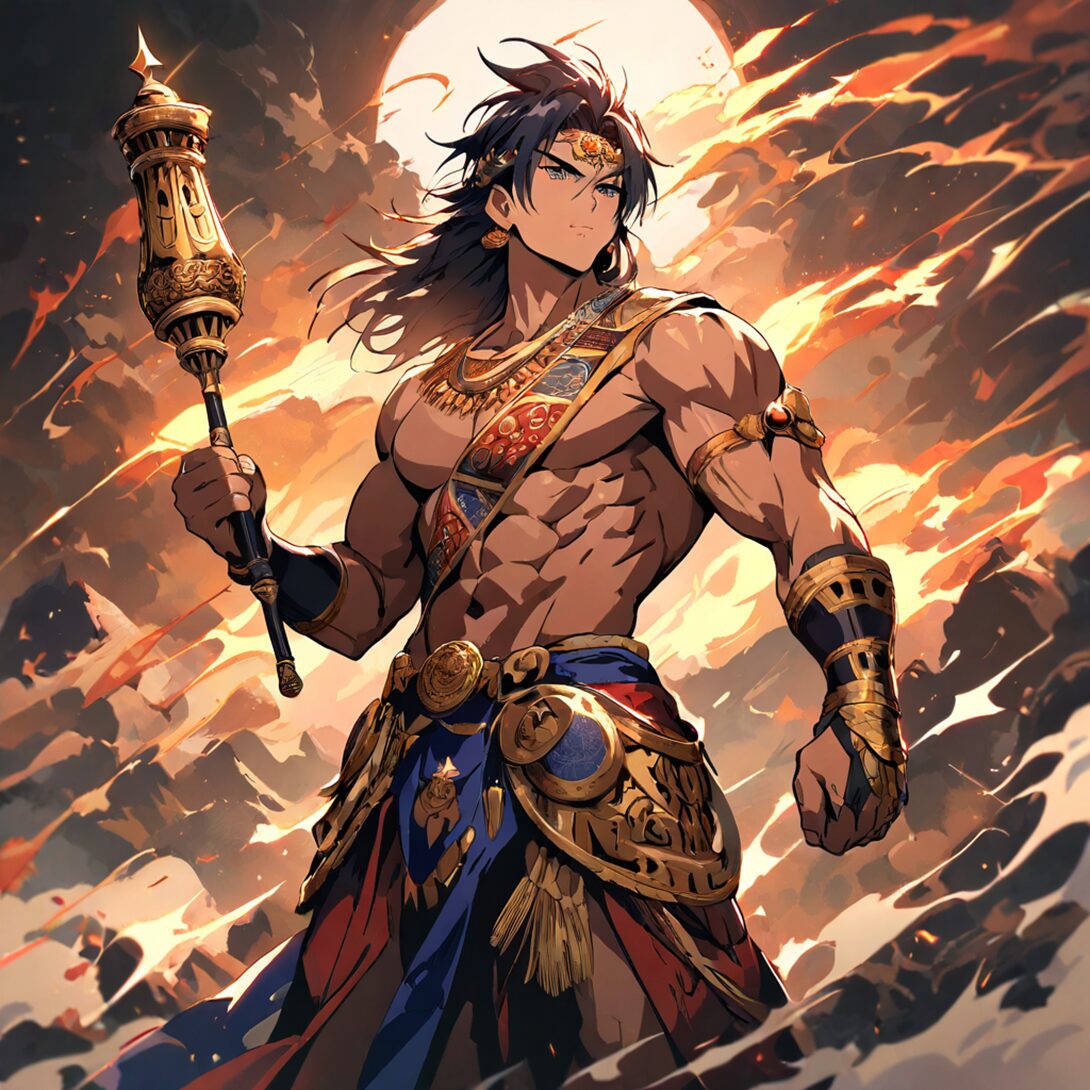
- The five Pandava brothers (Pandu’s children): the eldest, the justice-prizing Yudhishthira; the mighty Bhima; the master archer Arjuna; and the twins Nakula and Sahadeva. In fact all five were demigods, each with a god as father (Yudhishthira, son of the justice god Dharma; Bhima, son of the wind god Vayu; Arjuna, son of the thunder god Indra). They have a common wife, Draupadi.
- The hundred Kaurava brothers (Dhritarashtra’s children): the hundred brothers, led by the eldest, the ambitious Duryodhana.
Duryodhana deeply envied the Pandavas, the legitimate heirs to the throne, and persistently tried to ruin them, even targeting their lives from childhood.
The Backstory — Vows and the Feuds of the Heroes
A long accumulation of feuds led up to the great war.
One who holds a key to the story is the elder “Bhishma,” the granduncle of both houses. To make it possible for his father the king to take a second wife, he made the harrowing vow that “I will never marry in my life and will never take the throne.” Because of that self-sacrificing vow, the royal bloodline grew tangled, a remote cause of the later succession struggle. He was also an invincible old general who had gained the boon of “dying only when he wills it.”
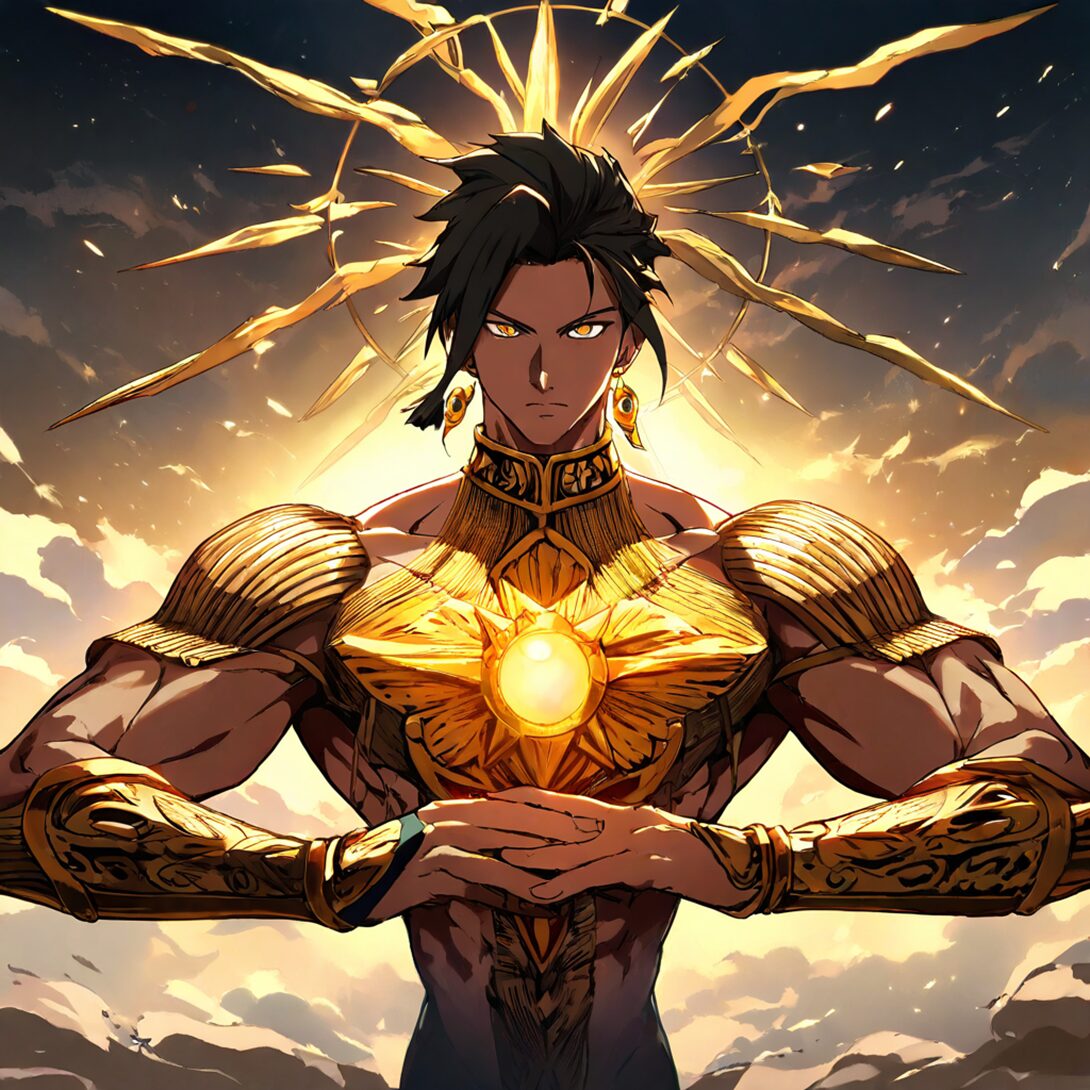
Another important figure is the tragic hero “Karna.” He was in fact the hidden eldest brother, born to the Pandavas’ mother Kunti, in her unmarried days, with the sun god Surya. But because he was set adrift on a river and raised in a charioteer’s family, he never knew his origin his whole life and came to fight on the side of Duryodhana, to whom he owed a debt of being raised up.
The brothers honed their skills under the martial teacher “Drona.” Arjuna in particular distinguished himself as a genius of the bow. Eventually, at the husband-choosing (svayamvara) of the neighboring princess “Draupadi,” Arjuna won her by stringing a divine bow none could string and hitting a difficult target. But through a misunderstanding of his mother Kunti’s instruction, Draupadi became the common wife of the five brothers.
The Kaurava side repeatedly targeted the Pandavas’ lives, even trying to burn them to death by trapping them in a flammable “house of lac (resin).” Yet the brothers got through these crises and eventually built their own capital, “Indraprastha,” and flourished greatly. That very prosperity all the more fanned Duryodhana’s envy.
Exile by Gambling
Duryodhana exploited the honest, gambling-refusing nature of Yudhishthira and lured him into a “dice game.” The one rolling the dice was Duryodhana’s uncle “Shakuni,” a master of cheating.
Before Shakuni, who threw whatever number he wished, Yudhishthira kept losing. He bet and lost his kingdom, his property, his brothers, himself, and at last even their common wife Draupadi.
The triumphant Kauravas dragged Draupadi out before the assembled court and tried to humiliate her by stripping off her clothes. When the despairing Draupadi prayed from her heart to Krishna — no matter how much they pulled, her garment (sari) appeared endlessly, and in the end no one could strip her bare. A miracle by Krishna’s protection. At this time, Draupadi, her hair disheveled, vowed, “I will not tie up my hair until I receive recompense for this humiliation,” and this became the decisive trigger of the great war.
As a result of the gambling, the Pandavas were forced into 13 years of exile. The last year of which had the condition of being spent in disguise, found by no one. Enduring harsh wandering in the forest and serving at court in disguise, the Pandavas, as agreed, demanded the return of their kingdom. But Duryodhana refused, saying “I will not give even as much land as a needle’s point.” Even as Krishna labored as an envoy of peace, talks broke down, and at last they rushed into a great war embroiling the kings of all India.
The Eve of Battle — the Bhagavad Gita
Just as the two armies faced off on the battlefield of Kurukshetra, on the very eve of battle. Here is placed one of the most important scriptures in Hinduism, the “Bhagavad Gita (the Song of the Lord).”
The master archer Arjuna, realizing that those arrayed in the enemy ranks are his own kin, teachers, and friends, deeply agonizes, “Is there meaning in fighting even to the point of killing blood relatives?” and, losing his will to fight, stands stock-still. At this time, the avatar of Vishnu, “Krishna,” who served as the charioteer of Arjuna’s chariot, teaches him the nature of life and death, duty, and faith.
This battlefield dialogue has been widely read as an independent scripture in its own right, separated even from the whole Mahabharata. Its profound content is explained in detail chapter by chapter in the next article (Article 6), so here let us just keep in mind that “the great war began after this philosophical dialogue.”
The Great War of Kurukshetra — an 18-Day Total War
The “Battle of Kurukshetra” that thus began became a terrible 18-day total war, in which armies said to total several million on both sides clashed. The Kaurava side’s commander-in-chief was succeeded by mighty heroes one after another. The heroes of both armies met terrible ends.
In the 18-day battle, to decide the contest, stratagems by Krishna’s advice (means bordering on deception) were often used. This connects to the heavy question of this epic — “for the sake of justice, how far is permitted?” Many famous scenes are told.
- The fall of Bhishma: the invincible old general Bhishma, who could choose his own time of death, held the creed of “never turning a weapon on the warrior Shikhandin, who had once been a woman.” The Pandavas exploited this, and with Shikhandin as a shield, Arjuna shot arrows, and Bhishma, pierced by countless arrows, lay on a “bed of arrows.”
- The death of Abhimanyu: a painful scene in which Arjuna’s young son Abhimanyu charges alone into a battle-formation trap, the “chakravyuha,” which he only knows how to enter, and is surrounded by a great host and slain, unable to get out.
- The death of Drona: to defeat the invincible teacher Drona, by Krishna’s scheme, Bhima killed “Ashvatthaman (an elephant with the same name as Drona’s son),” and had the honest Yudhishthira speak the half-lie, “Ashvatthaman is dead.” Drona, mistaking it for his son’s death and losing his will to fight, was slain.
- The death of Karna: in the midst of single combat with his fated rival Arjuna, the wheel of Karna’s chariot sank into the ground. By the warrior’s code one should not strike a defenseless opponent, but, urged by Krishna, Arjuna shot the defenseless Karna trying to fix his wheel. A tragedy of a younger brother slaying his elder, not knowing he was his brother.
And on the final day, Bhima, as if fulfilling Draupadi’s earlier vow, shattered the thigh of his archenemy Duryodhana and struck him down, ending in victory for the Pandava side.
A Grim Conclusion — the Emptiness of Victory
But that victory was by no means bright.
The very night after it was decided, the surviving Kaurava warrior “Ashvatthaman” (Drona’s real son), burning with vengeance, attacked the enemy camp as they slept and massacred the sleeping Pandava children. The Pandavas, who should have won the great war, lost their heirs.
The Kaurava mother “Gandhari,” who had lost all her 100 children, in her grief laid a curse on Krishna, who could have stopped the war: “May your clan too perish the same way, in internal slaughter.” Later, just as this curse said, Krishna’s clan perished in internal strife, and Krishna himself departed the world, struck by an arrow a hunter loosed.
Amid the deep grief of losing his clan and many heroes, the eldest, Yudhishthira, takes the throne. But there was no joy of victory there — only the heavy question, “Justice won. But what did this war bring about?” Depicting the emptiness of victory at the end of vast death is the depth of the original text called the Mahabharata.
The Great Departure — the Dog and Dharma
At the end of the story, the Pandava brothers, having ruled for long years, hand the throne to their successor (Abhimanyu’s surviving child) and set out on a final journey to cross the Himalayas toward heaven. A single dog followed them.
On the way, the brothers and Draupadi collapse one after another, exhausted. Before the eldest, Yudhishthira, who kept walking to the end, the king of the gods Indra appears in a chariot to receive him and invites him to heaven. But when Indra says, “You cannot bring the dog,” Yudhishthira refused to go to heaven, saying, “I cannot abandon this faithful dog, which followed me out of affection, and enter heaven alone.”
In that instant, the dog reveals its identity. It was the incarnation of the justice god “Dharma,” Yudhishthira’s own father, and was a trial of his virtue to the very last. Yudhishthira, who held to justice (dharma) even before any reward, was welcomed into heaven in his body. Asking “what is righteousness?” to the very end, the story comes to a close.
The Countless Stories the Great Epic Holds — the Love of Savitri
The Mahabharata is called an “encyclopedia” because woven into the gaps of the main thread are countless independent episodes (sub-stories). Many famous tales are told in the form of stories the exiled Pandava brothers hear from sages in the forest.
Especially beloved is the story of “Savitri and Satyavan.” The princess Savitri knowingly chooses as her husband the poor young man Satyavan, prophesied to have “one year to live.” On the fated day, when the death god Yama tries to carry off her husband’s life, Savitri follows Yama, who departs holding her husband’s soul, all the way. Impressed by her firm fidelity and wise words, Yama promises to grant any wish “other than your husband’s life.” So Savitri wished, “May I become the mother of many children.” Yama, having consented, suddenly realizes: unless her husband revives, that wish cannot be granted. Bound by his promise of words, Yama finally had no choice but to return the life of her husband Satyavan.
This story, in which she out-argued even the death god with wisdom and love, has been handed down in India as the model of the ideal wife. That it holds, apart from the main thread of the great war, many such gems of stories is the bottomless richness of the world’s longest epic.
How Strong Are the Characters Here? — The Power Ranking
The gods and heroes appearing in this article are also introduced in strength order in the “Mythology, Religion & Legend Power Ranking.” Enjoy their exploits in the original text alongside their “strength.”
To Learn More
Conclusion
In this article, I explained the story of the world’s longest epic, the “Mahabharata,” in detail. How was it?
From the throne struggle between cousins, through the exile by gambling, to the 18-day great war of Kurukshetra. The invincible old general Bhishma, the tragic hero Karna, the stratagem-using Krishna — many heroes meet terrible ends, and even the victors carry deep loss; in that conclusion, I hope you could feel the weight of this epic, which keeps asking “what is righteousness (dharma)?”
In the next article (Article 6), I will explain the scripture “Bhagavad Gita,” which Krishna taught Arjuna on the eve of that battle, along with the heart of its teaching.
I hope you’ll read the next article too.
Also popular with readers
📚 Series: The Original Texts of Hindu Mythology (6/8)