Thank you for visiting. This article is the fourth installment in a series explaining the original texts of Hindu mythology.
This time, I explain, one by one, the “ten avatars of Vishnu (Dashavatara)” conveyed by the Puranas.
For an overview map of Hindu mythology’s original texts as a whole, please see this summary article.

What Is an Avatar (Avatara)?
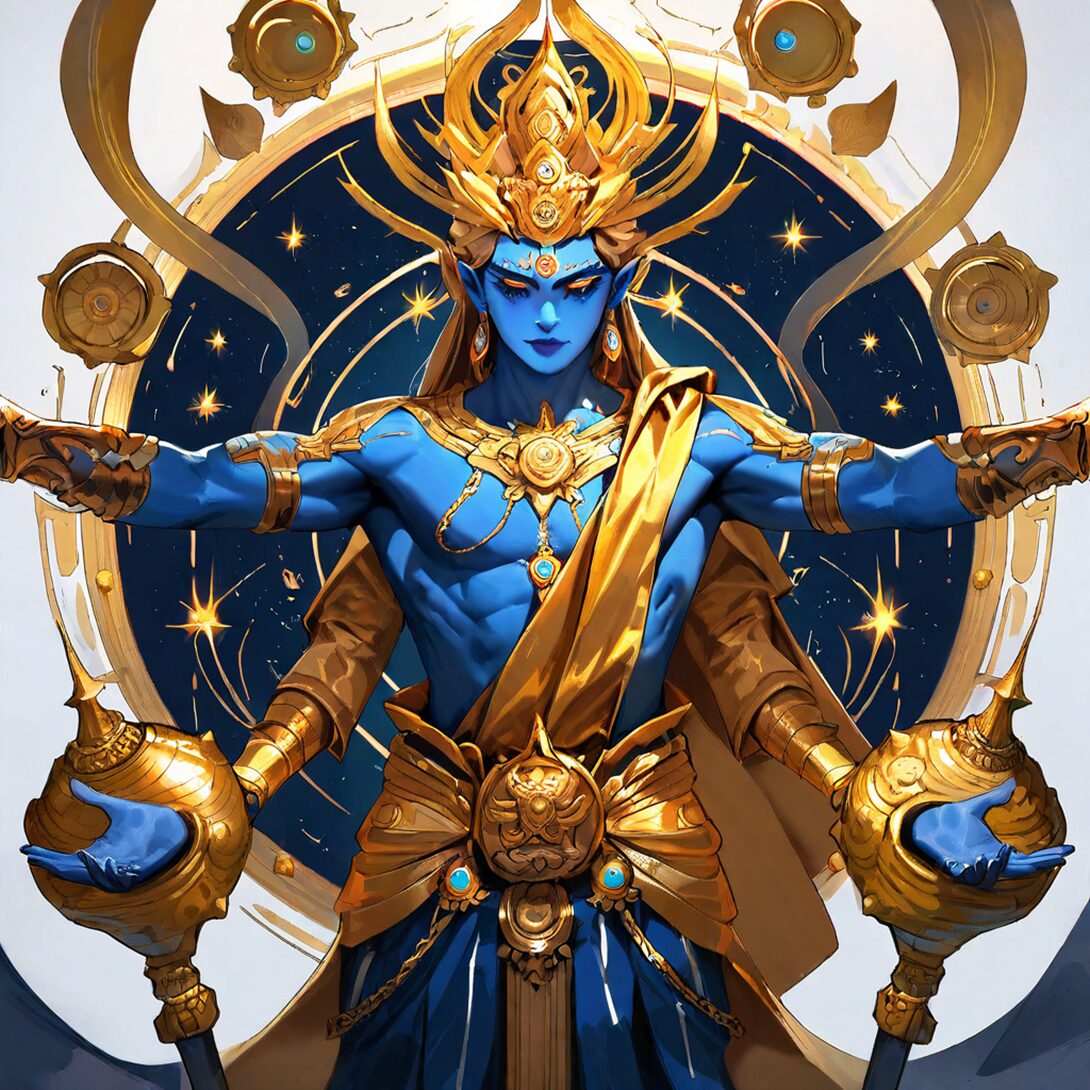
The preserver god “Vishnu” is said to appear on earth in a form fitting the age, saving the world, whenever the world’s order (dharma) is disturbed and falls into crisis with evil running rampant. This “form in which the god descends to earth” is called an “avatar (avatara)” (the origin of the English word “avatar”).
There are many avatars, but the ten especially important ones are called the “Dashavatara (ten avatars).” Interestingly, their order is one that suggests the evolution of life: fish → turtle → boar → man-beast → human.
| # | Avatar | Form | Main role |
|---|---|---|---|
| 1 | Matsya | Fish | Saves humankind from the great flood |
| 2 | Kurma | Turtle | Supports the mountain in the churning of the ocean |
| 3 | Varaha | Boar | Lifts up the sunken earth |
| 4 | Narasimha | Man-lion | Defeats an invincible demon king |
| 5 | Vamana | Dwarf | Recovers the world in three steps |
| 6 | Parashurama | Man with an axe | Slays the corrupt warrior class |
| 7 | Rama | Prince | Defeats the rakshasa king Ravana |
| 8 | Krishna | Cowherd, hero | Guides justice (teaches the Gita) |
| 9 | Buddha | The Buddha | Teaches compassion (accounts vary) |
| 10 | Kalki | Rider on a white horse | Appears in the future, ends the age of evil |
1. Matsya (Fish) — Saving Humankind from the Great Flood
When the ancestor of humankind, “Manu,” scooped water in a river, there was a small fish in his palm. The fish said, “If you protect me, I will save you someday.” When Manu carefully raised it, the fish grew rapidly and eventually became so large it could swim only in the sea. It was the “fish (Matsya)” into which Vishnu had transformed.
The fish foretold Manu that a great flood that would swallow the world was coming soon, and had him build a giant boat. When the flood came, Manu boarded the boat with the scriptures (the Vedas), the sages, and the seeds of all living things. Matsya had the boat tied to his own horn and guided it through the raging muddy torrent, saving humankind and life. It is India’s great flood myth, akin to Noah’s Ark in the Bible and the Mesopotamian flood myth.
2. Kurma (Turtle) — Supporting the Churning of the Ocean
During the “churning of the ocean of milk” (see Article 3) to obtain the elixir of immortality, Mount Mandara, the churning rod, was about to sink into the sea. So Vishnu became a giant “turtle,” dove into the sea, supported the mountain from below with his shell, and led the churning to success.
3. Varaha (Boar) — Lifting Up the Earth
The demon “Hiranyaksha” dragged the earth (the goddess Bhumi) deep beneath the water. Vishnu became a giant “boar,” dove into the sea, supported the earth on his tusks and lifted it to the surface, struck down the demon, and restored the world.
4. Narasimha (Man-Lion) — Defeating an Invincible Demon King
The demon king “Hiranyakashipu,” resentful at his brother Hiranyaksha being slain by Vishnu (Varaha), gained from the creator god Brahma, through severe asceticism, the nearly invincible boon that he could “be killed by neither god, human, nor beast, by neither day nor night, neither inside nor outside a house, neither on the ground nor in the air, by no weapon whatsoever.” The now-invincible demon king forced people to worship him as a god and gave himself over to tyranny.
But his son “Prahlada” defied his father and single-mindedly worshipped Vishnu. The enraged demon king tried to poison his son, had an elephant trample him, threw him into fire, and pushed him off a cliff — but Prahlada was utterly unharmed, by Vishnu’s protection. At last, when the demon king kicked apart a pillar of the palace, saying “Then is your god inside this pillar too?” — at that very moment.
From within the pillar, Vishnu appeared with a roar as the “man-lion (Narasimha),” with the upper body of a lion and the lower body of a human. And at dusk (neither day nor night), on the threshold of the palace entrance (neither inside nor outside), placing the king on his lap (neither ground nor air), with his claws (not a weapon), he tore the demon king apart. A vivid slaying among myths, slipping through every condition of Brahma’s boon. Prahlada, who held to his faith, afterward became a good king.
5. Vamana (Dwarf) — Recovering the World in Three Steps
The demon king “Bali” was a virtuous and generous good ruler, but his power reached the three worlds (heaven, earth, the underworld) to the point of threatening the gods. So Vishnu appeared in the form of a small “dwarf (a Brahmin boy)” at a charity rite Bali held, and asked, “Please give me three steps’ worth of land.”
Bali’s teacher, the demon preceptor “Shukra,” saw through that the boy was Vishnu’s avatar and warned, “Refuse — it is a trap.” But Bali, saying, “Once I have promised to give, I cannot break it even if the recipient is a god,” dared to grant the wish.
In that instant, Vamana grew giant enough to cover heaven and earth, and covered heaven with one step and the earth with two. When there was no place left for the third step, to keep his promise, Bali offered his own head for it to be stepped on, and retreated to the underworld. Moved by his cleanness and faithfulness, Vishnu made Bali king of the underworld and permitted him to return to the people of the earth once a year (South India’s harvest festival “Onam” celebrates the return of this good king Bali).
6. Parashurama (Man with an Axe)
A warrior born a Brahmin (priestly class), whose name means “Rama with the axe.” He wields a battle-axe granted by Shiva. He appeared in an age when the Kshatriyas (the warrior and royal class), who should have protected the world, were corrupt and tyrannical to the extreme, trading on their military power. Enraged at his father being killed by a king, Parashurama is said to have slain the arrogant rulers and corrected the order of the world. He also appears as the teacher of the later hero Rama (the 7th avatar) and of characters in the Mahabharata, spanning several stories — a feature of his. He can be called a transitional avatar, correcting the corruption of the warrior class with military force in turn.
7. Rama (Prince) — the Hero of the Epic Ramayana
The seventh avatar is Prince “Rama,” the hero of the great epic “Ramayana.” He rescues his wife Sita, abducted by the rakshasa king Ravana, with the help of the monkey hero Hanuman and others (explained in detail in Article 5). As the ideal king and ideal human, he boasts immense popularity in India.
8. Krishna (Hero) — the Guide of the Mahabharata
The eighth avatar is “Krishna,” one of the most widely beloved gods in Hinduism.
His life begins with the story of the tyrant “King Kamsa.” Fearing the prophecy “he will be killed by his sister’s eighth child,” Kamsa kills his sister’s children one after another, but the eighth child, Krishna, was secretly let escape to a cowherd village and raised. The charming anecdotes of Krishna’s cowherd days are especially beloved in India — his mischief stealing butter, his figure enchanting the maidens (gopis) with the sound of his flute, the tale of defeating the venomous snake “Kaliya” by dancing, and the tale of lifting the giant Mount Govardhana on his little finger to make an umbrella to protect the villagers from a storm.
Grown, Krishna strikes down his archenemy Kamsa, and eventually becomes the guide (charioteer) of the hero Arjuna in the great epic “Mahabharata.” He is known as the god who taught Arjuna the teaching of the “Bhagavad Gita” on the battlefield (explained in detail in Article 6). From a mischievous child, to a god of love, to a preceptor teaching profound philosophy, the appeal of Krishna is his many faces.
9. Buddha
As the ninth avatar, the founder of Buddhism, the Buddha, is often given. This is thought to be Hinduism incorporating Buddhism, which later spread in India, into its own system as “one of Vishnu’s avatars” (in some regions and texts, Krishna’s brother Balarama is taken as the ninth).
10. Kalki (Rider on a White Horse) — the Future Savior
The tenth, “Kalki,” is a future avatar who has not yet appeared. At the end of the present age, full of evil and confusion (the Kali Yuga), he is said to appear riding a white horse, with a blazing sword in hand, sweep away evil, and lead the world to a new golden age. A Hindu savior, governing the end and rebirth.
Why Does Vishnu Incarnate?
Beginning with a fish, through a man-lion, heroes, and a future knight — Vishnu’s avatars, appearing in such diverse forms, have a consistent purpose. What told it in the god’s own words is the famous passage of the Bhagavad Gita (Article 4). Krishna tells Arjuna:
“Whenever righteousness (dharma) declines and injustice runs rampant, I bring myself forth. To protect the good, destroy the evildoers, and establish justice, I appear age after age.”
In other words, an avatar (avatara) means the god descending to earth to set it right whenever the world’s order (dharma) collapses in crisis. That is exactly why an avatar takes the form most fitting the crisis of the age — a fish in the age of the flood, a man-lion or warrior in the age of runaway power. Arranging the ten avatars in order — fish (aquatic) → turtle (amphibian) → boar (mammal) → man-lion (half-beast, half-human) → dwarf → human — also seems to trace the path of the evolution of life, drawing the interest of later people. This idea that the god keeps engaging by changing form according to the age is also a source of Hinduism’s great inclusiveness.
The Thought of the Avatar — Why Does the God Descend to Earth?
Finally, let me touch on the very idea of the avatar (avatara).
Why does Vishnu, one of the supreme gods, take the trouble to descend to earth as a fish, a boar, or a human? The answer is shown in its most famous form in a passage of the Bhagavad Gita, said to be spoken by Vishnu’s avatar Krishna himself (the Gita is explained in detail in Article 6).
Whenever righteousness (dharma) declines and injustice runs rampant, I bring myself forth. To protect the good, destroy evil, and establish justice, I appear age after age.
In other words, the avatar is the thought that whenever the world’s order (dharma) is disturbed and falls into crisis, the god takes a form fitting that age, descends to earth, and saves the world. Changing form from fish to human, to hero, to future savior, the god keeps saving the world from evil again and again — this idea of “the god appearing to save many times” can be called a Hindu view of salvation, different from religions that teach a once-and-for-all salvation.
How Strong Are the Characters Here? — The Power Ranking
The gods and heroes appearing in this article are also introduced in strength order in the “Mythology, Religion & Legend Power Ranking.” Enjoy their exploits in the original text alongside their “strength.”
To Learn More
Conclusion
In this article, I explained, one by one, the “ten avatars of Vishnu” conveyed by the Puranas. How was it?
Beginning with the fish Matsya, who saves humankind from the great flood, through Narasimha and Vamana, who defeat evil, the heroes Rama and Krishna, and the future savior Kalki — I hope you have grasped the Hindu view of salvation, in which the god appears to save by changing form whenever the world falls into crisis.
In the next article (Article 5), I will explain the world’s longest epic, the “Mahabharata,” in which the avatar Krishna is active as a charioteer.
I hope you’ll read the next article too.
Also popular with readers
📚 Series: The Original Texts of Hindu Mythology (5/8)